
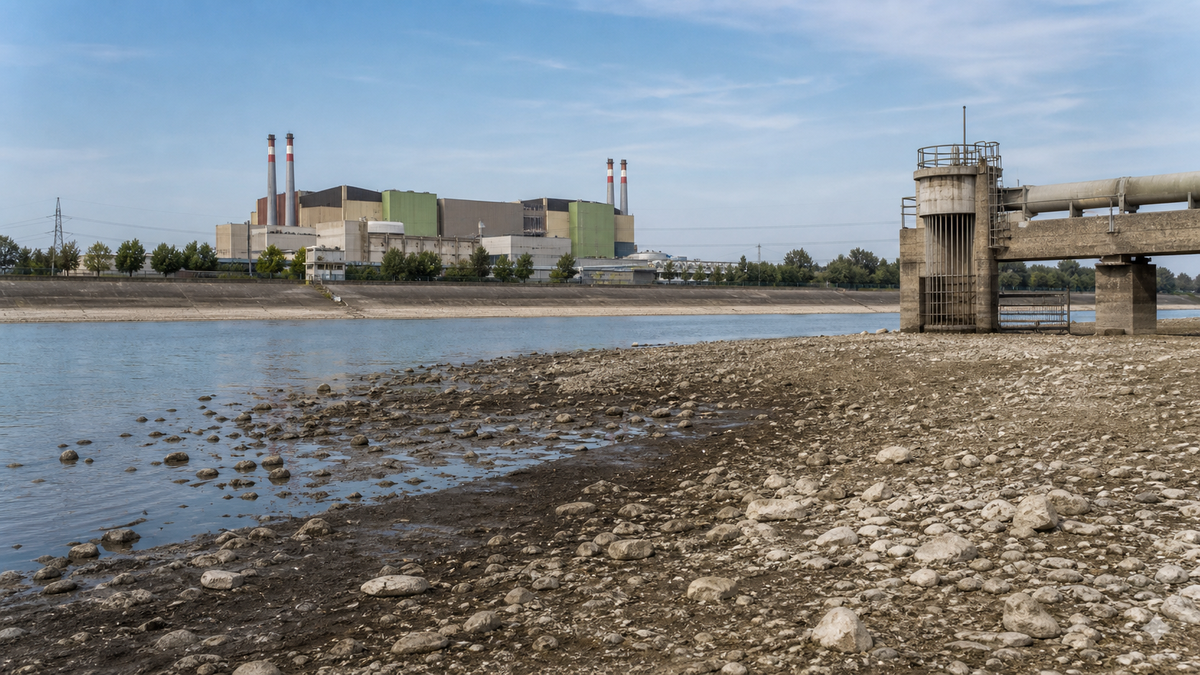
Hungary is preparing to shut down all four reactors at its Paks nuclear power plant because the Danube has fallen too low to supply enough cooling water for normal electricity production. Prime Minister Péter Magyar said on July 31 that the full shutdown, the first in the plant’s history, was likely on August 4 or 5 if the river continued to recede.
The plant was already producing less than half of its usual output, about 965 megawatts rather than 2,000 megawatts, according to Associated Press reporting. The event is an electricity-supply emergency, not a reported reactor accident. Shutting the generating units reduces their cooling requirement and is the prescribed response when river conditions can no longer support normal operation.
A historic low reaches the power system
Paks, about 90 kilometers south of Budapest, normally provides close to half of Hungary’s electricity. Its four Soviet-designed reactors use Danube water in their cooling system, making the river’s level and temperature operational limits rather than background environmental statistics.
The plant operator said the Paks gauge reached minus 106 centimeters on July 27, breaking the previous record. The negative number does not mean the river is below its bed. Hungarian gauges use a fixed historical reference point, as Telex explained in Hungarian.
Operators first reduced Unit 1 by 254 megawatts to comply with environmental limits. They then began shutting Unit 3 as the level continued to decline. Magyar said the river could fall to minus 144 centimeters at Paks, well below the former 2018 record of minus 98.
This summer has produced two related constraints. Low water can prevent intake pumps from receiving sufficient cooling water, while hot river water limits how much additional heat the plant may discharge. In June, Paks began continuous monitoring after the Danube passed 25 degrees Celsius. The operator said returned water is normally required to remain below 30 degrees at a measurement point 500 meters downstream.
Hungary weighs supply security against river protections
Hungarian official messaging has emphasized continuity of electricity supply and safe plant management. During earlier heat waves, the energy minister allowed temporary, limited exceptions to the normal temperature rule after the transmission-system operator requested relief. The operator said in Hungarian that this was intended to protect supply while an ecological institute assessed the effects.
Environmental limits still matter because the river supports wildlife and other users already under drought stress. Hungarian outlet Euronews Hungary reported that lakes and waterways elsewhere in the country were also approaching critical levels. That broader shortage makes the Paks shutdown part of a national water problem, not an isolated plant issue.
The immediate domestic question is how Hungary replaces the lost generation during a heat wave. Solar power can make a large daytime contribution, but evening demand remains difficult. Imports, gas generation, batteries and voluntary or compulsory industrial reductions may all be used to balance the grid.
A European warning about water-dependent power
The Danube crosses or borders 10 countries, and its record lows are disrupting shipping, tourism and industry beyond Hungary. Regional AP reporting described exceptionally low levels along much of the river and exposed sandbars, rocks and shipwrecks.
Hungary’s case also illustrates a climate-adaptation problem for thermal power stations. Nuclear and fossil-fuel plants often rely on rivers or coastal water to remove heat. Drought can reduce available water, while heat waves raise both water temperature and electricity demand. The same weather can therefore weaken supply precisely when air-conditioning use pushes demand upward.
The shutdown does not by itself show that nuclear power is unsafe or unusable in a warmer climate. It does show that plant design, cooling systems, river forecasts, interconnection capacity and demand planning have to reflect conditions more severe than historical records.
What to watch
The first milestone is whether the remaining Paks units stop on August 4 or 5. Grid operator MAVIR will then have to show how the lost output is replaced and whether large industrial consumers are ordered to reduce demand.
The next question is restart timing. Magyar said the plant might remain offline for several weeks if the river continues falling. Rainfall upstream, Danube forecasts and the condition of the cooling-water intakes will determine whether units can return one by one.
Longer term, watch for a government or regulatory review of Paks cooling resilience, emergency imports and the environmental exemptions used during heat waves. Those decisions will matter before the next prolonged drought, even if late-summer rain resolves the immediate shutdown.
Sources
- Associated Press, international, shutdown timetable, plant output and Danube forecast.
- MVM Paks Nuclear Power Plant, Hungary, record gauge and initial output reduction, Hungarian.
- Telex, Hungary, drought, river gauges and water-temperature context, Hungarian.
- Euronews Hungary, Hungary, wider water-shortage effects, Hungarian.
- Associated Press, international, regional Danube impacts.
This article was prepared with AI assistance and reviewed by a human editor. English- and Hungarian-language sources were checked.