
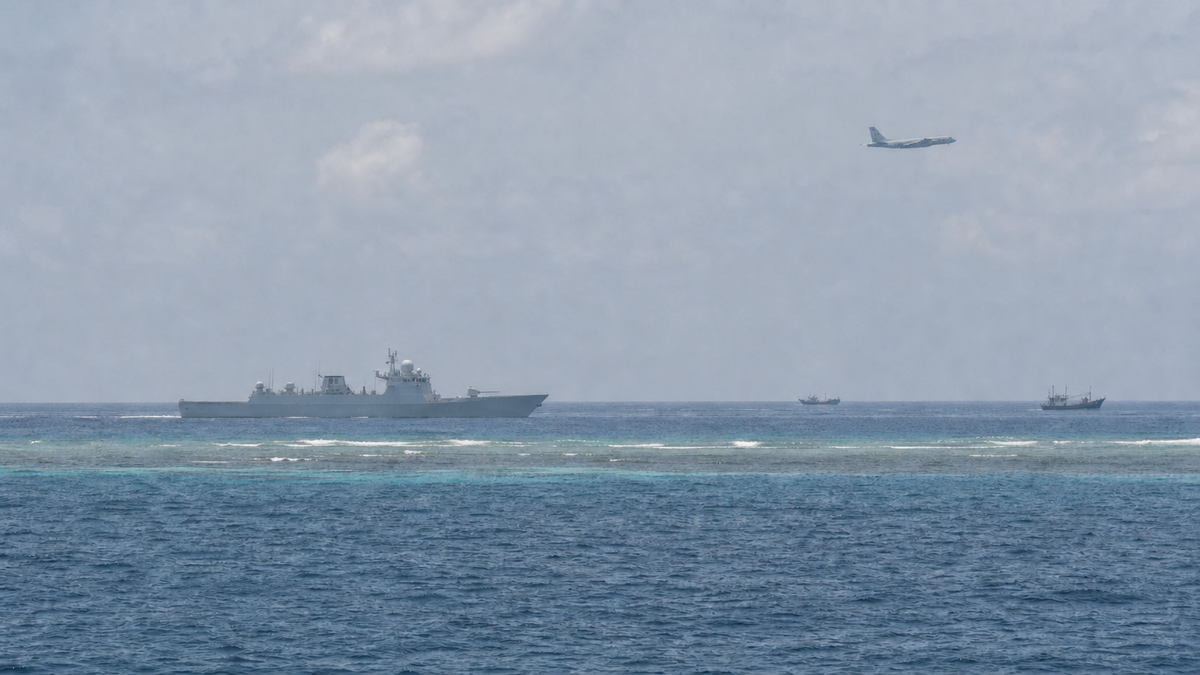
China held coordinated naval and air drills near Scarborough Shoal on August 1 as its dispute with the Philippines expanded from repeated confrontations at sea to a new argument at the United Nations. Beijing said the exercises tested joint operations and rapid reinforcement. Manila had recently presented an extended continental-shelf submission involving waters that include the disputed shoal.
The drill took place after at least three confrontations between Chinese and Philippine vessels in one week. It also coincided with new Chinese rules for a nature reserve around the shoal. Together, the military, legal and environmental measures show how both governments are trying to strengthen their positions without resolving the underlying dispute.
Beijing presents enforcement as sovereignty
China calls the feature Huangyan Dao and says it has sovereignty over the shoal and adjacent waters. According to Associated Press reporting, the Southern Theater Command used naval and air forces in the August 1 exercise. State broadcaster CCTV said the activity tested coordination and reinforcement.
A Chinese military notice in Chinese from a similar May patrol described the area as Chinese territorial sea and airspace. Beijing’s latest response rejected Philippine baselines around what it calls Huangyan Dao as illegal and invalid.
China also issued rules for a national nature reserve established around the reef in 2025. The restrictions prohibit unauthorized fishing, mining and coral collection. Beijing presents the reserve as environmental management. Manila has previously argued that Chinese installations and control measures at the shoal are unlawful exercises of authority in waters where the Philippines has maritime rights.
Manila separates territorial claims from maritime rights
The Philippines calls the feature Bajo de Masinloc or Panatag Shoal. It lies about 124 nautical miles west of Luzon, inside the Philippines’ 200-nautical-mile exclusive economic zone. That proximity gives the Philippines resource rights under the UN Convention on the Law of the Sea, but it does not by itself settle sovereignty over the shoal’s rocks.
This distinction is central. The 2016 South China Sea arbitration did not decide which country owns Scarborough Shoal. It rejected the legal basis for China’s sweeping historic-rights claim and found that the shoal cannot generate an exclusive economic zone of its own. The tribunal also recognized traditional fishing access for fishers from several countries.
Manila’s current UN process concerns the continental shelf, the seabed and subsoil beyond the ordinary 200-nautical-mile limit. A continental-shelf submission is not a transfer of sovereignty and the UN commission does not decide territorial disputes. The Philippine legal position argues that China’s claimed maritime zones unlawfully overlap entitlements generated from Luzon.
Philippine officials have also protested activity on the water. In June, Manila took diplomatic action over a structure spotted inside the lagoon. The government said it would defend a rules-based order under UNCLOS and the 2016 award.
Pressure rises around fishing and patrols
China has maintained effective control around the shoal since a 2012 standoff. Philippine government and fishing vessels continue to approach it, producing close encounters with China’s coast guard. On July 24, Chinese ships used water cannon against two Philippine fisheries vessels, according to AP’s account of the confrontation.
Those incidents make an announced military drill more than a symbolic display. Aircraft, naval ships, coast guard cutters and civilian fishing vessels can operate in the same crowded area under different command systems. The danger is not only a planned escalation, but also collision, injury or miscalculation.
International coverage often describes the dispute through China-US rivalry because the Philippines is a US treaty ally. The immediate interests, however, are local and regional: Filipino fishing access, Chinese enforcement claims, marine conservation, shipping safety and the ability of Southeast Asian governments to use international law without triggering coercive responses.
What to watch
The next concrete step is China’s formal response to the Philippine presentation at the UN Commission on the Limits of the Continental Shelf. The commission may defer consideration where a dispute exists, but the documents submitted by both sides will clarify their competing legal arguments.
At sea, watch the next Philippine fisheries or coast guard mission near Scarborough Shoal and whether China applies the reserve rules to Filipino fishers. Any arrest, collision, boarding or use of water cannon would quickly test calls for restraint.
The Philippines may also file another diplomatic protest or seek a public statement from security partners. The important measure will be whether those steps preserve access and reduce operational risk, rather than simply producing stronger language from all sides.
Sources
- Associated Press, international, August 1 drills and nature-reserve rules.
- PLA Daily, China, Southern Theater Command patrol language, Chinese.
- Philippine Department of Foreign Affairs, Philippines, maritime-zone legal position.
- Philippine News Agency, Philippines, diplomatic protest and government position.
- Associated Press, international, July confrontations near the shoal.
This article was prepared with AI assistance and reviewed by a human editor. English- and Chinese-language sources were checked; Philippine official material was available in English.