
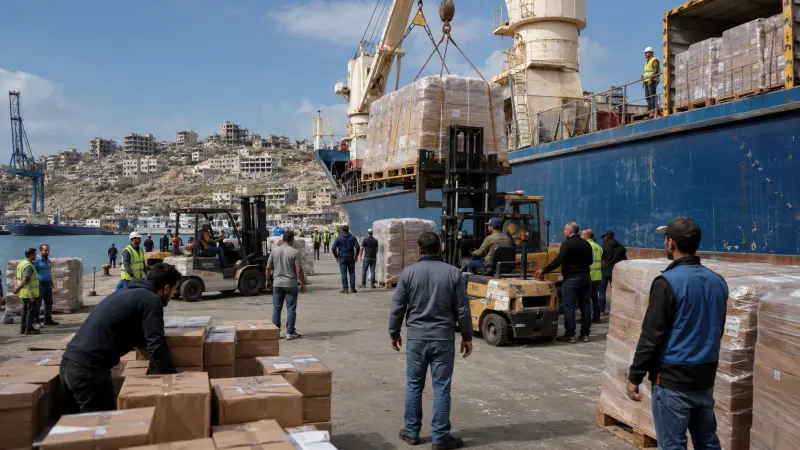
Nearly 2,000 US military personnel are supporting earthquake relief operations in Venezuela following the twin 7.2 and 7.5 magnitude quakes that struck the country’s Caribbean coast on June 24, 2026, according to US Southern Command. Officials reported the death toll had risen past 2,900 by early July, with more than 16,000 injured and tens of thousands still unaccounted for, though figures vary between Venezuelan and international estimates. US forces have taken direct operational roles at both of Venezuela’s critical relief gateways: American airmen and Marines have staffed the air traffic control tower at Simón Bolívar International Airport in Maiquetía alongside Venezuelan controllers, and the amphibious transport ship USS Fort Lauderdale has been the first US Navy vessel to dock at La Guaira port in decades.
The scale and directness of the US role is unusual for a disaster response and carries a specific historical weight: SOUTHCOM, the command running the relief effort, is the same body that carried out the January 2026 operation that captured then-president Nicolás Maduro in Caracas, and the USS Fort Lauderdale, now delivering aid, also took part in that earlier operation.
The view from Washington
US officials have described the deployment strictly as humanitarian and time-limited. SOUTHCOM Commander General Francis Donovan said the roughly 2,000 personnel would leave once their work is done, and expressed hope the mission would improve military-to-military cooperation with Venezuela. Washington has committed more than $300 million in aid, following an initial $150 million authorized by President Trump on June 25, and the operation has included urban search-and-rescue teams, MV-22 Osprey and CH-47 Chinook transport aircraft, and repair crews that restored both the airport’s runway and the port’s damaged infrastructure within days.
US officials have been careful to frame the relief effort as separate from the broader sanctions regime still in force against Venezuela. The Treasury Department issued only a narrow license authorizing transactions tied specifically to earthquake relief, meaning most frozen Venezuelan assets abroad remain untouched even as US troops work inside the country. A senior US administration official told journalists the mission was directed by the State Department as civilian-led diplomacy, with the military in a supporting role.
The view from Caracas and the Venezuelan left
Interim President Delcy Rodríguez, who took office after Maduro’s capture and has governed with Washington’s backing since, has publicly welcomed the US deployment while facing intense domestic criticism over her own government’s response. Rodríguez was booed by residents during a visit to a collapsed building in an affluent Caracas neighborhood in late June, with bystanders shouting “out, out” and accusing her of political campaigning amid tragedy; she rejected the criticism and defended her decision to militarize La Guaira state, saying it was necessary to prevent what she called media-driven disinformation from obstructing search and rescue work. She has since opened talks with the US State Department and the IMF to help finance reconstruction.
Independent and left-wing Venezuelan outlets have described the US presence in far starker terms than the government’s own statements. One outlet, writing that the country’s ports and airport have “in practice stopped being sovereign” and become logistics hubs for the US Southern Command, argued that what began with the January capture of Maduro has mutated into open military intervention under the umbrella of disaster assistance, carried out with Rodríguez’s approval. A separate Venezuelan analysis piece calculated that of roughly $11.6 billion in oil Venezuela exported under US oversight between January and May 2026, about 70 percent, more than $8.1 billion, remains under direct American control, and contrasted that figure with Washington’s $300 million aid commitment. A Venezuelan analyst quoted in that piece warned the US government “could risk adventurous calculations to expand its current perimeter of dominion… using the facade of humanitarian aid to expand military presence.”
What to watch
Rodríguez’s own political position is a near-term marker in its own right: her 180-day mandate as interim president expired around the same period as the earthquake response, and Venezuelan authorities have offered little clarity about what happens once that term lapses, according to Spanish-language reporting on her press conference defending the relief effort.
The duration and scope of the US military footprint is the central open question. General Donovan’s statement that forces will leave “once they are done” leaves the actual withdrawal timeline undefined, and critics on the Venezuelan left are watching closely for any sign the port and airport roles become more permanent rather than reverting fully to Venezuelan control once acute relief needs subside. Whether the narrow sanctions license tied to earthquake relief is expanded, and how reconstruction financing talks with the IMF and US State Department proceed, will show whether the disaster becomes an opening for broader economic engagement or remains bounded to the immediate crisis.
Next specific milestones: any formal timeline for US troop withdrawal from La Guaira port and Maiquetía airport; the outcome of Rodríguez’s reconstruction financing talks with the IMF and US State Department; clarity on Rodríguez’s political status following the lapse of her interim mandate; and any expansion or narrowing of the sanctions relief tied to earthquake reconstruction.
Sources
- US Southern Command (US government), official operational updates via southcom.mil and GlobalSecurity.org
- Task and Purpose (US, defense-focused outlet), on the air traffic control tower operation and unit details
- Rio Times (Latin America-focused English outlet), on the SOUTHCOM/Maduro-capture connection and sanctions context
- Venezuelanalysis (Venezuela-focused, left-leaning outlet, English), on US military footprint and sovereignty concerns
- La Izquierda Diario (Venezuela/Latin America, socialist outlet, Spanish-language), describing the deployment as de facto occupation
- Revista Raya (Venezuela, Spanish-language), on oil revenue control figures and analyst commentary
- CNN en Español and La Nación (international/Argentina, Spanish-language), on Rodríguez’s press conference and public criticism
- Infobae (Latin America, Spanish-language), on Rodríguez’s international outreach for reconstruction specialists
This post was produced with AI assistance and human editorial review. Spanish-language Venezuelan coverage, including left-wing and government-critical outlets, was reviewed alongside US military and English-language reporting.