
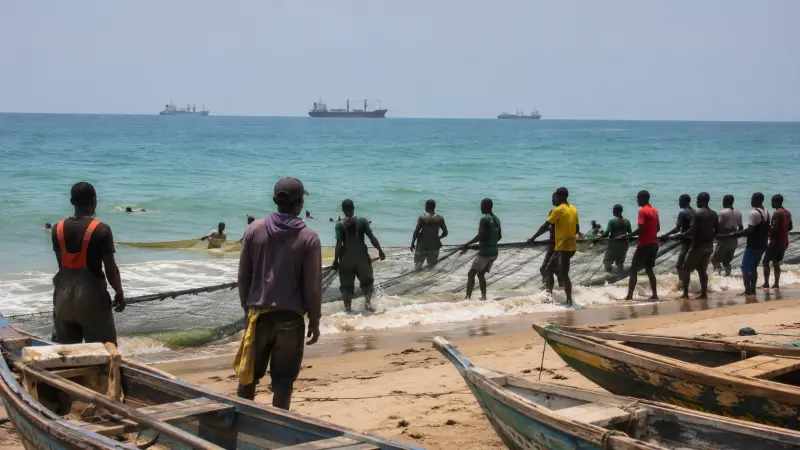
Fishers on Sierra Leone’s Sherbo Island, and at Tombo harbour near the capital Freetown, say their catches have fallen sharply in recent years, and nearly all of them point to the same cause: large foreign trawlers entering waters set aside for small-scale fishing. Thomas Turay, president of Sierra Leone’s Fishermen’s Union, told the BBC in reporting published July 6, 2026 that average catches among his members are down roughly 40 percent, and described trawlers anchoring outside the country’s seven-mile exclusion zone by day and entering it almost every night. Some fishers allege trawler crews deliberately cut their nets after dark, costing up to $250 each time to replace; others describe collisions and damaged boats.
West Africa remains, by most estimates, the global epicenter of illegal, unreported and unregulated fishing. A widely cited 2024 study put the region’s share of the world’s unlicensed catch at roughly 40 percent, costing West African nations a combined $10 billion in lost revenue and threatening the food security of millions who depend on fish as a primary protein source. Sierra Leone’s fishing sector alone supports roughly 500,000 people and provides protein to 80 percent of the country’s population, according to figures cited in prior Guardian reporting.
The nationality question, and who answers for it
Asked which countries’ vessels are most responsible, Steve Trent, head of the environmental group Environmental Justice Foundation, told the BBC that while Sierra Leone’s waters once saw South Korean, Taiwanese and European vessels engaged in problematic practices, the fleet today is “overwhelmingly Chinese.” Chinese-flagged or Chinese-owned companies have historically held the large majority of Sierra Leone’s industrial trawling licenses, a pattern consistent across multiple West African coastal states, with similar complaints documented in Senegal, Ghana, Kenya and elsewhere along the continent’s Atlantic and Indian Ocean coasts.
Sierra Leonean fishers describe official channels as unresponsive. Mohamedi Kamara, a Tombo fisherman, said complaints to the Fisheries Ministry “go nowhere. Nobody listens.” Turay went further, alleging corruption: “Government authorities are afraid to help the local fishermen… somebody who is doing this illegal business has the money to bribe and pay.” Sheku Sei, a director at Sierra Leone’s Ministry of Fisheries, strongly denied the allegations, telling the BBC that illegal fishing “used to be a big problem” but has been reduced through mandatory vessel-tracking transponders and routine government inspections. Pressed on whether transponders can simply be switched off, as has been documented elsewhere in global shipping to evade sanctions, Sei maintained this does not happen in Sierra Leone’s waters, though he could not point to enforcement examples when asked.
The view from Beijing
China’s foreign ministry, responding to the broader pattern of illegal-fishing allegations against Chinese vessels globally, has repeatedly rejected the characterization outright. In a statement addressing similar accusations, the ministry said China is “a responsible fishing nation” that “strictly regulates its distant-water fishing activities and carries out mutually beneficial fishing cooperation with relevant countries in accordance with international law,” and it has separately called comparable US allegations “a deliberate political maneuver” with no basis in objective fact or international law.
Chinese state and diplomatic messaging around West African fishing specifically has stressed the economic relationship’s benefits rather than engaging the environmental and labor complaints directly. In an earlier detailed statement addressing similar Sierra Leone allegations, China’s embassy there said Chinese fishing enterprises pay close to $10 million annually in licensing fees, employ thousands of Sierra Leoneans directly and tens of thousands indirectly, retain more than 65 percent of their catch for the local market well above the 30 percent legal requirement, and continued operating through the Ebola and COVID-19 crises to help stabilize local fish supply and prices. The Chinese Chamber of Commerce in Sierra Leone did not respond to the BBC’s request for comment on the current allegations, according to the network’s July report.
The dispute has occasionally escalated beyond words. Sierra Leonean fishers boarded a Chinese trawler in a prior incident after their nets were repeatedly destroyed, and were allegedly offered a bribe by the crew before the country’s navy intervened; separately, a US Navy vessel working with Sierra Leonean authorities searched a Chinese trawler suspected of illegal fishing earlier this year, a boarding the Chinese embassy denounced as an attempt to “drive a wedge” in China-Sierra Leone cooperation.
What to watch
Enforcement capacity remains the practical constraint regardless of which account of intent is correct: Sierra Leone has historically operated with only a small number of functioning patrol vessels against a coastline that international agencies rank among the world’s most exploited by unlicensed and illegal fishing. Whether transponder tracking, government inspections, and any expanded patrol capacity produce verifiable enforcement actions, rather than assurances without documented cases, is the concrete test both sides have effectively agreed matters.
The regional pattern is also worth tracking beyond Sierra Leone alone. Similar disputes are active in Senegal, where fishers say Chinese-linked joint ventures use borrowed Senegalese flags and licenses to operate, and where a new government under President Bassirou Diomaye Faye has ordered an audit of suspected front-company arrangements, and in Kenya, where artisanal fishers report similar competitive displacement by larger Chinese vessels.
Next specific milestones: any documented enforcement action or prosecution under Sierra Leone’s seven-mile exclusion zone rules; further Chinese embassy or foreign ministry responses to the specific July 2026 BBC reporting; progress on Senegal’s audit of flag-of-convenience fishing arrangements; and any updated catch or licensing data from Sierra Leone’s Ministry of Fisheries.
Sources
- BBC News, via The Star Kenya and other syndication partners, the original July 2026 field reporting from Sherbo Island and Tombo harbour
- Environmental Justice Foundation (international NGO), on fleet nationality data and enforcement recommendations
- Institute for Security Studies (South Africa, pan-African policy institute), background on prior enforcement incidents and Chinese economic messaging
- Business and Human Rights Resource Centre (international NGO), on licensing statistics and prior boarding incidents
- Chinese Ministry of Foreign Affairs press briefings, via Sohu (China, state-facing outlets), on Beijing’s rejection of illegal-fishing characterizations
- Chinese Embassy in Sierra Leone (Chinese government), detailed rebuttal statement on economic contributions
- Wenxuecity and Wuyou Zixun (Chinese-language diaspora and mainland-facing news aggregators), translated coverage of the BBC report and embassy response
- Atlantic Council (United States, policy institute), regional context on Chinese fishing’s environmental and labor impact across West Africa
This post was produced with AI assistance and human editorial review. Chinese-language state media and embassy statements were reviewed alongside the original English-language BBC field reporting from Sierra Leone.