
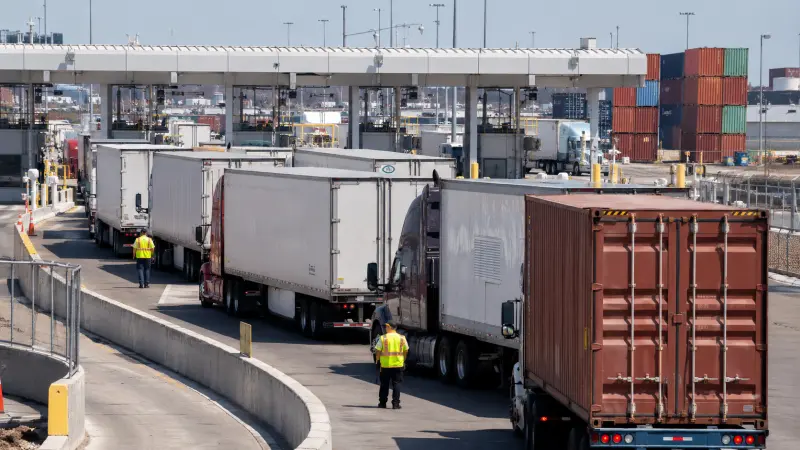
The United States declined to renew the US-Mexico-Canada Agreement in its current form at the pact’s first mandatory six-year review on July 1, 2026. In a statement, US Trade Representative Jamieson Greer said the agreement was not being extended and pointed to what Washington calls its shortcomings and to US trade deficits with both neighbors. Mexico and Canada had each asked to lock in a further 16-year term. Because the three did not agree, the treaty now enters a rolling annual review that runs until the deal either gets extended or expires in July 2036.
The practical effect on the day was close to zero. The agreement stays fully in force, and existing tariff preferences, rules of origin and investment protections are unchanged. The 16-year extension is deferred, not lost, and the three heads of government can still confirm it in writing at any point. What changed is the negotiating posture: the United States now holds a yearly lever over two economies deeply wired into its own.
The view from Washington
US officials framed nonrenewal as leverage rather than rupture. Greer’s office said talks would continue on the deficits and on what it calls the agreement’s weaknesses, and a third bilateral round with Mexico is set for the week of July 20 in Mexico City. President Trump has spent months signaling ambivalence about a deal he negotiated in his first term, at one point saying he would rather not have the agreement but might still sign it. Officials have singled out the transshipment of Chinese goods through Mexico to dodge US tariffs, and have pushed for stricter North American content rules, including a floor on US-made components for reduced auto tariffs.
There is a tension inside the US position that American outlets flagged. Greer has said he wants supply chains sourced from this hemisphere for national-security reasons. Yet the same annual-review mechanism that pressures Mexico and Canada also injects the uncertainty that discourages the investment needed to move sourcing away from Asia.
The view from Mexico City and Ottawa
Mexican coverage struck a markedly calmer note than the US framing. Economy Secretary Marcelo Ebrard told reporters the government was in no rush, arguing that if Washington wanted to leave the treaty it would already have done so, and that markets had priced in the outcome well in advance. President Claudia Sheinbaum voiced confidence the pact would eventually be extended given how integrated the two economies are. The left-leaning daily La Jornada and the business paper El Financiero both led with continuity and the July 20 talks rather than crisis, and Ebrard noted US concerns had narrowed from 54 issues to 14, with Mexico bringing 13 of its own.
Ebrard did draw a red line. He said Mexico would not accept US-sought seasonal restrictions on agricultural imports and would seek other suppliers if pressed, and he warned that a permanent review cycle could choke off investment, which he called self-defeating if the US goal is to replace Asian suppliers. Canada’s tone was different again. Trade Minister Dominic LeBlanc reaffirmed what he called unwavering support for the pact, but Ottawa has not begun substantive text talks, and US officials have publicly complained that Canada has been harder to engage. A deputy USTR accused Prime Minister Mark Carney’s team of political malpractice, and Canadian priorities center on US sectoral tariffs on steel, aluminum, autos and lumber.
What to watch
The near-term calendar is concrete. The third US-Mexico bilateral round runs the week of July 20 in Mexico City, focused on rules of origin, economic security around China, and agriculture. Canada, by contrast, has not been announced as a participant in a formal joint-review round with the United States, and the gap between the two bilateral tracks is itself a story to follow. A senior US official has suggested the administration does not intend to let the review process run the full decade, which points to a push for a faster resolution.
The larger arc is whether North America drifts from one trilateral rulebook toward two bilateral ones. The administration has floated a two-track approach with Canada and Mexico handled separately, which industry groups warn could produce divergent rules across an integrated supply chain, particularly in autos and metals where parts cross borders several times before a vehicle is sold. Analysts at the Asia Pacific Foundation of Canada expect the most likely path is the annual-renewal cycle rather than collapse, while economists note that triggering the six-month withdrawal clause remains unlikely given the deal’s economic weight.
Next specific milestones: the July 20 Mexico City round and any published US demands on auto content; whether a formal US-Canada joint-review round is scheduled; any US move on steel and aluminum tariffs that Ottawa has made its priority; and the timing of the next annual review in mid-2027.
Sources
- Office of the US Trade Representative (US government), Ambassador Greer’s statement on the joint review
- Al Jazeera (Qatar), international trade coverage of the nonrenewal
- Foreign Policy (United States), analysis of leverage and the China-sourcing tension
- La Jornada (Mexico, left-leaning daily), Spanish-language coverage of the trilateral meeting
- El Financiero (Mexico, business daily), Spanish-language coverage of Ebrard’s remarks and the “no rush” framing
- Excélsior and La Razón (Mexico), Spanish-language coverage of the annual-review timeline
- White & Case and Brownstein (law firm client alerts), technical explanation of Article 34.7 and the negotiating calendar
This post was produced with AI assistance and human editorial review. Spanish-language Mexican coverage was reviewed alongside US and English-language editions; Canadian French-language coverage was not separately reviewed for this post.