
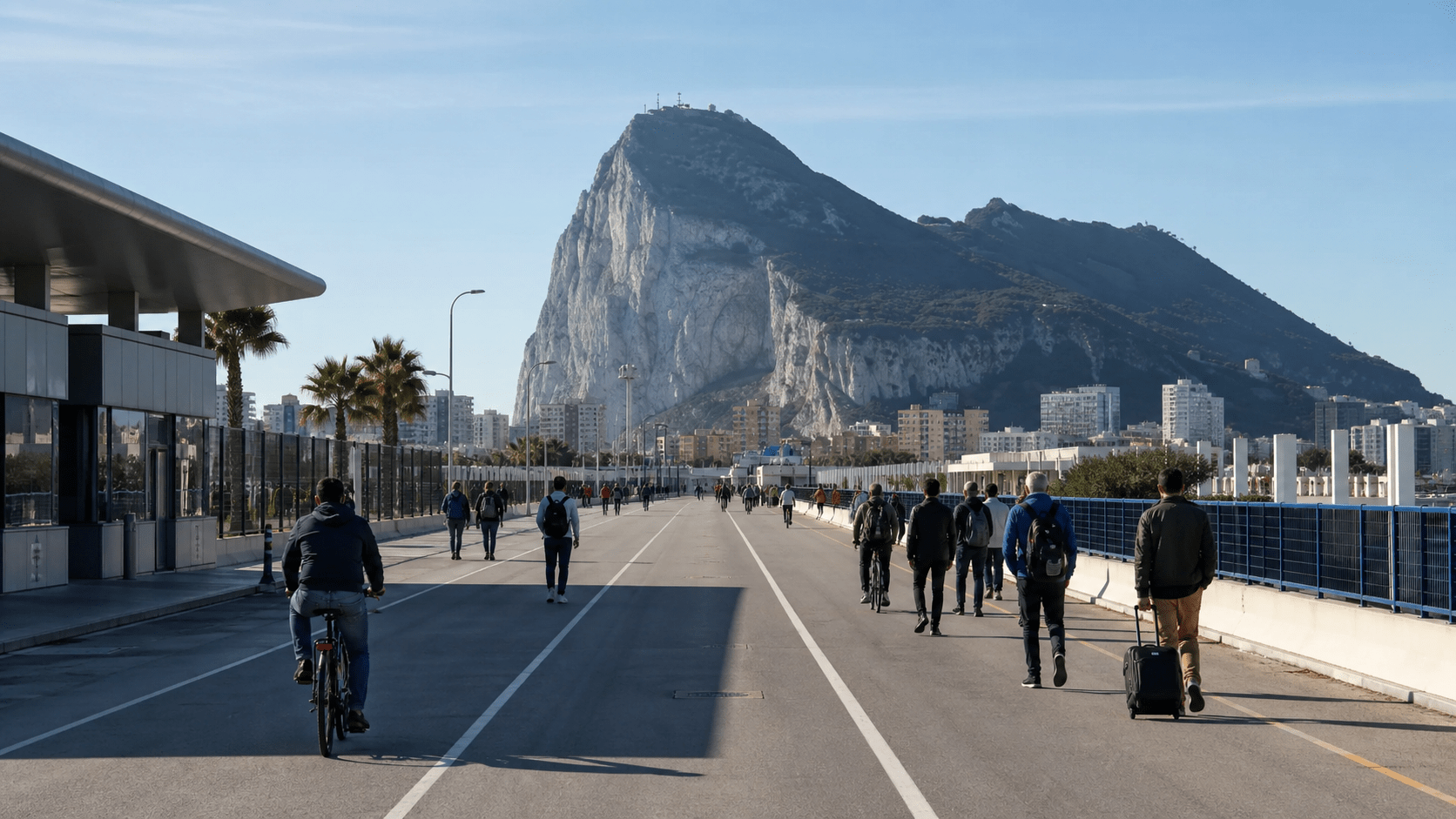
Routine checks on people crossing between Gibraltar and Spain ended at midnight on July 15, opening the land frontier after the European Union and United Kingdom signed their long-negotiated Gibraltar treaty in Brussels a day earlier. People began walking between Gibraltar and the Spanish city of La Linea de la Concepcion without stopping at the former passport booths, turning a post-Brexit negotiation into an immediate change in daily life.
The agreement matters most to the approximately 15,500 people who cross the frontier for work each day, about half of Gibraltar’s workforce, as well as families and visitors who have long planned around queues and document checks. The physical fence and checkpoint structures were dismantled ahead of the opening. The treaty is being applied provisionally while the remaining formal ratification process continues.
What changed, and what moved elsewhere
The visible change is at the land crossing: routine passport checks on people moving between Spain and Gibraltar are gone. The agreement integrates Gibraltar into the practical operation of the Schengen travel area without changing its status as a British Overseas Territory. It is intended to prevent the hard border that would otherwise have followed the United Kingdom’s departure from the EU.
Border control has not disappeared. Travelers arriving in Gibraltar by air or sea now face two checks at the airport or port: one by Gibraltar authorities for entry into the territory and another by Spanish officers applying Schengen rules. The Associated Press compared the arrangement to juxtaposed British and French controls at Eurostar terminals.
Goods are more complicated than people. The treaty aims to create a close customs arrangement and remove routine friction at the land frontier, but Spanish tax authorities describe transitional formalities while the institutions created by the agreement complete parts of the customs framework. Saying that every border control has vanished would therefore be broader than what began on July 15.
The view from Gibraltar
Gibraltar’s government presents the treaty as economic security without a constitutional concession. Its statement on the signing emphasizes an easier frontier for residents, workers and tourists, along with the unanimous approval of Gibraltar’s Parliament. Chief Minister Fabian Picardo said the agreement preserved British sovereignty while replacing a dividing frontier with cooperation.
That framing answers the central local anxiety surrounding years of negotiations: whether free movement could be obtained only by giving Spain a new sovereign role over the territory. Gibraltar says no. It treats Spanish Schengen officers at the airport and port as a practical border arrangement governed by the treaty, not as Spanish control of Gibraltar itself.
On the first morning, Picardo and La Linea mayor Juan Franco emphasized the people who live on both sides rather than the flags above them. Their local message, reflected in Cadena SER’s Spanish-language coverage, was that the frontier had functioned as one labor market and community even when the checkpoint made that relationship harder.
The view from Spain and Britain
Spain describes the same outcome as regional integration achieved without abandoning its historic claim. The Spanish Foreign Ministry’s explanation of the agreement highlights economic development, social protections and cooperation, while stating that Spain’s sovereignty claim remains intact. Spanish coverage also gives greater prominence to Spain’s responsibility for Schengen checks at Gibraltar’s airport and port.
The removal of the fence carries additional historical weight in Spain. Spanish outlets described the end of a barrier first erected in 1909 and linked the opening to the daily reality of thousands of Spanish workers. El Pais framed the midnight opening as a way for the surrounding region to escape the practical damage of Brexit, while continuing to describe Gibraltar as disputed territory.
London’s emphasis is similar to Gibraltar’s but more explicitly strategic. The UK government says the treaty protects British sovereignty, the autonomous operation of UK military facilities and Gibraltar’s economic future. Its signing announcement presents the deal as a practical solution to a problem created when Gibraltar was left outside the main EU-UK trade agreement after Brexit.
These positions are not mutually exclusive because the treaty deliberately does not settle sovereignty. Gibraltar and Britain can say British sovereignty is protected, while Spain can say its claim is preserved. What changed is the management of movement and trade around that unresolved dispute.
The view from Brussels
The EU places less weight on the symbolic British-Spanish argument and more on protecting common systems. Its account stresses that opening the land frontier is paired with safeguards for the Schengen area, the EU single market and the customs union. Spain’s role in external border checks is central to that assurance because Gibraltar itself is not an EU member.
The agreement also fills a legal gap left in 2020. Gibraltar was not covered by the EU-UK Trade and Cooperation Agreement, so its post-Brexit relationship required a separate negotiation involving London, Brussels, Madrid and Gibraltar. More than four years of talks produced a framework that lets a small, interdependent border region operate differently from the wider UK-EU frontier.
What to watch
The first test is operational. Airport and port staff must make the dual-control system work without replacing land queues with arrival delays, and authorities must explain the new rules clearly to British, EU and other travelers. Commuters will also be watching for any return of spot checks or congestion during the first busy weeks.
The second test concerns goods. Businesses need the transitional customs rules to develop into the promised low-friction system, including alignment on taxes and product standards designed to prevent distortions across the open land frontier. That implementation will determine whether the treaty improves commerce as visibly as it improves pedestrian movement.
Next specific milestones: the first weeks of dual Gibraltar-Spanish checks at the airport and port; business guidance on transitional goods movements; decisions by the treaty’s joint institutions on the customs framework; European Parliament consideration currently indicated for December 2026; and final ratification beyond the provisional application that began July 15.
Sources
- Government of Gibraltar (Gibraltar, official statement), signing, frontier-worker figures, provisional application and sovereignty framing
- UK Foreign, Commonwealth and Development Office (United Kingdom, official statement), economic, sovereignty and military provisions
- Spanish Ministry of Foreign Affairs (Spain, Spanish-language official explanation), implementation, cooperation and Spain’s continuing sovereignty claim
- European Commission Representation in Spain (European Union, Spanish-language official statement), treaty signing and post-Brexit legal framework
- Associated Press (international news agency), the midnight opening, dual controls and daily cross-border life
- El Pais and Cadena SER (Spain, Spanish-language national outlets), local reaction and Spanish framing of the border’s removal
This post was produced with AI assistance and human editorial review. Spanish-language official and national coverage was reviewed alongside Gibraltar, UK and EU statements and English-language international reporting.