
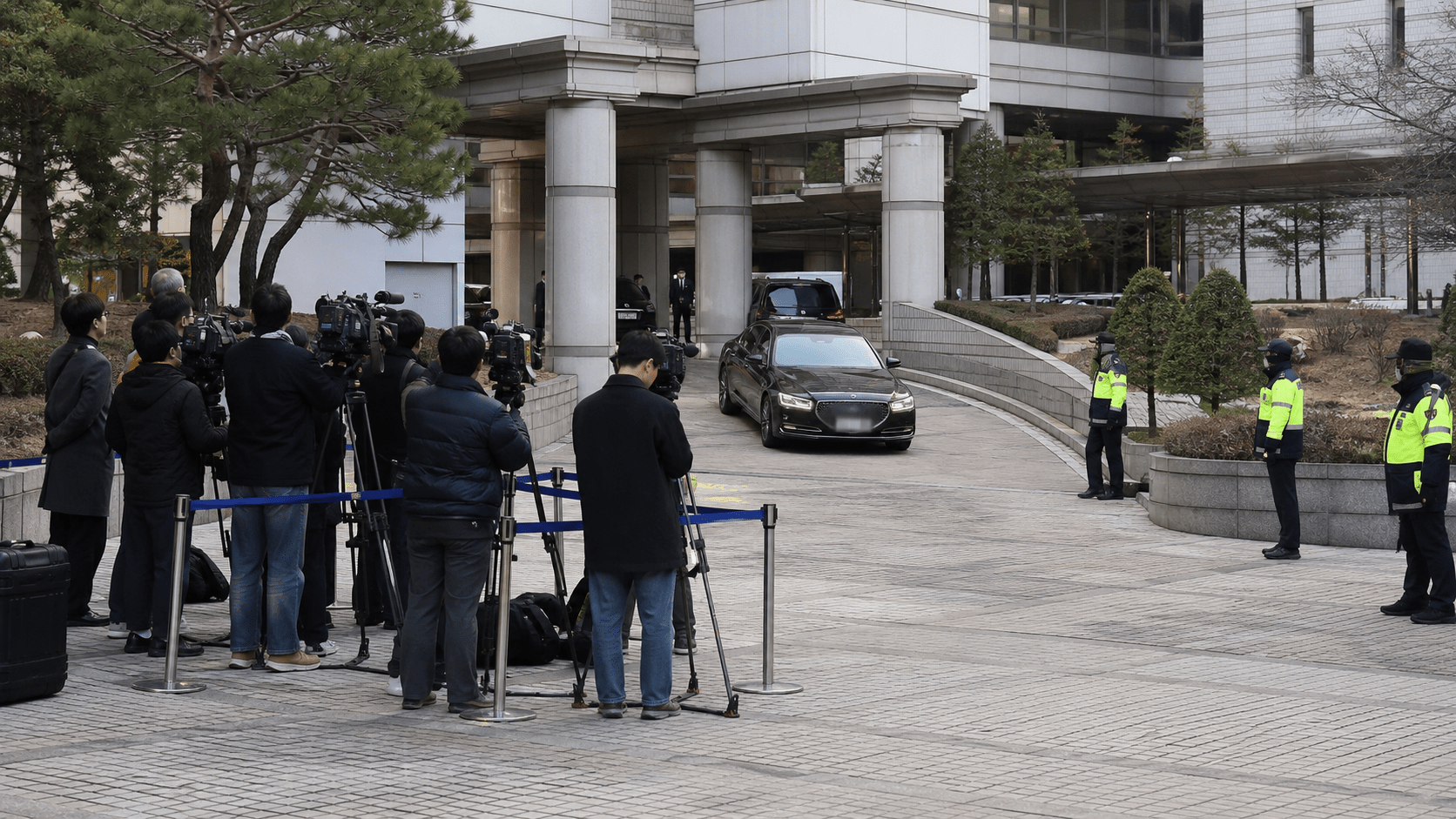
A Seoul court has sentenced former South Korean President Yoon Suk Yeol to two years in prison for receiving free opinion polls from political broker Myung Tae-kyun, adding another conviction to the former leader’s growing list of legal cases. The Seoul Central District Court found Yoon guilty of violating the Political Funds Act and ordered him to forfeit 13.96 million won, about $9,300, according to Yonhap’s report on the ruling.
The court accepted that Yoon received 14 polls without payment. Prosecutors had alleged that he and former first lady Kim Keon Hee received 58 polls worth about 270 million won between April 2021 and March 2022, but the court recognized a smaller portion of that case. It also found that Yoon promised help securing a governing-party nomination for former lawmaker Kim Young-sun in return, Yonhap reported.
Myung received an 18-month prison sentence in the same case. The court said the polls had damaged fairness and transparency, while Yoon’s lawyers said they would appeal. South Korean broadcaster SBS reported the appeal filing on July 15.
Why the ruling is contested in South Korea
The case turns on a precise legal question: whether the free polling work counted as prohibited political funding and whether it was linked to political favors. In its ruling, the court said the services and election advice were something of value and found a tacit agreement between Yoon and Myung, as reported by the Korea JoongAng Daily.
Yoon’s defense points to a different outcome in Kim’s separate case. An appeals court had acquitted her over the same free-poll allegations, in part because the polls were also provided to other people. The special counsel has appealed that acquittal, while Yoon’s lawyers argue that the conflicting outcomes make his partial conviction hard to understand.
That split is why the ruling is more than another count in a long legal record. For supporters of accountability, the judgment is a test of whether influence around a presidential campaign can be investigated and punished. For critics of the prosecution, the divergent decisions involving the former president and his wife raise questions about how evenly similar evidence is being read.
How the case is seen outside South Korea
International coverage has placed the polling case alongside Yoon’s wider legal unravelling after his short-lived December 2024 martial law declaration and removal from office. The Associated Press described the new sentence as one of several trials facing the conservative former president and noted that the Supreme Court had recently upheld a separate seven-year sentence.
That framing can make the story look like a measure of South Korea’s democratic resilience: courts, prosecutors and appeals processes are continuing to act against a former president. It can also obscure the narrower issue before this court, which was not the martial law case but free polls and an alleged nomination favor. Keeping those cases separate matters when judging both the verdict and the institutions handling it.
What to watch
Yoon’s appeal will move the case to a higher court, where the treatment of the polling services and the nomination evidence will be tested again. The defense is likely to emphasize the earlier acquittal in Kim’s separate trial, while the special counsel will point to the facts the trial court accepted about the 14 polls.
Watch, too, for the next court or prosecutorial steps involving Myung and others connected to the alleged network. The appeal record, any new charges, and the final outcome of the special counsel’s appeal in Kim’s case will show whether the differing rulings narrow or deepen the dispute over electoral integrity.
Sources
- Yonhap News Agency (South Korea, English): court ruling, recognized polls, sentences and reactions.
- SBS News (South Korea, Korean): Seoul court’s first-instance ruling and forfeiture order.
- SBS News (South Korea, Korean): report that Yoon filed an appeal.
- Korea JoongAng Daily (South Korea, English): court reasoning and the differing outcome in Kim Keon Hee’s case.
- Associated Press (United States, English): international context and Yoon’s other cases.
This article was prepared with AI assistance and reviewed by a human editor. Reporting in English and Korean was checked, including South Korean domestic coverage.