
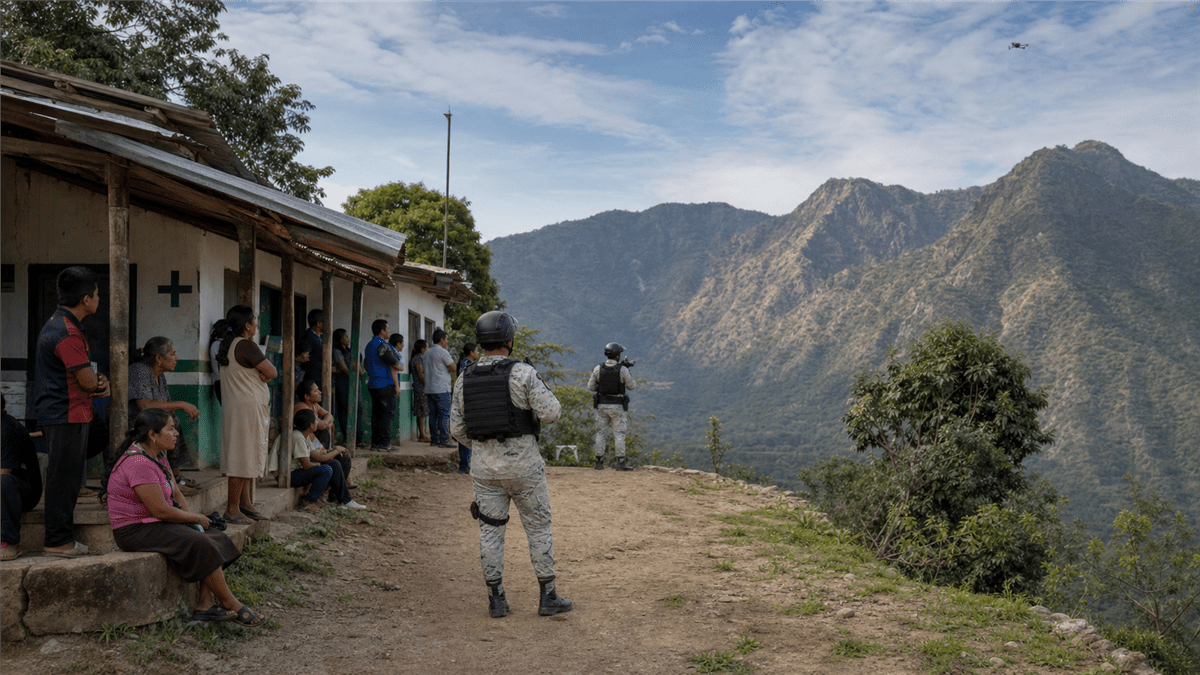
Residents of Guajes de Ayala in Mexico’s Guerrero state reported gunfire and explosives dropped from drones on July 8, forcing families to shelter in homes, churches and an abandoned clinic. Videos shared by residents captured detonations and smoke, while local leaders said they had warned authorities for weeks that armed men associated with La Nueva Familia Michoacana were approaching the mountain communities.
The full scale of the attack remains contested. Mexico’s federal Security Cabinet initially said authorities had ruled out the events described in news reports, while Guerrero officials later sent state police, soldiers and aerial surveillance to the area. The conflicting accounts have turned a remote security emergency into a test of whether forces concentrated around World Cup host cities left other violent regions with thinner protection.
Local accounts challenge the official timeline
Spanish-language reporting in Guerrero followed the residents’ calls for help closely. Local outlet El Sur de Acapulco reported that people in several communities described armed attacks and drone-delivered explosives in the Sierra of Coyuca de Catalán on July 8. A regional government official said security personnel were being sent to verify the reports before the state issued a formal account.
Residents said the response was slow. The president of the Guajes de Ayala ejido told Pulso Informativo Guerrero that no security force had reached the affected settlements more than 24 hours after the first alert. He said around 100 explosive devices had been launched, but reported no injuries. That number has not been independently confirmed.
By July 9, the state government said a coordinated operation was under way. Infobae’s Mexican edition reported that Guerrero’s aerial unit, state police and the Mexican Army were conducting flights, ground patrols and surveillance around Guajes de Ayala. Authorities still had not publicly confirmed the residents’ description of explosives dropped from drones.
The community is not a simple civilian party in a two-sided conflict. The Associated Press reported in March that Guajes de Ayala has an armed self-defense force equipped with rifles, grenades and drones. Its members describe it as an autonomous defense against cartel expansion, but AP also found that some weapons came through rival criminal groups and that at least one member had cartel ties. That ambiguity is common in parts of Guerrero where state protection is weak and local defense groups can become entangled in wider territorial conflicts.
Outside coverage connects the attack to the tournament
The international angle emerged because the attack occurred while Mexico concentrated security resources on the World Cup. The Associated Press reported that about 100,000 security personnel were deployed largely around Mexico City, Guadalajara and Monterrey. Mexico’s part of the tournament ended July 12 without a major security incident at a host site.
Security analyst David Saucedo told AP that moving military and National Guard personnel to the host cities left some non-host regions less protected. That is an analyst’s assessment, not a demonstrated cause of the Guajes de Ayala attack. The residents had faced pressure from armed groups before the tournament, and Guerrero’s fragmented conflicts long predate the World Cup.
Still, the comparison exposes two valid measures of security performance. Federal authorities can point to safe stadiums, transport corridors and fan zones during a global event. Rural residents can ask whether achieving that result shifted scarce personnel away from communities already warning of an imminent attack.
The crisis also has a cross-border dimension. AP’s earlier reporting found U.S.-made rifles among the self-defense force’s weapons and described military-grade arms smuggled from the United States. The drones may be commercially available technology adapted for violence, while the firearms economy is tied to northbound drugs, southbound weapons and continuing U.S. pressure on Mexico over cartel power.
What to watch
The first need is a verified official account of what happened on July 8: the number and type of explosive devices, any deaths or injuries, damage to homes and the identity of the attackers. Authorities also need to reconcile the federal cabinet’s initial denial with Guerrero’s subsequent deployment and the residents’ videos.
The durability of the security presence matters next. Patrols that arrive after an attack may reduce immediate danger but will not settle control of the mountain routes or protect witnesses once national attention moves on. Watch for permanent National Guard or army deployments, arrests, weapons seizures and safe access for displaced families.
A broader review should follow the tournament’s Mexican leg. The government has not announced that World Cup redeployments caused the Guerrero gap, and available reporting does not prove that claim. Concrete evidence would include unit-transfer records, staffing levels before and during the tournament, and an after-action assessment comparing host-city protection with violence in states that supplied personnel.
Sources
- El Sur de Acapulco, Mexico: initial resident reports and Guerrero government response, Spanish.
- Pulso Informativo Guerrero, Mexico: local leader’s account of response delays, Spanish.
- Infobae México, Mexico: state security operation and surveillance measures, Spanish.
- Associated Press, United States and Mexico: attack accounts, official denial and World Cup deployment context.
- Associated Press, United States and Mexico: earlier field reporting on the self-defense force, weapons and cartel links.
This article was researched and drafted with AI assistance and reviewed by a human editor. Spanish- and English-language Mexican, local and international reporting was checked directly.