
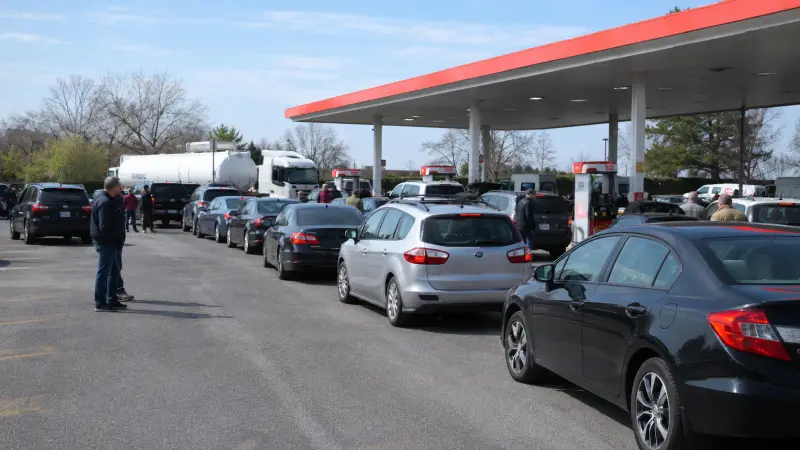
Russia banned all diesel exports on July 8, 2026, after months of Ukrainian drone strikes on its refineries triggered fuel shortages and hours-long lines at gas stations across the country. Deputy Prime Minister Alexander Novak announced the ban, running through July 31, at a televised government meeting with President Vladimir Putin, saying it would free up supply for the domestic market. The measure extends an existing ban on gasoline exports that has been in place, with interruptions, since 2023.
The scale of the damage is unusual even for a war now in its fifth year. Ukrainian strikes have hit refineries thousands of kilometers from the border, including Russia’s largest, the Omsk plant in Siberia, and estimates cited by the Financial Times put lost refining capacity at 20 to 40 percent nationwide. Russian seaborne diesel exports fell 39 percent in June from the prior month, and global diesel prices have jumped to multi-year highs as the disruption compounds an already tight market linked to the Iran war and Strait of Hormuz risk.
The view from Moscow
The Kremlin’s public framing split along two tracks. Putin himself minimized the strategic threat, telling the government meeting that Ukraine is trying to create anxiety in Russian society but that the goal is unattainable given what he called the resilience of Russia’s energy system, among the highest in the world. He also floated building more small, dispersed refineries partly because he said they would be harder for Ukrainian drones to hit.
Novak’s own language was more candid about the shortage than the Kremlin’s usual posture, telling reporters plainly that Russia has a fuel deficit because refineries are being knocked offline for repairs after drone strikes, and that queues and unstable pump operations are a real concern for the public. Independent and exile-based Russian outlets highlighted that admission as notable, since officials have historically avoided linking domestic economic strain directly to the war. Novak reported that all ten of Russia’s largest refineries by capacity have now been struck at least once, including plants in Omsk and Perm previously considered out of reach, and that demand for motor fuel has risen roughly a third as the government redirects supply and imports fuel from abroad to stabilize the market. Crimea, run by Russia since its 2014 annexation, saw some of the sharpest price spikes, with the Sevastopol governor reporting gasoline prices had more than doubled.
The view from Kyiv
Ukrainian officials described the campaign in openly strategic terms. President Volodymyr Zelensky said Ukrainian long-range drones had reached every major Russian refinery, citing a strike on the Omsk plant nearly 2,500 kilometers from Ukraine’s border as proof, and called the ongoing operation a campaign of “far-reaching sanctions” designed to steadily reduce Russia’s capacity to wage war. Ukraine’s general staff, security service and drone forces have jointly targeted fuel depots, oil terminals, and so-called shadow fleet tankers, with independent trackers citing dozens of vessel strikes in the Sea of Azov and Black Sea within a single week in July.
Ukrainian officials frame the campaign as forcing hard tradeoffs on the Russian military, since diesel also fuels the trucks and armored vehicles supplying the front line; Ukrainian drone operators told journalists earlier in the year that strikes were already forcing some Russian units to cut diesel use and move supply depots farther back. US President Donald Trump, when asked about the strikes, called them an escalation but said the escalation could help bring the war to an end, and Secretary of State Marco Rubio said the long-range campaign is one of the dynamics that has shifted the conflict in recent months.
What to watch
The declared diesel ban runs only three weeks, through July 31, and Russia imposed a similar ban in 2023 that was later extended once market pressure proved persistent; analysts widely expect an extension is likely if refinery repairs lag. Turkey and Brazil, the two largest buyers of Russian diesel, together with Morocco, Egypt and Senegal as smaller importers, face the most direct near-term supply disruption and will likely compete with Europe for alternative Middle Eastern and US Gulf Coast barrels.
The repair-versus-strike cycle is the core dynamic to track. Ukrainian forces have shown they can hit the same facilities more than once, as with Gazprom Neft’s Nizhegorodnefteorgsintez refinery, which was struck again shortly after resuming operations, meaning sustained restoration may prove difficult regardless of Kremlin measures. Whether Putin’s proposal for smaller, more dispersed refineries moves beyond a suggestion is worth watching as a sign of how seriously Moscow expects the strikes to continue.
Next specific milestones: whether the diesel export ban is extended past July 31; further data on Russian refining capacity and export volumes from Kpler and Reuters shipping trackers; any additional Ukrainian strikes on the remaining unstruck refineries; and the trajectory of European and global diesel crack spreads as the Iran-related Strait of Hormuz situation evolves in parallel.
Sources
- Reuters via Baird Maritime and CNN Business (international wire), on the export ban and market impact
- Bloomberg, on Russia’s share of global diesel supply and price effects
- Kommersant and Vedomosti (Russia, business dailies), Novak’s remarks to the government meeting and regional fuel-price data
- Novaya Gazeta Europe and Meduza (independent Russian outlets, operating in exile), on the shortage’s scale and Novak’s admission of refinery damage
- Radio Svoboda / RFE/RL Russian service (US-funded, in exile), on Putin’s remarks and the mini-refinery proposal
- Ukrainian General Staff statements via 5 Kanal and UNIAN (Ukraine), on specific strikes and targets
- LB.ua and Gazeta.ua (Ukraine), President Zelensky’s statements on the Omsk strike and the “far-reaching sanctions” framing
- TechStory and Discovery Alert (energy-sector trade press), on refinery capacity loss estimates
This post was produced with AI assistance and human editorial review. Russian-language official, business, and independent exile-press coverage was reviewed alongside Ukrainian-language coverage and English-language wire reports.