
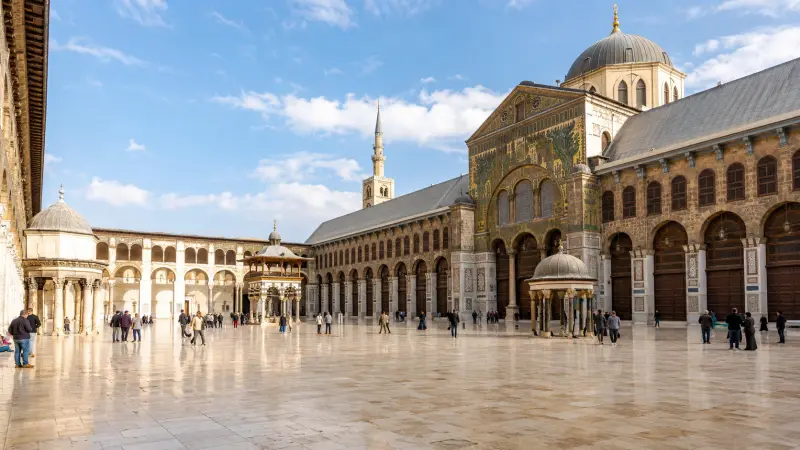
French President Emmanuel Macron arrived in Damascus on July 6, 2026, becoming the first Western European head of state to visit Syria since rebel forces led by Ahmad al-Sharaa toppled Bashar al-Assad in December 2024. Over two days, Macron and al-Sharaa restored full diplomatic ties, severed for more than a decade, and signed a package of economic, security and infrastructure agreements, including French technical assistance for Syria’s central bank and its banking sector. Al-Sharaa, who leads Syria’s Sunni Muslim majority and once commanded the al-Qaeda-linked group Hayat Tahrir al-Sham before severing ties with the network in 2016, has spent the eighteen months since Assad’s fall courting Western and Middle Eastern governments that once shunned Damascus.
The visit was not incident-free. Two improvised bombs exploded near the hotel where Macron had stayed and met civil society groups on the morning of July 7, wounding 18 people, though Macron’s office said he did not hear the blasts and met al-Sharaa shortly afterward as scheduled. No group claimed responsibility, though Islamic State, which has fought al-Sharaa’s government since announcing a new phase of operations against it in February, has claimed a string of prior attacks.
The view from Damascus and Paris
Al-Sharaa framed the visit as validation of Syria’s return to the international system, telling a joint economic forum that the country had regained a “vital role” as a transit corridor for global trade after the Strait of Hormuz crisis, and that he wanted France to be Damascus’s primary partner in that role. State news agency SANA described the trip as a pivotal step in restoring Syria’s international presence. Macron, for his part, emphasized reconstruction and institution-building over more Assad-era security cooperation, pledging French help modernizing Syria’s financial sector and infrastructure, and reaffirming French backing for lifting Western sanctions, most of which have already been removed following his earlier advocacy.
France’s engagement did not come without a stated condition. According to the French presidency, Macron told al-Sharaa directly that Syria could only be a genuine partner for France if pluralism were fully respected, and that it was out of the question for one form of exclusive power to simply replace another. French officials also said Macron secured a private commitment from al-Sharaa that Syrian forces would not enter Lebanon under any circumstances, a pledge al-Sharaa had previously made after denying rumors of any such plan.
The view from Syria’s minorities
The optimism radiating from the Damascus summit sits uneasily against a documented pattern of sectarian violence since al-Sharaa took power, one that Arabic-language analysis has tracked closely even as international coverage of the Macron visit largely set it aside. In March 2025, Alawite coastal villages were attacked by security forces and allied militias, reportedly killing thousands including women and children, under the stated justification of pursuing Assad-era remnants. In July 2025, clashes in the Druze-majority city of Sweida escalated into what regional Arabic outlets described as targeted killings, prompting Israeli military intervention that Israel justified as protecting the Druze community, a intervention Arabic analysts have read as also serving Israel’s own interest in weakening a unified Syrian state along its border. In June 2025, a gunman attacked a church in Damascus, killing more than 25 Christians during a Sunday service.
Human Rights Watch’s 2026 world report on Syria documents continuing arbitrary detentions and restrictions on expression, alongside more than a decade of landmine and war-remnant contamination that continues to obstruct safe returns for displaced people. Alawite community sources cited in Arabic-language research describe a government that has publicly pledged not to pursue collective retaliation and promised legal accountability for crimes against them, with some community members saying Hayat Tahrir al-Sham forces have treated them with a respect that eased their worst fears, even as deep anxiety about the community’s political future persists. Druze leaders, meanwhile, objected as early as March 2025 to Syria’s transitional constitutional declaration for omitting ethnic and religious diversity from political representation and concentrating appointment power in the executive rather than through elections.
What to watch
The test of Macron’s stated condition, that partnership depends on genuine pluralism, is whether it produces any concrete follow-through beyond rhetoric, such as monitoring mechanisms tied to the new economic agreements or public French statements if sectarian violence recurs. France’s three-step approach since Assad’s fall, pushing to lift EU sanctions, hosting a February 2025 Paris conference that produced a governance roadmap, and now this state visit, suggests Paris sees continued engagement rather than renewed isolation as its primary lever, a bet that will be tested by events on the ground rather than in Damascus meeting rooms.
Also worth tracking is whether other Western governments follow France’s lead. European Commission President Ursula von der Leyen visited in January and Ukraine’s Volodymyr Zelensky in April, but Macron’s trip is the first by a head of state from a major Western European power, and diplomatic sources say talks are underway about upgrading France’s diplomatic presence in Damascus beyond its current charge d’affaires.
Next specific milestones: any further sectarian incidents in Alawite, Druze or Christian communities and the government’s documented response; progress on the French-backed banking and infrastructure agreements; whether other major Western states schedule similar visits; and developments in the ISIS-claimed attack campaign against the al-Sharaa government.
Sources
- Al Jazeera, France 24 and The Arab Weekly (Qatar / France), on the visit’s diplomatic and economic content
- i24NEWS (Israel), on the specific agreements signed and the bombing near Macron’s hotel
- Asharq Al-Awsat English edition (Saudi Arabia, pan-Arab daily), detailed reporting on the bombing and security context
- The Media Line (Middle East-focused outlet), on the economic and historical context of French-Syrian relations
- Human Rights Watch, Arabic-language 2026 World Report chapter on Syria
- Hadara Center for Studies and Research and True Studies (Arabic-language regional research centers), on Alawite and Druze community responses to the transitional government
- Dama Post (Syria-focused Arabic outlet), on the pattern of sectarian violence since Assad’s fall
This post was produced with AI assistance and human editorial review. Arabic-language regional analysis on minority communities was reviewed alongside French and English-language coverage of the Macron visit; some of the minority-focused sourcing predates July 2026 and is presented as background context rather than as reporting on current events.