
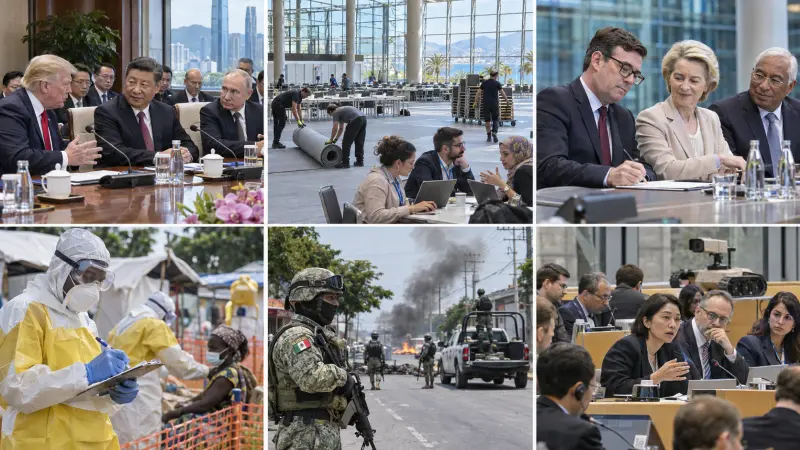
Trump, Xi and Putin sign a short peace declaration in Shenzhen
On Thursday, November 19, Donald Trump, Xi Jinping and Vladimir Putin met for roughly 90 minutes at the Kylin Villa in Shenzhen, on the sidelines of the APEC summit. The resulting Declaration toward Peace, released by Xinhua and the Kremlin, commits the three to the principle that a nuclear war should never be fought, to UN reform, to higher output of refined petroleum products, and to immunity for state officials from international courts. It does not mention Ukraine or the US-Iran war. Trump said afterward that all three agreed Iran cannot obtain a nuclear weapon, but AP found no sign he secured help from either leader on ending that conflict.
The coverage split cleanly by capital. A Global Times editorial called the summit unprecedented and history-making, while the Hong Kong-based South China Morning Post argued the declaration showed it was more than a photo op. AP’s account led with the lack of breakthroughs and noted that Chinese officials barred a Bloomberg reporter from the trilateral session. In Europe, attention went to what happened in parallel: more than 40 leaders backing Ukraine met in Berlin with US envoys, and Trump dialed in after leaving Shenzhen.
For the domestic backdrop to Trump’s trip, PoliTalking’s post on the Democrats winning Congress covers what the midterm result means abroad.
Washington weighs a reported Iranian dirty bomb plot
On November 16, CNN reported that US intelligence showed Iran exploring plans to target senior Trump administration officials in Washington with a radiological “dirty bomb” or a chemical weapon. Al Jazeera’s explainer notes the report relied on seven unnamed US officials, who described the planning as options rather than an imminent attack. Speaking in Manila the next day, Trump said Iran would “pay a price the likes of which no country has ever paid before,” as reported by Euronews. The White House said it had identified no credible threat to the homeland, and Homeland Security Secretary Markwayne Mullin called the planning “aspirational.”
Tehran’s response, carried widely in regional outlets, treated the report itself as the story. Foreign Ministry spokesman Esmaeil Baghaei dismissed it as a fabricated media narrative, and Russia’s state agency TASS quoted him saying the US and Israel were laying the groundwork for new aggression. The report landed in a war that began on February 28 and has settled into a standoff that Iran’s chief negotiator, Mohammad Bagher Ghalibaf, told Al Jazeera Tehran wants to break, with Qatar-mediated talks stalled. Bahrain said on November 19 that its air defences had intercepted Iranian aerial threats.
COP31 runs into overtime with fossil fuels cut from the text
The UN climate summit in Antalya, Türkiye, was scheduled to close on Friday, November 20, but negotiators were still working through Saturday with no agreed text. The sticking point is a revised draft from November 19 that, as RTÉ reported, removed every reference to transitioning away from fossil fuels and dropped a proposed $120 billion target for adaptation finance. An earlier draft had called for an accelerated phase-out, language no UN climate decision has ever adopted.
Turkish coverage, led by the Hürriyet Daily News, focused on COP31 President Murat Kurum’s push for what he calls an “Antalya Consensus.” A coalition of European, African, Latin American and Pacific countries held a joint press conference on Friday, reported by UN News through the Manila Times, to say the text was not good enough. Several outlets, including the Manila Times, pointed to the Iran war and the resulting oil price shock as a reason energy security had hardened positions.
PoliTalking’s opening-week report on COP31 explains the unusual Turkish-Australian split presidency. Status current as of Saturday, November 21.
Britain and the EU seal a reset ten years after the Brexit vote
At a summit in Brussels on Friday, UK Prime Minister Andy Burnham, European Commission President Ursula von der Leyen and European Council President António Costa concluded deals on three files: easier food and agricultural trade, linked emissions trading systems, and a youth experience scheme letting young people live, work or study in each other’s territory. Burnham’s office said the package could add 0.5 percent to Britain’s economy. Rejoining the EU was not on the summit agenda, though Burnham has said he will present options for a new relationship next month.
The domestic argument is over direction more than detail. Burnham has called Brexit more harmful than helpful, Reform UK’s Nigel Farage has described closer ties as a betrayal, and Conservative leader Kemi Badenoch said the deal would deliver the worst of both worlds. Brussels sounds warmer but more guarded: EU diplomats told Reuters they do not expect Britain to rejoin any time soon and that any deeper relationship would have to respect core EU demands, including free movement of people.
Denmark expels Russia’s defence attaché over a foiled murder plot
On Friday, Danish Prime Minister Mette Frederiksen’s office said authorities had thwarted a plot, allegedly directed by Russian intelligence, to kill a Ukrainian American rapper performing in Denmark. Two men described by police as members of the banned gang Loyal to Familia are under investigation for attempted murder and for helping a foreign intelligence service, CBS News reported. Foreign Minister Lars Løkke Rasmussen announced the expulsion of Russia’s defence attaché, Vladimir Grekov, and Anadolu reported that Denmark is also halting non-essential visas for Russian citizens.
Rasmussen called it a “deliberate Russian strategy of trying to intimidate us,” according to NewsNation, aimed at weakening Danish support for Ukraine. Grekov was already a known figure in Denmark: the Danish newspaper Information and the Dutch daily NRC exposed his military service record earlier, as the Center for European Policy Analysis documented. Moscow answered Denmark’s last large expulsion, in 2022, by expelling Danish diplomats in kind.
Ethiopia and Eritrea mass troops near Badme
Ethiopia and Eritrea have built up forces along their shared border of more than 1,000 kilometres, Reuters reported on November 18, citing conflict monitors and people tied to militias in Tigray. The monitoring group ACLED recorded drone strikes and a November 13 clash near Badme, the town at the centre of the 1998 to 2000 war that killed tens of thousands. A UN boundary commission later placed Badme inside Eritrea. The two countries cut diplomatic ties in October.
The two governments tell incompatible stories. Ethiopia’s army chief, Field Marshal Birhanu Jula, has accused the Tigray People’s Liberation Front of working with Eritrea to split Tigray from the country, and Addis Ababa has accused Sudan and Egypt of backing Tigrayan rebels, which both deny. Eritrean Information Minister Yemane Gebremeskel told Reuters the reports were Ethiopian ruling-party propaganda, without addressing the build-up itself. Coverage outside the Horn has been thin relative to the stakes, with most international reporting tracing back to the single Reuters story.
Congo’s Ebola outbreak is still out of control after six months
Jean Kaseya, head of the Africa Centres for Disease Control and Prevention, said on November 15 that the Ebola outbreak declared in the DRC on May 15 is still not under control. Government data cited by Reuters puts the toll at more than 11,200 cases and 5,500 deaths, though the European Centre for Disease Prevention and Control counted 11,376 confirmed cases and 5,568 deaths through November 14. The worst previous outbreak in the country, from 2018 to 2020, killed nearly 2,300 people.
Kaseya blamed weak coordination between Kinshasa and donors, calling it “a collective failure,” and Africa CDC says 80 percent of new cases are found outside health surveillance. AP added that more than $700 million in Ebola aid remains unaccounted for. Cases have reached Uganda, Kenya and Nigeria, making this the most geographically widespread Ebola outbreak on record, though Kaseya told RFI that Uganda has brought its cases under control.
Mexico captures “El Chapo Isidro,” and Sinaloa erupts
Mexican soldiers captured Fausto Isidro Meza Flores, known as “El Chapo Isidro,” in Guasave, Sinaloa, on the night of Friday, November 20. The fighting that followed left at least 11 people dead, seven alleged cartel gunmen and four soldiers, according to AP and Mexico’s Defense Ministry, and footage showed fans fleeing gunfire at a baseball game. Meza Flores, on the FBI’s Ten Most Wanted list since February 2025 with a $5 million US reward, was flown to Mexico City on Saturday.
How the US role is described depends on who is describing it. Fox News headlined the capture as coming after US help, and ABC7 reported the Defense Ministry crediting American assistance. Mexico’s government has drawn a careful line on earlier operations: after the February 2026 raid that killed “El Mencho,” President Claudia Sheinbaum said US agencies supplied intelligence only and Mexican forces carried out the operation. Mexican outlets also remember November 2025, when TV Azteca and others reported his capture in Guasave before officials declined to confirm it.
Canada and China expand tariff relief
Meeting in Shenzhen on November 17, Canadian Prime Minister Mark Carney and Xi Jinping announced new tariff cuts building on a January agreement. China will ease duties on Canadian pork, fish and seafood worth around C$400 million, according to AFP. In return, Canada will extend its tariff exemptions on Chinese steel and aluminium by two years and widen them to 32 more product categories, as reported by dpa.
Carney said Canada was well ahead of its target of raising exports to China by 50 percent by 2030, and he had warned a day earlier that Canada could turn to Chinese, European or Japanese carmakers if talks with Washington fail. US trade adviser Peter Navarro said it was offensive for Carney to play China against the United States. Carney still met Trump on the APEC sidelines, CTV reported, and both sides have recently sounded more hopeful about a deal. PoliTalking’s Canada update covers Ottawa’s parallel move toward the EU.
Israel’s opposition takes the Knesset speaker’s chair
On November 17, the Knesset elected Matan Kahana of Gadi Eisenkot’s Yashar party as speaker with 66 votes, replacing Likud’s Amir Ohana, a Benjamin Netanyahu ally. The win depended on Arab parties, while the ultra-Orthodox United Torah Judaism and Shas voted with Likud for its candidate, Ofir Katz, who drew 52. Eisenkot received the mandate to form a government on November 8 and has 28 days, extendable by 14.
Israeli outlets read the vote very differently. Eisenkot called it a democratic move reflecting the majority for change, while Likud accused the bloc of relying on the votes of what it called terror supporters, JNS and other outlets reported. The following day, Naftali Bennett spent nearly three hours with Netanyahu and floated a rotation arrangement, according to the Jerusalem Post, and Likud and Eisenkot’s bloc were due to meet on Sunday to discuss a possible unity government.
UN talks on autonomous weapons settle for two more years of work
The Seventh Review Conference of the Convention on Certain Conventional Weapons ended in Geneva in the early hours of Saturday, November 21, without opening negotiations on binding rules for lethal autonomous weapons. Instead, states agreed to elaborate a possible accord by 2028, NPR reported, which could end up binding or optional. The International Committee of the Red Cross had pushed for binding rules within a year, and the United States had proposed five more years of work toward a voluntary text.
Reactions depended on starting expectations. Switzerland welcomed the result as the start of work on an instrument, while humanitarian groups quoted by NPR called it far short of what was needed. AFP reported that Russia in particular slowed the five days of talks. PoliTalking’s global guide to AI policy sets the weapons question against wider national approaches to AI regulation.
Dates to watch
- Sunday, November 22: Likud and Eisenkot’s bloc meet on a possible unity government in Israel.
- Late November: COP31 plenary in Antalya, if negotiators reach a consensus text.
- Early December: Eisenkot’s initial 28-day mandate expires, with a possible 14-day extension.
- December: Burnham’s promised options paper on the UK’s future relationship with the EU, and the G20 summit in Florida, where Trump and Xi are scheduled to meet again.
- December: South Sudan’s first general elections since independence.
- 2028: Deadline for the CCW work on a possible autonomous weapons instrument.
Sources
- Full text: China-Russia-U.S. Heads of State Declaration toward Peace (People’s Daily Online / Xinhua, China, state media)
- China-Russia-US summit is unprecedented and makes history: Global Times editorial (Global Times, China, state-affiliated)
- Xi, Trump and Putin ‘peace declaration’ suggests summit is more than a photo op (South China Morning Post, Hong Kong)
- Trump, Xi and Putin hold rare 3-way talks on nuclear risks but deliver no breakthroughs (Associated Press via ITV News)
- Takeaways from the historic summit between Trump, Xi and Putin (Associated Press via WPXI)
- Trump, Xi and Putin hold rare 3-way talks (Associated Press via Action News Jax)
- Is Iran plotting a ‘dirty bomb’ attack in the US? What we know (Al Jazeera, Qatar)
- Trump warns Iran over allegations of dirty bomb threat to Washington (Euronews, pan-European)
- Donald Trump Wants Iran to Think He Might Use Nuclear Weapons if Tehran Ever Attacked with a ‘Dirty Bomb’ (National Security Journal, US)
- Iran calls CNN dirty bomb report ‘fabricated’ pretext for new attacks (Türkiye Today, Türkiye)
- US sets stage for ground aggression with dirty bomb claims: Iranian Foreign Ministry (TASS, Russia, state news agency)
- ‘No war, no peace’: Can Iran break the deadlock with the US? (Al Jazeera, Qatar)
- Iran war live: Houthis target Saudi Arabia as CENTCOM chief meets with MBS (Al Jazeera, Qatar)
- COP31 draft climate deal removes mention of fossil fuels (RTÉ, Ireland, public broadcaster)
- COP31 talks extended as countries seek final deal (Hürriyet Daily News, Türkiye)
- COP31: Countries demand stronger climate deal as talks in Antalya reach final day (UN News via The Manila Times, Philippines)
- Crunch time for COP31, but no agreement in sight (The Manila Times, Philippines)
- ‘The deal is done’: EU, UK agree to reset relations 10 years after Brexit (Al Jazeera, Qatar)
- What will Andy Burnham agree at the UK-EU summit in Brussels? (The Scotsman, UK)
- As Britain seeks closer EU ties, Brexit trade-offs return (Reuters via Devdiscourse)
- UK’s Burnham risks reopening Brexit debate with bid to find consensus on EU ties (Reuters via The Star, Malaysia)
- Badenoch on the UK-EU deal (London Loves Business, UK)
- Denmark accuses Russia of assassination plot against U.S.-Ukrainian citizen on its soil (CBS News, US)
- Denmark accuses Russia of plot to kill US-Ukrainian rapper (NewsNation, US)
- Denmark accuses Russian intelligence of plotting to kill American Ukrainian on its soil (Associated Press via ABC News)
- Someone rotten in the state of Denmark (Center for European Policy Analysis, US think tank)
- Ethiopia and Eritrea amass forces along border, heightening war fears, sources say (Reuters via Al-Monitor)
- Ethiopia and Eritrea amass forces along border (Reuters via The Korea Times, South Korea)
- Ethiopia War Security Review, November 17, 2026 (Critical Threats Project, US think tank)
- Ethiopia-Eritrea Border Clashes Raise Fears of Regional War (AllAfrica, pan-African aggregator)
- Africa CDC says Ebola outbreak in DR Congo ‘still not under control’ (Al Jazeera, Qatar)
- DR Congo Ebola outbreak still out of control six months on, Africa CDC warns (RFI via Modern Ghana)
- Ebola Outbreak Remains out of Control in Congo Six Months Into Response (Associated Press via JEMS)
- DR Congo Ebola outbreak uncontrolled six months on, agencies warn (Streamline Feed, Kenya, citing ECDC)
- DR Congo Ebola outbreak surpasses 11,000 cases as conflict hampers response (Africanews, pan-African)
- Mexico detains top cartel boss ‘El Chapo Isidro,’ setting off a burst of violence in Sinaloa (Associated Press via PBS NewsHour)
- Mexico captures FBI’s most-wanted cartel boss ‘El Chapo Isidro’, triggering violence (Euronews, pan-European)
- FBI Ten Most Wanted cartel leader ‘Chapo Isidro’ captured by Mexico’s ‘elite military forces’ after US help (Fox News, US)
- Cartel kingpin on FBI’s most wanted list captured in dramatic Mexican military operation (ABC7 Los Angeles, US)
- ¿Hubo participación de EUA? Sheinbaum aclara situación en operativo de captura de ‘El Mencho’ (N+, Mexico, Spanish)
- Detienen en Sinaloa a Fausto Isidro Meza Flores, alias el Chapo Isidro (TV Azteca, Mexico, Spanish)
- Canada, China extend trade deals as Xi meets Carney ahead of APEC summit (AFP via Kuwait Times)
- China and Canada agree further tariff reductions (Bernama-dpa, Malaysia, state news agency)
- Canada-China trade deal ahead of Trump summit (Newsweek, US)
- China and Canada Agree to Lift More Tariffs (Breitbart, US)
- CTV News in China: Carney and Trump meet at APEC summit (CTV News via CP24, Canada)
- Matan Kahana elected Knesset speaker with 66 votes as Eisenkot bloc takes control (Ynetnews, Israel)
- Knesset speaker vote and Haredi parties (JFeed, Israel)
- Matan Kahana elected Knesset speaker, drawing Likud rebuke (JNS, US/Israel)
- Israel’s president picks Eisenkot over Netanyahu to form next government (Al Jazeera, Qatar)
- Live Updates: Replacing Netanyahu top priority for Eisenkot-led bloc, Bennett floats rotation deal with Netanyahu (The Jerusalem Post, Israel)
- Nations at UN talks on AI killer robots agree to more talks but no firm commitment to rein them in (NPR, US)
- Killer robots: U.N. talks fall short of hopes for legally binding rules (NPR via KPBS, US)
- Global leaders struggle on whether to regulate ‘killer robots’ at UN conference (AFP via BNN Bloomberg, Canada)
- International Talks on Autonomous Killer Robots Achieve Historic Deal to Think It Over for 2 More Years (Gizmodo, US)
This post was produced with AI assistance and human editorial review. Spanish-language Mexican coverage was reviewed for the Sinaloa item and Danish-language searches were run for the Denmark item; characterizations elsewhere rely on English-language editions, including English services of state media. Figures current as of November 21, 2026.