
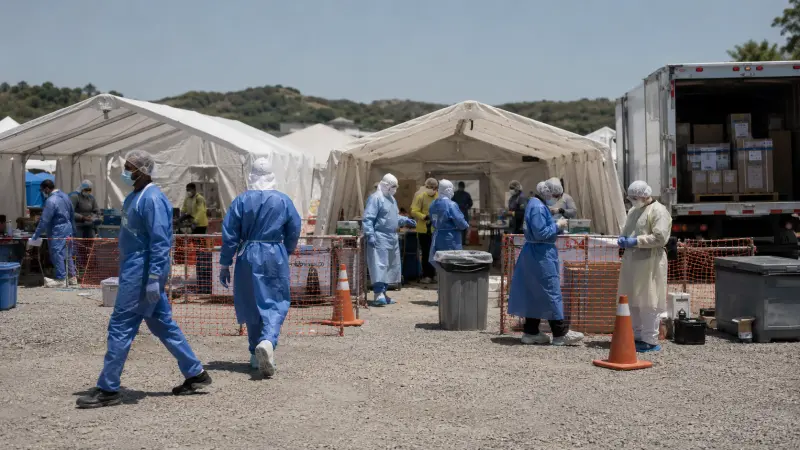
The Ebola outbreak in the eastern Democratic Republic of the Congo has spread beyond its epicenter in Ituri province, with suspected cases reported in the previously unaffected provinces of Tshopo and Haut-Uele and the confirmed death toll passing 600 in early July 2026. Confirmed cases nationwide had climbed past 1,750 by mid-July. The Africa Centres for Disease Control has called it the fastest-growing Ebola outbreak recorded on the continent, and international agencies rank it among the largest on record.
The outbreak is unusual and dangerous for a specific reason. It is caused by the Bundibugyo species of the virus, for which there is no approved vaccine or proven treatment, because existing Ebola countermeasures were certified against a different species, Zaire ebolavirus. Congolese authorities declared the outbreak on May 15 after the virus had been circulating undetected for weeks, and the World Health Organization designated it a public health emergency of international concern the following day. It is the country’s 17th Ebola outbreak and began only months after the previous one ended.
The view from Kinshasa and the response
Congolese coverage, reported in French, emphasized a government-led response scaling up under severe strain. The health ministry and the national biomedical research institute in Kinshasa have coordinated the effort, and testing capacity rose from roughly 30 samples a day in the capital to more than 2,000 across ten decentralized laboratories in the affected provinces. President Félix Tshisekedi, speaking in Kinshasa alongside visiting South African President Cyril Ramaphosa, stressed that epidemics do not respect borders. On July 2 a clinical trial known as PARTNERS began, coordinated by the Congolese institute with WHO support, testing a monoclonal antibody and the antiviral remdesivir, alone and in combination.
The response is running behind the virus, and Congolese and French-language reports were frank about why. WHO’s representative in the DRC, speaking from Bunia, said the outbreak’s true scale is not yet established and declined to call it stabilizing. Treatment centers are near saturation, ambulances are short, and community mistrust and violence keep interrupting the work. In one week an Ebola treatment center in Ituri was attacked and burned, two people were killed, and patients fled. The International Rescue Committee earlier warned the real figures likely exceed official counts, with many sick people avoiding facilities and staying in the community.
The view from outside
The outside framing diverged sharply by audience. For the WHO, MSF and UN agencies, the story is a humanitarian and scientific race: expanding beds, tracing contacts, and running the first trial against Bundibugyo. Médecins Sans Frontières, which has more than 1,400 staff on the ground across Ituri, North Kivu and South Kivu and in Uganda, described a response still falling short of the crisis as it reaches new provinces.
For high-income governments far from the outbreak, the framing tilted toward border protection. The US Centers for Disease Control advised against nonessential travel to the affected provinces, and Washington issued an order suspending entry of certain foreign nationals for a period. Europe’s disease agency assessed the risk to people in the EU as very low even after imported cases surfaced: an American doctor medically evacuated to Germany in May, and a French doctor who self-reported symptoms on arrival at a Paris airport in June after five weeks treating patients in Ituri. Uganda, which recorded a cluster in and around Kampala, closed its border with the DRC for a period and imposed isolation on arrivals.
The conflict layer complicates all of it. Eastern DRC remains a war zone, with fighting between the Congolese army and the M23 armed group, which Rwanda is accused of backing and denies. Some outbreak areas sit under M23 control, and the group at one point claimed Ebola had been eradicated in its zones, a claim WHO could not confirm. The security situation, funding gaps and attacks on health facilities were named repeatedly as the core obstacles.
What to watch
The near-term question is geographic. Whether the suspected Tshopo and Haut-Uele cases are confirmed, and whether the Kisangani cluster in Tshopo signals genuine spread to a major city nearly 600 kilometers from the epicenter, will shape the outbreak’s trajectory. One of the suspected Tshopo cases was linked back to an Ituri health zone; another had no obvious geographic connection, which is the more worrying signal.
The scientific question is the trial. Because no treatment is proven against Bundibugyo, early PARTNERS results carry weight well beyond this outbreak, and WHO has said it is working to secure access to the therapies if they prove safe and effective. The UN has appointed a senior response coordinator, Julien Harneis, based in Bunia, to tighten coordination.
Next specific milestones: laboratory confirmation of the Tshopo and Haut-Uele suspected cases; the next WHO and Africa CDC situation updates; whether the case-fatality ratio, running around 30 percent, shifts as treatment capacity grows; enrollment and early readouts from the PARTNERS trial; and whether renewed fighting or facility attacks force treatment centers to close again.
Sources
- World Health Organization (international institution), Disease Outbreak News and the PARTNERS trial announcement
- UN News, English and French services, on case counts, the clinical trial and the response coordinator
- European Centre for Disease Prevention and Control (EU agency), threat assessment and imported-case notes
- Médecins Sans Frontières (international NGO), response overview and treatment-center figures
- Euronews, coverage of the spread to Tshopo and Haut-Uele provinces
- Associated Press via NPR (United States), on the spread to new provinces
- Xinhua via GlobalSecurity.org (China state media), on the intensifying outbreak and saturation of treatment centers
- Wikipedia, timeline of the outbreak’s geographic spread
This post was produced with AI assistance and human editorial review. French-language Congolese and agency coverage was reviewed alongside English-language editions. This report describes a public health emergency; readers seeking guidance should consult official health authorities.