
The routine framing
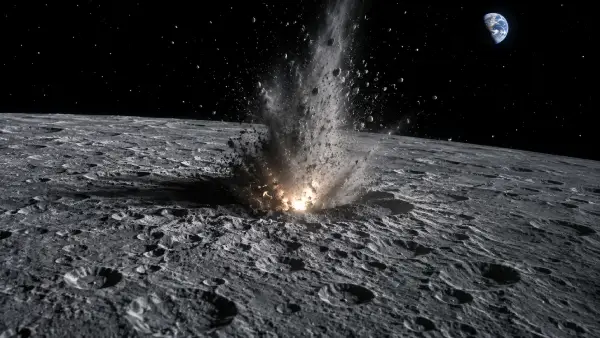
In American science coverage, this was treated largely as a welcome and fairly ordinary opportunity. Carl Schmidt, a planetary scientist at Boston University, told CBS News the event offers a rare chance to study how the Moon’s thin atmosphere behaves, noting he has only seen it happen twice in his career. The object had been tracked for months by Bill Gray, an independent astrodynamicist whose software, Project Pluto, first flagged the coming impact in July using publicly available orbital data. NASA confirmed the trajectory and crater estimates, and astronomers across the Americas pointed telescopes at the Moon hoping to capture the impact directly.
This is not the first time Gray has made this kind of call, and the history is worth knowing because it complicates any clean story about whose debris this is. In 2022, Gray identified a piece of moon-bound junk as a SpaceX booster, only to later correct himself: it was actually the spent stage of China’s 2014 Chang’e 5-T1 lunar mission. NASA’s own Lunar Reconnaissance Orbiter subsequently imaged the resulting crater, confirming the object had struck the Moon largely as predicted. China’s foreign ministry, notably, disputed that identification even after the independent correction, claiming the rocket stage in question had burned up in Earth’s atmosphere instead. NASA’s imagery did not support that account. That episode is a useful caution against assuming any government or company will readily claim its own abandoned hardware, and it is a reminder that this week’s event, this time genuinely SpaceX’s, is not unique to one country’s space program.
The governance gap
Outside the immediate science story, a different and more pointed conversation has been building among space-law researchers and policy analysts, one this event has sharpened rather than started. The core problem they describe is straightforward: no binding international rule currently requires any operator, American, Chinese, European, Indian, or Japanese, to responsibly dispose of hardware once it leaves Earth orbit.
The 1967 Outer Space Treaty, still the foundational law signed by every major spacefaring nation, prohibits claims of sovereignty over the Moon but says remarkably little about practical lunar governance or environmental protection, according to analysis from The Conversation republished by The Weather Network. The Artemis Accords, now signed by roughly 70 countries, address cooperation and the protection of heritage sites like the Apollo landing zones, but they too stop short of binding disposal requirements, according to a review by the law firm Clyde & Co cited in coverage by Traveler’s Today. The US Federal Communications Commission’s rule requiring satellite operators to deorbit spacecraft within five years applies only to Earth orbit and has no lunar equivalent. The United Nations Office for Outer Space Affairs, the body most likely to eventually write such rules, operates with a global mandate and, according to The Conversation’s analysis, a staff of only around 40 people.
Jonathan McDowell, a Harvard astrophysicist who tracks orbital objects, offered a blunter framing to the Washington Times: as lunar traffic from multiple countries increases, uncontrolled impacts that scatter debris and dust across hundreds of miles of the lunar surface, near future landing sites, scientific instruments, or historic locations, “is not going to be acceptable.” More than 187,000 kilograms of human-made material already rest on the Moon’s surface, according to figures cited by The Conversation, and Forbes reported the week’s impact pushed the wider count of lunar-adjacent debris in orbit past 209 tons.
An inconsistent record, not a uniquely reckless one
The available evidence suggests this is a shared problem rather than one company’s oversight, though the record on any single actor’s practice is mixed. Bill Gray’s own technical notes on the object, published on his Project Pluto site, observe that both SpaceX and China’s National Space Administration have historically been reluctant to discuss their disposal planning publicly. He notes that CNSA’s more recent lunar launches have shifted toward placing spent stages in orbit around the sun rather than leaving them on a path toward Earth or Moon, and that SpaceX appears to have done the same, deliberately, for at least one other recent Falcon 9 upper stage launched in November 2025. That suggests this week’s impact reflects an earlier design choice or a genuine gap in planning for the January 2025 mission specifically, rather than a fixed company-wide practice of abandoning lunar hardware. SpaceX has not published a detailed public account of why this particular stage was left adrift, and the company was not otherwise quoted directly in the reporting reviewed for this piece.
What to watch
The near-term technical question is whether NASA’s Lunar Reconnaissance Orbiter or another spacecraft can locate and image the new crater, a process that took weeks to months after the 2022 impact and helped settle the earlier dispute over whose debris it actually was. Confirmed imagery would close out the scientific side of this specific event.
The longer-running and more consequential question is whether an incident with no casualties and no real damage is enough to move international space law forward, or whether, as The Conversation’s analysis suggested, it takes a more serious accident, contamination of a lunar ice deposit, or damage to a future outpost, before governments treat lunar debris disposal as an urgent rather than theoretical problem. With NASA, China, and multiple commercial operators all planning an accelerated pace of lunar missions in the coming years, the number of opportunities for a costlier repeat is only growing.
Next specific milestones: any Lunar Reconnaissance Orbiter imagery confirming the crater’s location and size; any public statement from SpaceX on the January 2025 mission’s disposal planning; movement within UNOOSA or the UN Committee on the Peaceful Uses of Outer Space toward binding lunar debris rules; and whether other spacefaring states adopt CNSA’s and SpaceX’s more recent practice of routing spent lunar-mission stages into solar orbit rather than leaving them on a collision path.
Sources
- Al Jazeera (Qatar), on the initial confirmation and impact circumstances
- CBS News (United States), on impact speed, force, and crater estimates, with comment from Boston University’s Carl Schmidt
- CNN (United States), on the European Southern Observatory’s spectroscopic confirmation
- NPR (United States), on NASA’s crater estimate and the mission background
- Al Jazeera (Qatar), on independent tracking data and impact location
- Wikipedia (reference compilation), on mission history and technical figures
- The Conversation, via The Weather Network (Canada), on Outer Space Treaty gaps and UNOOSA capacity
- Traveler’s Today, on the Artemis Accords and FCC deorbit rules, citing Clyde & Co legal analysis
- The Washington Times (United States), on Jonathan McDowell’s comment and the 2022 Chinese debris precedent
- Forbes, on cumulative lunar debris figures
- Project Pluto (Bill Gray, independent astrodynamicist), original technical notes on SpaceX’s and CNSA’s disposal practices
- Sunday Times Sri Lanka, via PressReader, on China’s 2022 dispute of the corrected Chang’e 5-T1 debris identification