
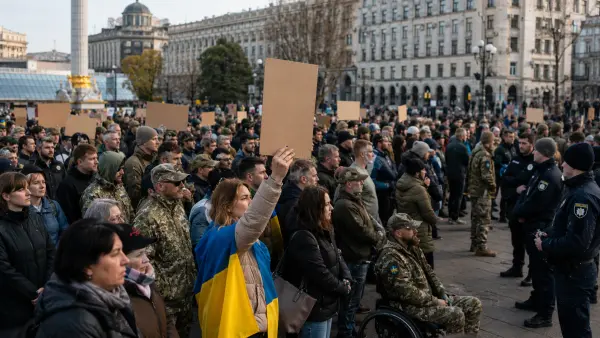
Thousands of Ukrainians protested in Kyiv and other cities on July 16 after President Volodymyr Zelenskyy removed Defense Minister Mykhailo Fedorov during a wider government reshuffle. The demonstrations turned an internal dispute over military management into a public test of how Ukraine balances wartime command, civilian oversight and political accountability.
Fedorov, 35, had led the Defense Ministry for six months after years overseeing Ukraine’s digital transformation. He was associated with faster defense procurement, expanded drone warfare and efforts to deny Russian forces access to Starlink terminals. Zelenskyy said the immediate problem was a breakdown in cooperation between Fedorov’s ministry and Gen. Oleksandr Syrskyi, commander-in-chief of the armed forces, according to the Associated Press account of the reshuffle.
The change came through the replacement of the full cabinet rather than a stand-alone parliamentary vote to dismiss Fedorov. Parliament approved a new government on July 16 without filling the defense portfolio. Zelenskyy then asked Maj. Gen. Yevhenii Khmara, the acting head of the Security Service of Ukraine, to perform the defense minister’s duties and said he would later seek parliamentary approval for Khmara.
Why Ukrainians took the dispute to the streets
Domestic coverage shows that the protesters were defending more than one minister. Many described Fedorov as the public face of a faster, technology-led approach to war and feared that his departure would restore slower decision-making inside the defense establishment. Ukrainska Pravda interviewed protesters in Kyiv, including civilians and military personnel who cited procurement changes, drone development, Starlink restrictions and proposed Gripen fighter acquisitions as reasons they wanted his work to continue.
The demonstrations also drew on Ukraine’s recent protest culture. Participants again used handmade cardboard signs, echoing the July 2025 rallies that pushed Zelenskyy to reverse restrictions on independent anti-corruption bodies. Ukrainian public broadcaster Suspilne recorded actions in cities including Lviv, Odesa, Dnipro, Zaporizhzhia, Rivne, Ivano-Frankivsk and Kyiv, showing that the reaction extended beyond one group in the capital.
There is still domestic disagreement about what Fedorov’s popularity proves. Supporters see measurable progress and a civilian official willing to challenge entrenched practices. Others argue that a defense minister who cannot maintain a working relationship with the top military commander creates a different kind of wartime risk, especially when battlefield decisions require coordination rather than competing chains of authority.
A public break over military reform
Fedorov made the institutional conflict unusually direct after leaving office. At a July 16 briefing, he accused the military leadership of obstructing a new contract system and placed responsibility for parts of Ukraine’s mobilization crisis on Syrskyi. Ukrainska Pravda reported his allegations, including his claim that some units adopted the proposed contracts while the broader system faced resistance from the General Staff.
Zelenskyy presented his decision as a response to an impasse. He said the disagreement reached several levels of the Defense Ministry and armed forces and that he had to resolve it when the two sides could not. He also acknowledged the protests as an expression of the democratic freedom Ukraine is fighting to protect, while saying the final personnel process had not yet been completed, according to Suspilne’s Ukrainian-language report.
Those accounts leave important questions unresolved. Fedorov’s claims about blocked reforms are his version of the dispute, not an independent finding. Syrskyi’s supporters can point to his role in the defense of Kyiv and the 2022 Kharkiv counteroffensive, while critics question whether the command structure has adapted quickly enough to drone warfare, recruitment pressures and decentralized battlefield innovation.
Why foreign partners are watching continuity
International coverage has largely treated the removal as a test of stability in a government fighting a much larger invading force. The concern is not that every defense policy will change with one minister, but that a bitter leadership split could interrupt procurement, weapons production and coordination with allies. The timing sharpened that concern because Russia continued large aerial attacks while Ukraine’s partners were discussing new weapons and industrial cooperation.
European and NATO officials avoided intervening directly in Ukraine’s appointment process. They nevertheless praised Fedorov’s work. Ukrainska Pravda summarized allied reactions from NATO Secretary General Mark Rutte, European Defence Commissioner Andrius Kubilius and EU Ambassador Katarina Mathernova. Rutte said he did not expect the personnel change to produce a major shift in Ukraine’s strategy, while EU figures highlighted their cooperation with Fedorov’s team.
That outside view differs from the domestic argument in emphasis. Ukrainians are debating who can reform mobilization, procurement and command practices while preserving public trust. Foreign governments are more likely to judge the transition by whether Ukraine keeps battlefield capabilities, defense contracts and joint production plans moving without disruption.
What to watch
The first test is whether Khmara continues the reforms associated with Fedorov or changes their direction. Zelenskyy has instructed him to continue defense-sector reform, but the practical evidence will come from personnel choices, procurement rules, the proposed military contract system and the relationship between the ministry and Syrskyi’s command.
The second test is political. Zelenskyy said he would submit Khmara’s nomination after the necessary legal procedures, and the defense minister requires parliamentary approval. The Verkhovna Rada’s July 16 record shows lawmakers pressing for a candidate who can retain public and parliamentary confidence while preserving Ukraine’s technological advantage.
Specific milestones include any extraordinary parliamentary sitting, the expected return to regular parliamentary work in August, a formal vote on Khmara or another nominee, and the first Defense Ministry decisions on contracts and procurement under the acting leadership. Further demonstrations, senior military resignations or a public response from Syrskyi would show whether the dispute is narrowing or becoming a broader crisis of wartime authority.
Sources
- Ukrainska Pravda (Ukraine, Ukrainian): reporting from the Kyiv protest and interviews with civilian and military participants.
- Ukrainska Pravda (Ukraine, Ukrainian): Fedorov’s briefing and allegations about military contracts and mobilization.
- Suspilne (Ukraine, Ukrainian): Zelenskyy’s response to the protests and description of the appointment process.
- Verkhovna Rada of Ukraine (Ukraine, Ukrainian, official record): July 16 parliamentary proceedings and debate over the defense vacancy.
- Associated Press (United States, English): nationwide protests, government reshuffle, leadership conflict and Khmara’s interim role.
- The Guardian (United Kingdom, English): international framing, Zelenskyy’s explanation and allied concern about the transition.
This article was prepared with AI assistance and reviewed by a human editor. Ukrainian- and English-language reporting was checked, including Ukrainian domestic coverage and an official parliamentary record.