
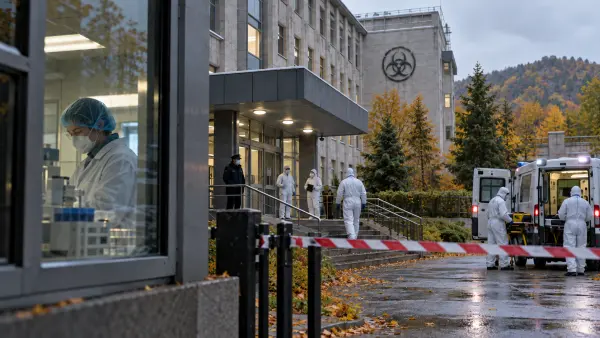
A 28-year-old laboratory technician at the Irkutsk Anti-Plague Institute in Siberia died in a hospital in the town of Shelekhov in the early hours of October 2, and the cause of death is disputed. The governor of the neighboring Buryatia region first said she died of plague, then softened his post to add “possibly.” Russia’s health watchdog, Rospotrebnadzor, says her diagnosis was pneumonia of unknown cause and that no microorganisms linked to her work were found.
Rospotrebnadzor placed nearly 200 contacts under testing and observation, and the World Health Organization says the risk to the general public appears low while it asks Moscow for details. No Russian or international health authority had confirmed plague as of October 6. Independent regional outlets, including Lyudi Baikala, report that she broke a vial of plague bacteria on September 25. That account is unconfirmed, and the watchdog says an expert commission found no emergency at the institute.
What is known, and what is not
Independent Russian outlets named the technician as Darya Shipilova. Rospotrebnadzor has not named her. Most reports give her age as 28, while the Irkutsk outlet Irkutsk Today gave 27 and a death date of October 1, a day earlier than most accounts. The Moscow Times, as relayed by the Ukrainian outlet UNIAN, reported that she was hospitalized on September 29 and put on a ventilator.
The regional response became public on Friday, October 2. A Baikal Journal explainer in Russian puts her death in the night of October 2 and the number of people taken for testing and quarantine at about 200. Governor Igor Kobzev of Irkutsk Region said he had convened an extraordinary meeting with Russia’s chief sanitary physician about a suspected case of a particularly dangerous infection, and the Shelekhov hospital closed its inpatient department for quarantine, the New York Times reported.
On Sunday, Rospotrebnadzor said in a statement that an employee of the institute had been diagnosed with “pneumonia of unknown etiology.” It added that the sanitary and epidemiological situation in Irkutsk and Shelekhov was stable and that no signs of infectious disease had appeared among her contacts. A commission also found no emergency involving pathogens at the institute. The portions of the statement carried by state outlets do not describe which tests were run.
An official line with visible seams
The federal position has been consistent since Monday. Kremlin spokesman Dmitry Peskov told reporters to rely on Rospotrebnadzor’s statements and not on rumors, according to The Insider, an independent outlet that cited a TASS report. Rospotrebnadzor is the agency that also reported the stable situation and the absence of a lab accident, so the Kremlin line and the watchdog line are the same one.
Before that line settled, several officials and outlets said something different. Buryatia’s governor, Alexei Tsydenov, wrote that the woman had died of plague, said she had never visited Buryatia, and then added “possibly” to the post, as CBS News and CNN reported. On October 3 the administration of Baikalsk, a town about 125 kilometers from Shelekhov, asked residents to avoid Shelekhov because of unofficial information about a plague case, and Meduza noted the post was removed about two hours later. The Insider added that the federal channel REN TV deleted five Telegram posts about plague in the region, and that Kommersant removed a report on U.S. monitoring of the case within 25 minutes of publishing it.
Independent outlets reported more than officials confirmed. Lyudi Baikala, a regional outlet that CBS says operates in exile, reported that residents of Shelekhov and Irkutsk were buying antibiotics, and the New York Times relayed its report that other Irkutsk clinics and a maternity ward had closed. The official statements reviewed for this piece did not address closures beyond the Shelekhov hospital.
A different domestic framing came from Pavel Stepanov, a local journalist. He posted that a young technician had broken a vial and died, a claim the New York Times said it could not verify, and then argued that authorities should check whether this was “sabotage by our enemies.”
Russian-language coverage of the official line has been terse. The news site Lenta.ru, in a short Tuesday report, said Rospotrebnadzor had ended observation for 60 percent of her contacts. The report put the plague suspicion down to unnamed publications and did not mention the Buryatia governor’s post.
The New York Times linked the public skepticism to past concealment by Russian authorities, including the AIDS outbreak of the 1980s. The Insider recalled that in spring it reported officials describing a livestock outbreak as pasteurellosis and rabies while farmers and experts pointed to foot-and-mouth disease. Neither claim bears directly on this case, and no source reviewed alleges what the authorities are withholding here.
Reaction outside Russia
The World Health Organization told CNN it was in contact with Russian authorities to verify the event, its circumstances and the laboratory results. In a statement quoted by The Conversation, it said that on unofficial information the public health risk to the general population “appears to be low,” and that it would update the assessment when more information arrives.
The United States has been more pointed than the WHO. The State Department told Newsweek it was aware of reports of a fatal case of suspected pneumonic plague and urged Russia to share accurate information quickly and openly. Secretary of State Marco Rubio said on Monday that the case was “cause for focus” and not for alarm, citing limited travel between the two countries, though he described a lab worker who was infected and a concern that it could have spread. That description goes further than anything Rospotrebnadzor has said.
Axios reported that the White House is monitoring, and the New York Times reported that European Union officials are as well. Closer to Russia, Kazakhstan, Kyrgyzstan and Uzbekistan strengthened sanitary controls, The Insider reported. Kazakhstan’s health ministry called the risk very low, CNN reported, and Uzbekistan has no land border with Russia. This review did not find coverage from Mongolia or China, which also border Russia and have natural plague foci.
Specialists commenting for outside outlets have been cautious about scale. The London School of Hygiene and Tropical Medicine said laboratory-acquired plague infections are rare and that person-to-person spread is less common than with respiratory viruses such as SARS-CoV-2. The Conversation’s microbiologist wrote that only one major pneumonic plague outbreak is documented, in China in the 1910s. Ian Jones of the University of Reading told the New York Times the case looks like a rare lab accident unlikely to go much further, a view that assumes plague was involved at all.
What to watch
The central gap is laboratory evidence. Rospotrebnadzor has said no microorganisms tied to the technician’s work were found, but it has not published which tests were run or whether plague was tested for by name. The WHO has said its risk assessment will be updated once more information is available, and that update is the most likely point at which an outside body weighs in on the cause.
Two other threads depend on Moscow. Contact tracing is only partly closed, with observation ended for 60 percent of contacts as of Tuesday. The quarantine at the Shelekhov hospital and the status of the other Irkutsk clinics reported by Lyudi Baikala have no official end date. None of the items below has a published date.
- Publication of laboratory results or a named cause of death from Rospotrebnadzor
- The WHO’s updated risk assessment for the Irkutsk event
- Completion of observation for the remaining contacts of the technician
- Lifting of the Shelekhov hospital quarantine and any other Irkutsk hospital restrictions
- Whether Kazakhstan, Kyrgyzstan and Uzbekistan keep their border controls in place
- Any further statement from the U.S. State Department or White House
Sources
- Russia plays down plague fears and denies lab accident, says scientist died of “pneumonia of unknown origin” (CBS News)
- Dozens quarantined after researcher at Russian plague laboratory dies of ‘unknown’ infection (CNN)
- Russia’s Response to Suspected Plague Outbreak Under Scrutiny (Newsweek)
- Russia’s plague mystery: What we know about the suspected outbreak (Axios)
- Russia moves to tamp down speculation about plague in Siberia (The New York Times, via The Philadelphia Inquirer)
- The death of a Russian plague researcher, explained by a microbiologist (The Conversation)
- Rapid reaction: Suspected plague death in Russia reported (London School of Hygiene and Tropical Medicine)
- Роспотребнадзор: сотрудница Иркутского института заболела пневмонией (RIA Novosti)
- Раскрыты детали наблюдений за контактировавшими с сотрудницей противочумного института (Lenta.ru)
- Умершая сотрудница противочумного института болела пневмонией: Роспотребнадзор (Irkutsk Today)
- Четыре вопроса о чуме (Baikal Journal)
- В Иркутской области чиновники посоветовали не ездить в город Шелехов, где пациентка больницы могла умереть от чумы. А потом удалили пост (Meduza)
- Власти России отрицают вспышку чумы, а СМИ удаляют публикации о заболевании. Страны Центральной Азии вводят санитарный контроль на границе (The Insider)
- В России разразилась чума: больницы закрывают на карантин, на заводах вводится масковый режим (UNIAN)