
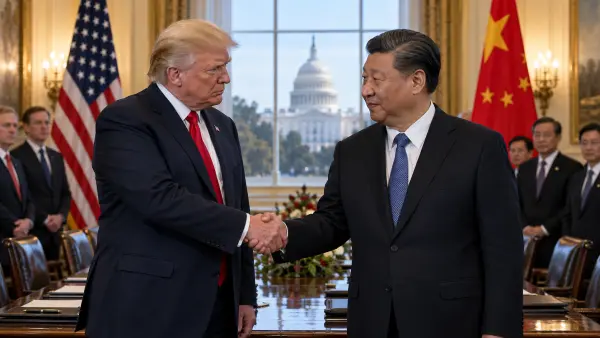
Chinese President Xi Jinping’s state visit to Washington, September 23 to 25, extended the US-China trade truce by two months, to January 10, 2027, and set up new channels on trade, investment and artificial intelligence. Neither side announced agreement on Taiwan, chip export controls or rare earths. In the ten days since, the details have shifted: tariff-cut lists have appeared without rates or dates, Beijing has answered a question about wording, and a US ambassador’s remark about arms sales has been disowned by his own government.
The summit was the second between Donald Trump and Xi this year, after Trump’s state visit to Beijing in May, and it followed the truce struck in Busan in October 2025. According to a White House fact sheet, the leaders put a Board of Trade into operation, with each side naming about $30 billion in non-sensitive goods for lower tariffs, and agreed on a dialogue about advanced AI that is due to meet again by November. The same document says China will import at least 10 million metric tons of US coal in each of 2027 and 2028.
Two readouts of the same three days
Beijing’s foreign ministry summarized the visit as eight deliverables and understandings. Most overlap with the US account: a pledge to build what both call a constructive relationship of strategic stability, the Board of Trade, the $30 billion tariff arrangement, an AI dialogue with an incident channel, mutual support for hosting APEC and the G20, and a pair of pandas for Zoo Atlanta. Both texts also say no country or institution can be allowed to impose tolls on international waterways.
The differences are in what each side leaves out. Neither list of outcomes mentions Taiwan, but Beijing’s account of the leaders’ talks says Xi hoped Washington would keep “the correct position of opposing ‘Taiwan independence.'” Beijing’s summary also says the two militaries agreed to conclude a crisis-communication memorandum as soon as possible, which the White House sheet does not mention.
The US sheet, for its part, announces the coal purchases and says Trump advocated three-way arms control talks with Russia and China, and Beijing’s texts mention neither. Neil Thomas of the Asia Society Policy Institute noted in a ChinaFile roundtable that Beijing did not publicly confirm the coal commitment.
The AI track carries a naming dispute. The White House says the leaders agreed to call the technology “super intelligence” and named the new channel accordingly, while Beijing’s texts keep “artificial intelligence” and report Xi telling Trump that humans should keep control of it. Asked about the term on September 26, a Chinese foreign ministry spokesperson said Beijing “respects their choice of the term,” an acknowledgment short of adoption. The Japanese technology site ASCII.jp made the same observation, noting that China’s official announcements continue to use the characters 人工智能.
How each capital framed it
Chinese state media presented the visit as a success. A Xinhua commentary published in Chinese on September 26 called the trip 成果丰硕 (fruitful) and said the new framing of relations was meant to last rather than serve as a stopgap. It also reported Xi’s announcement that China would invite 100,000 young Americans over five years, a pledge that does not appear in the White House sheet or in the English-language foreign ministry readouts reviewed for this article. People’s Daily’s “Zhongsheng” commentary, run the same day, said the international community saw the summit as sending the world a signal of certainty.
The Xinhua piece gives Taiwan its own paragraph, calling it the most important issue in the relationship and repeating Beijing’s line that mishandling it could push the two countries into collision or conflict. That warning does not appear in the English-language readout of the talks, though the Chinese-language version of that readout was not checked line by line.
In Washington the account splits. The White House sheet presents the visit as a set of results for Americans, leading with Chinese fentanyl-precursor controls and 21 arrests in China and listing the coal commitment. Brookings fellow Ryan Hass argued America came away with a weaker hand because the readout shows no movement on critical minerals. His colleague Susan Thornton argued the visit’s value lies in new institutions: the Board of Trade, the AI dialogue and the military channels.
Fortune quoted Ali Wyne of the International Crisis Group describing the relationship as on “tactical autopilot.” The South China Morning Post quoted Wendy Cutler of the Asia Society Policy Institute calling the truce “very fragile.” ChinaFile contributor Alvin Wang Graylin wrote that Senate Democrats used Xi’s arrival to push three bills tightening chip export controls, and that Trump has called AI catastrophe warnings a hoax.
Taipei, Tokyo and the markets
Neither leader answered when reporters asked whether Taiwan had come up, Focus Taiwan, the English edition of Taiwan’s Central News Agency, reported on September 24. Xi’s request that Washington oppose independence therefore reached the public through Beijing’s account rather than Washington’s. The $14 billion arms package Trump held back after the May summit has still not been formally notified to Congress, according to Simona Grano of the University of Zurich in the ChinaFile roundtable.
Grano wrote that US officials cite weapons-production constraints, while Taiwan’s deputy foreign minister said Taipei expects the sale to proceed. She also cited a survey released just before the summit in which 47 percent of Taiwanese respondents lacked confidence in continued US military assistance, against 44 percent who had confidence.
Brookings fellow Mireya Solís wrote that the visit unsettled Tokyo, pointing to Trump’s remarks recalling the wartime US-China alliance at a time when Beijing is pressuring Japan. Her Brookings colleague Jonathan Czin argued Washington missed a chance to coordinate with European governments weighing their own measures against a second wave of Chinese export pressure. Both are US-based analysts describing allied positions; official reactions from Tokyo and Brussels did not surface in the sources reviewed.
What has changed since Xi left
Within days of the visit the White House published the Board of Trade’s terms of reference and two product lists. Fortune reported that the US list covers 77 goods, mostly consumer items such as toys and household equipment, while China’s covers 1,619 product categories, including agricultural products, timber, seafood and medical equipment. The National Association of Manufacturers noted that the lists carry no tariff rates and no start dates, and reported that some 90 percent of the goods could revert to most-favored-nation rates while about 10 percent would initially keep Section 301 tariffs. A trade-advisory note from Sobel Network Shipping dated October 5 said no effective date had yet been published.
Beijing’s follow-up on AI has been steady in tone. On September 28 foreign ministry spokesperson Guo Jiakun called dialogue with Washington an “important pathway” and said China wants the United Nations to play a central role in AI governance, the Express Tribune reported. The same report says Treasury Secretary Scott Bessent has indicated future talks could cover protocols for responding to uncontrollable autonomous AI agents and the spread of cyber and biological weapons capabilities to non-state actors.
The sharpest reversal came over arms. On September 27 US Ambassador David Perdue told Fox News that Trump had asked Xi whether he wanted to buy American weapons, and the State Department replied that US law prohibits arms sales to China and that there was no offer or plan. Trump disputed the account on Monday, suggesting Perdue had confused China with Taiwan, then added that “maybe it’s a good idea.” Hass wrote that statements like Perdue’s risk leaving Beijing doubting the credibility of what Trump says.
Markets split the same Monday. Fortune reported that Hong Kong’s Hang Seng rose 0.7 percent while mainland China’s CSI 300 fell 2.2 percent, and gave no cause for the difference.
What to watch
The truce now runs past the November 3 US midterm elections, and Lindsay Newman of King’s College London told Fortune the short extension gives Trump breathing room through them. Thomas noted that both leaders have said they will attend each other’s summits, which would make four Trump-Xi meetings in 2026. Eurasia Group’s Dan Wang told Fortune she expects the truce to be extended again next year.
Several pieces of machinery are still empty. The Board of Trade’s deputies are to meet at least quarterly, the Board of Investment has produced no outcomes, and Scott Shaw of the ChinaFile roundtable noted that Chinese statements place it under the existing economic and trade consultation mechanism rather than as a separate body. The military crisis-communication memorandum, which only Beijing has described, has no announced date. The Taiwan arms decision remains with Trump.
- By November: the second round of the US-China AI dialogue, which Lizzi Lee of the ChinaFile roundtable expects to be held in Shenzhen.
- November 3: US midterm elections.
- November 10: the previous truce expiry date, now superseded.
- November 18 and 19: APEC leaders’ meeting in Shenzhen, which Trump has said he will attend.
- December: G20 summit in Miami, which Xi is expected to attend.
- January 10, 2027: the extended truce ends unless renewed.
- No date yet: USTR tariff rates and start dates for the 30-for-30 lists, the Taiwan arms notification, and the military memorandum.
Sources
- Fact Sheet: President Donald J. Trump Advances a Fair and Reciprocal Relationship with China While Hosting Historic State Visit (The White House)
- China and the United States Reach Eight Deliverables and Understandings (Ministry of Foreign Affairs of the People’s Republic of China)
- President Xi Jinping Holds Talks with U.S. President Donald J. Trump (Ministry of Foreign Affairs of the People’s Republic of China)
- Foreign Ministry Spokesperson’s Remarks on Issue Concerning Artificial Intelligence (Ministry of Foreign Affairs of the People’s Republic of China)
- 新华社评论员:共同构建“基于尊重、公平、对等的建设性战略稳定关系” (Xinhua, in Chinese)
- 人民日报钟声:把中美建设性战略稳定关系从愿景转化为行动 (People’s Daily, via The Paper, in Chinese)
- What Actually Happened at the Xi-Trump Summit (ChinaFile)
- What did the Trump-Xi summit actually accomplish? (Brookings)
- The U.S.-China relationship is on ‘tactical autopilot’ after the Xi-Trump summit. Maybe that’s not so bad (Fortune)
- US-China trade truce remains ‘fragile’ after Xi-Trump summit, analysts say (South China Morning Post)
- Trump, Xi mum when asked if Taiwan discussed in White House talks (Focus Taiwan)
- USTR Announces Proposed Tariff Reductions on U.S.–China Trade (National Association of Manufacturers)
- Industry Advisory: U.S. and China Target $30B in Reciprocal Tariff Relief via Board of Trade Framework (Sobel Network Shipping Co., Inc.)
- China says dialogue with US ‘important pathway’ for advancing AI (The Express Tribune)
- WATCH: Trump says Perdue ‘was probably talking about Taiwan’ in saying Trump offered Xi arms sales (PBS NewsHour)
- Not AI, but ‘SI’: US and China Leaders Agree on New Term? Translated as ‘Super Intelligence,’ but Distinct from ASI (ASCII.jp English Edition, Japan)
- 亚太经合组织第三十三次领导人非正式会议将于2026年11月18日至19日在深圳举行 (People’s Daily, in Chinese)