
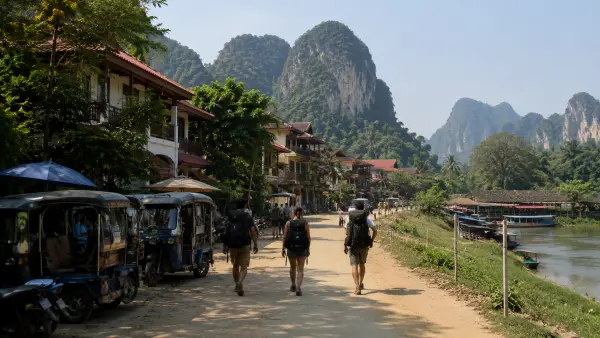
A court in Laos has charged a distillery owner in connection with the deaths of six foreign tourists who drank tainted alcohol in the town of Vang Vieng in November 2024. Denmark’s foreign ministry announced the charges on Friday, July 17, 2026, citing Lao authorities: selling food harmful to health, and operating an illegal business. Conviction would carry a prison sentence of between three months and four years, plus a fine.
The six who died were Australian teenagers Bianca Jones and Holly Morton-Bowles, both 19; Danish women Anne-Sofie Orkild Coyman, 20, and Freja Vennervald Sorensen, 21; British lawyer Simone White, 28; and, according to Lao media, US citizen James Louis Hutson, 57. At least six others were hospitalised. Several of the dead had been staying at the Nana Backpacker Hostel, where roughly 100 guests were reportedly given free shots of Laotian vodka before heading out for the night. The Danish statement said the case will formally remain open for 15 years and that a more serious charge, such as negligent homicide, could still be brought if the evidence supports it. It did not say whether the charges relate to all six deaths.
Who was in the room
The announcement was made at the Ministry of Public Security in Vientiane, at a press conference open only to local media and the embassies of the countries involved. The Associated Press requested entry and was not approved. AP reporters saw cars from at least two of the concerned embassies, Australia and Britain, leaving the location that afternoon. When the AP asked the Lao foreign ministry for comment by text message, the reply was that information would be made available at that closed press conference.
The practical result is that the story of what Laos said reached the world through Copenhagen. Denmark’s foreign ministry issued the statement that most outlets then reported, and it did so citing Lao authorities rather than quoting them at length. Laos is a one-party communist state that tightly controls information, and the shortage of direct Lao official comment has been a feature of this case since November 2024, when details of the poisoning were slow to emerge and the government’s first public acknowledgement was a short statement of condolence and a promise to bring those responsible to justice.
The view from the families and their governments
The reaction from the countries whose citizens died was uniformly negative, and it arrived before the charges were formally announced. Australian Foreign Minister Penny Wong said she was “deeply frustrated and bitterly disappointed” that authorities were not pursuing the most serious charges, and said the charges should reflect the gravity of the tragedy. Wong and Prime Minister Anthony Albanese dispatched an envoy, Pablo Kang, to Laos to convey the government’s objections, and Australia summoned the Lao ambassador in Canberra.
Denmark’s foreign minister, Lars Løkke Rasmussen, said he was deeply disappointed that the indictment did not reflect the seriousness and extent of the tragedy. He acknowledged that meeting the burden of proof for the most serious charges in such a case can be complicated, while adding that it remains difficult to come to terms with an indictment this lenient. He said his office would now work with relatives and the other affected countries on next steps.
The Australian families were blunter. Speaking at a Melbourne news conference on Friday morning, before the charges were confirmed, Bianca Jones’s mother Michelle said it was as though her daughter’s life did not matter, describing the family as appalled and the outcome as devastating for two teenagers who had gone abroad for what she called a rite of passage. Shaun Bowles, father of Holly Morton-Bowles, called the expected outcome mind-boggling given how many young travellers visit Laos, and said he expected potential visitors to reconsider going, citing what he described as the value placed on tourists’ lives and an attempt to cover the case up. That last characterisation is his, and Lao authorities have not responded to it publicly.
Danish parents have described a different frustration. Freja Vennervald Sorensen’s parents told Danish public broadcaster DR that they have been left in the dark since the tragedy, that no autopsy was performed on their daughter, and that her death certificate recorded cardiac arrest as a natural cause. They said their daughter had taken precautions throughout her travels and that they had never known methanol poisoning was a risk.
What came before
Friday’s charges are the second legal outcome in this case, and the first one shaped how the second was received. Ten people charged with destruction of evidence received suspended sentences and fines of about $185 each, with no plans for further action, according to what the UK government told the family of Simone White. Her brother, Zak White, told BBC Newsbeat the punishments were an absolute joke and said he doubted the family would ever get to the bottom of what happened.
The investigation’s earlier stages moved quickly and then went quiet. Police detained the Nana hostel’s 34-year-old manager and seven employees in November 2024, all Vietnamese nationals aged between 23 and 44, according to the state-affiliated Laotian Times. The hostel’s owner, Duong Van Huan, also Vietnamese, said publicly that he had never added methanol to drinks at the bar and that local police had checked the alcohol at the hostel and its suppliers. The manager denied responsibility. The hostel closed, took down its online presence, and stopped accepting bookings. We could not establish from available reporting whether the distillery owner charged on Friday is connected to any of those previously detained, and the person’s name and nationality were not disclosed in the material released.
The part that is not about tourists
Methanol poisoning is not primarily a tourist problem, and the international coverage of this case tends to obscure that. Methanol is a toxic alcohol sometimes added to drinks as a cheaper substitute for ethanol, and it is also a byproduct of poorly distilled home-brewed liquor, meaning it can reach a bar’s glasses through negligence rather than intent. The AP notes both routes remain possible here.
The burden falls hardest on local populations in countries where legal alcohol is expensive or restricted. Statistics of suspected cases compiled by Doctors Without Borders show Indonesia, India and Russia reporting the most incidents. Laos is one of Southeast Asia’s poorest countries, and Vang Vieng, roughly two hours north of Vientiane, has been a fixture of the backpacker trail for decades, once known for alcohol-fuelled river parties before rebranding toward eco-tourism. The six deaths that drew four Western governments into a two-year diplomatic effort are a small fraction of a global toll that generates almost no diplomatic pressure at all.
What to watch
The 15-year window is the concrete thing to track. Denmark’s statement says the case stays formally open for that period and that negligent homicide charges remain possible if proof becomes sufficient, which gives the affected governments a specific legal hook rather than only a rhetorical one. Rasmussen’s stated plan to coordinate with relatives and other affected countries suggests a joint approach may follow, and Australia’s summoning of the Lao ambassador and dispatch of an envoy indicate Canberra intends to keep pressing bilaterally.
Whether any of that changes the charge is a different question. Rasmussen himself acknowledged the burden-of-proof difficulty, and the evidentiary picture has not obviously improved with time: no autopsy in at least one case, ten convictions already secured for destroying evidence, and an investigation conducted largely outside the view of foreign media. The families’ more immediate lever may be the one Shaun Bowles named, which is Laos’s reputation among the young travellers its tourism economy depends on.
Next specific milestones: any trial date or verdict for the charged distillery owner; whether Pablo Kang’s mission to Vientiane produces any Lao response; whether Denmark convenes the affected countries into a joint position; any release by Lao authorities of the accused person’s identity or the evidentiary basis for the charges; and whether Australian or British travel advice for Laos changes.
Sources
- Associated Press (United States, international wire), reporting by Grant Peck and Charlotte Graham-McLay on the charges, the closed press conference, and family and government reaction
- Danish Ministry of Foreign Affairs (Denmark), statement issued in Copenhagen citing Lao authorities, as reported by AP and Australian Associated Press
- Australian Associated Press via The Border Mail (Australia), on Penny Wong’s statement and the envoy’s mission
- BBC Newsbeat via Yahoo (United Kingdom), on the earlier suspended sentences and Zak White’s reaction
- CNN (United States), on the November 2024 detentions and the Laotian Times reporting
- CBS News (United States), on the detained hostel staff and victims’ identities
- BBC News (United Kingdom), on the Danish and American victims and the Vang Vieng governor’s early pledge
- Associated Press via Business Standard (India), on the Lao government’s initial November 2024 acknowledgement
- Danmarks Radio (Denmark), via AP’s reporting, on the Vennervald Sorensen family’s account of the missing autopsy
This post was produced with AI assistance and human editorial review. Lao-language coverage of Friday’s announcement could not be located, and the Associated Press was refused entry to the press conference at which Lao authorities disclosed the charges; the account of what Laos said therefore rests on the Danish foreign ministry’s statement and on wire reporting from outside the room. The distillery owner’s name, nationality, and any connection to those detained in 2024 could not be confirmed from available sources.