
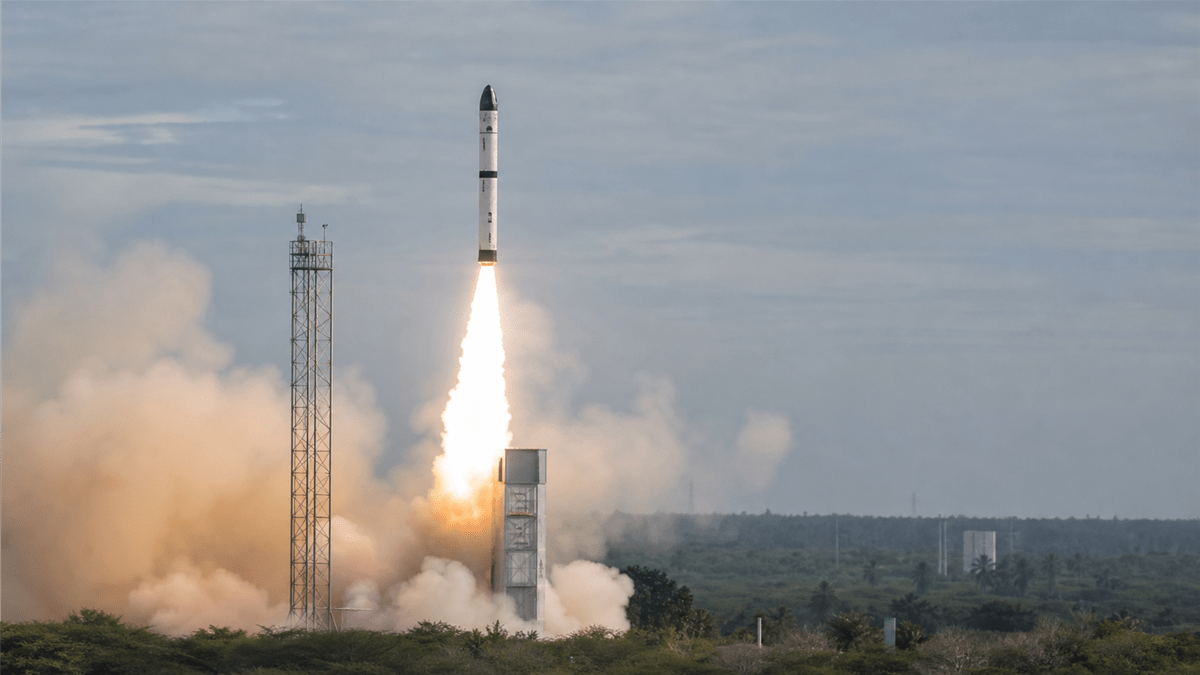
India’s first privately developed orbital rocket reached low Earth orbit on July 18, giving the country’s commercial space program a successful debut test at orbital scale. Skyroot Aerospace’s Vikram-1 lifted off from the Satish Dhawan Space Centre at Sriharikota and deployed payloads after completing its planned burns.
The flight was private in the sense that an Indian company designed, built and operated the launch vehicle. It was also the product of a public-private system: the mission used the national spaceport, and the Indian Space Research Organisation and regulator IN-SPACe provided technical and institutional support.
India celebrates a reform-era milestone
ISRO’s official account said Vikram-1 lifted off at 12:05:30 p.m. local time and placed the SCOPE and Grahaa payloads in low Earth orbit. The agency linked the mission to reforms announced in 2020 that opened more space activity to private industry.
Indian outlets largely treated the launch as proof that those reforms are producing hardware, not only startups and investment announcements. India Today emphasized that Skyroot designed, built and flew the vehicle, while also reporting continued ISRO and IN-SPACe support.
The distinction from Skyroot’s earlier Vikram-S flight is important. ThePrint noted that the 2022 mission was suborbital. Vikram-1 had to achieve the much greater speed and precision required to remain in orbit and deploy payloads.
Government coverage has presented the success as a national achievement shared by the company, ISRO and IN-SPACe. That framing reflects India’s model, in which private firms are expected to add capacity and commercial speed without replacing the state program or immediately duplicating its expensive infrastructure.
Outside India, the test is commercial
International attention has focused on India joining the small group of countries where a private company has placed a domestically developed rocket into orbit. Space.com described the flight as a successful maiden orbital mission and placed it alongside private launch capability in the United States and China.
That comparison can obscure differences in scale. Vikram-1 is designed for small satellites, with a stated capacity of about 350 kilograms to low Earth orbit. It does not compete directly with the largest commercial rockets, but it could offer dedicated launches to customers that do not want to wait for space on a larger vehicle.
A successful test flight establishes technical credibility, not a sustainable launch business. Skyroot must now demonstrate repeatability, manageable costs, reliable scheduling and a pipeline of paying satellite customers. Its access to Indian engineering talent and national facilities is an advantage, while the crowded small-launch market remains a challenge.
What to watch
The first milestone is Skyroot’s post-flight assessment. The company and regulators will examine propulsion, guidance, stage performance, telemetry and payload deployment data before approving another mission.
India Today reported that another Vikram-1 flight is expected after the debut mission, while the larger Vikram-2 is targeted for 2027. Firm launch dates, named commercial customers and evidence of faster production will show whether the program can move from a demonstration to a service.
Competition inside India also matters. Other private launch companies are developing different propulsion and vehicle designs, so the next concrete markers are Skyroot’s second orbital mission and the first orbital attempts by its domestic rivals.
Sources
- Indian Space Research Organisation, India: official launch time, payloads and mission outcome.
- India Today, India: mission significance and future vehicle plans.
- ThePrint, India: orbital achievement and comparison with Vikram-S.
- Space.com, United States: international launch account and vehicle specifications.
This article was researched and drafted with AI assistance and reviewed by a human editor. English-language Indian and international sources were checked directly; Hindi-language searches were also conducted.