
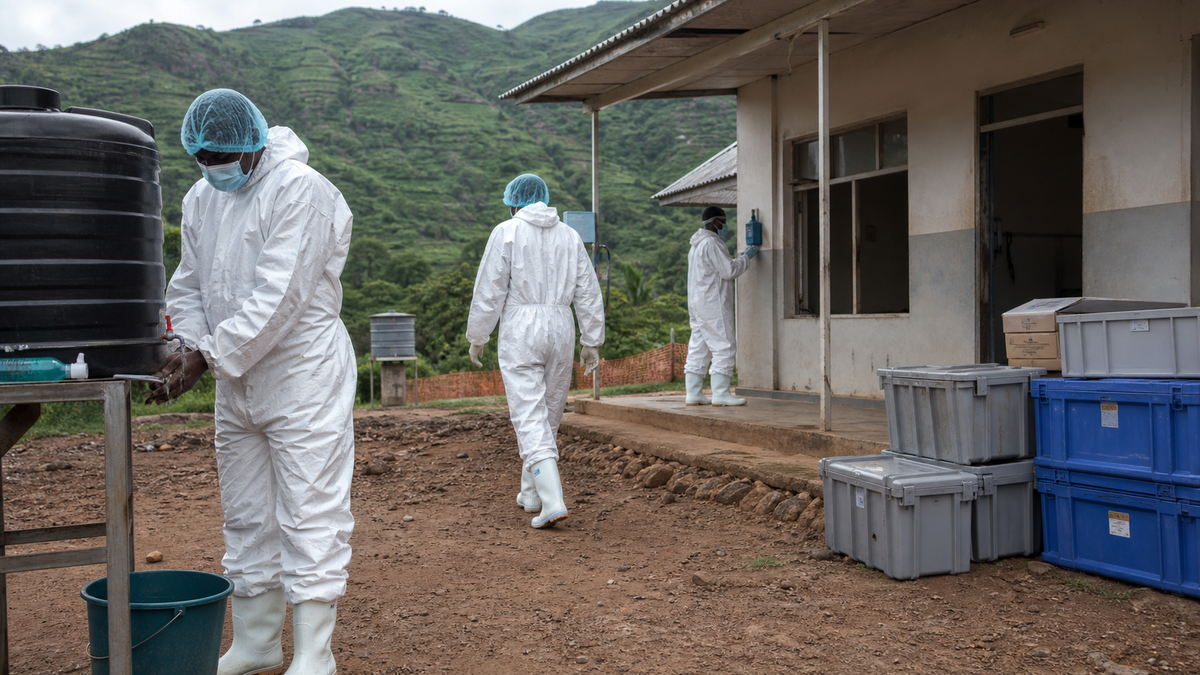
More than 1,500 people have died in the Democratic Republic of Congo’s fast-growing Ebola outbreak, according to the latest government count. As of July 28, authorities had recorded 3,442 cases and 1,521 deaths, a severe rise since the Bundibugyo-virus outbreak was declared on May 15.
The figures describe more than a biological emergency. Armed insecurity, unpaid health workers, population displacement and worsening hunger are weakening the systems needed to find cases, isolate patients and maintain public trust.
Kinshasa promises a stronger and lasting response
The Health Ministry maintains a national outbreak dashboard and the government has expanded testing beyond Kinshasa. During a July visit to Ituri, Prime Minister Judith Suminwa said the response should also leave the province with more durable health infrastructure.
Radio Okapi reported that officials want emergency investments to modernize the health system rather than disappear when the outbreak ends. Civil-society representatives in Ituri have also called for better coordination and action against misinformation.
Yet frontline labor disputes have exposed a gap between the national commitment and daily operations. Health workers in Bunia and at treatment facilities have protested over unpaid salaries or performance payments. In Nyakunde, international partners temporarily relocated after an attack on a hospital and treatment center following a patient’s death.
An epidemic layered onto conflict and hunger
The outbreak is concentrated in eastern provinces already affected by armed groups and repeated displacement. Treatment depends on safe access to communities, consistent protective supplies, functioning laboratories and public willingness to report symptoms. An attack on a clinic can interrupt several of those safeguards at once.
The World Food Programme has warned that the outbreak is worsening an existing food emergency. Movement restrictions, illness and fear can reduce trade and farming, while malnutrition makes the broader health burden more severe. Maternal health services are also under pressure, according to UNFPA reporting carried by Radio Okapi.
International health agencies continue to advise against blanket travel bans. Africa CDC guidance says broad restrictions can impede health workers and supplies while encouraging people to avoid formal crossings. The preferred response remains surveillance, contact tracing, infection prevention and rapid treatment.
What to watch
Africa CDC teams could return to areas where security has stabilized. Their redeployment, continued operation of decentralized laboratories and payment of frontline workers will show whether the response can keep pace with new infections.
The next Health Ministry update should clarify whether the sharp increase reflects continued transmission, improved detection, reporting delays or a combination of all three. The most concrete near-term milestones are restored operations at disrupted treatment centers and publication of the next national case count.
Sources
- Associated Press, United States/DR Congo, July 30 case and death update.
- DR Congo Health Ministry, outbreak surveillance dashboard, French.
- Radio Okapi, DR Congo, long-term health response, French.
- World Health Organization, international epidemiological background.
- Africa CDC, regional travel and public-gathering guidance.
This article was prepared with AI assistance and reviewed by a human editor. English- and French-language sources were checked.