
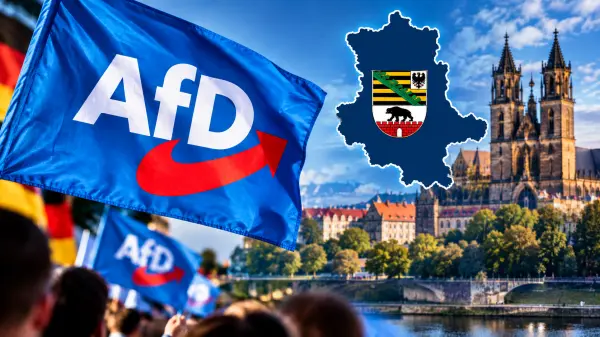
The far-right Alternative for Germany (AfD) won the September 6 state election in Saxony-Anhalt with 43.8 percent of the vote, the strongest result for a far-right party in a German regional election since the Second World War. The party took 39 of the state legislature’s 83 seats, three short of an outright majority, while Chancellor Friedrich Merz’s Christian Democrats (CDU) collapsed to 17.2 percent, roughly half their 2021 result, according to preliminary results reported by Al Jazeera.
Turnout reached almost 80 percent, a record for the state, and Austrian broadcaster ORF reported that around 170,000 people who stayed home in 2021 turned out this time for the AfD. The party’s path to governing is not settled. The Bündnis Sahra Wagenknecht (BSW) cleared the five percent threshold with roughly 5.3 percent and has said it will abstain rather than back either the AfD’s Ulrich Siegmund or the CDU’s Sven Schulze in a potential third round of voting for Minister-President, a move that could hand Siegmund the post on a technicality even without a governing majority.
The view at home
Merz called the result a “watershed,” according to Reuters, and told his party’s executive board it had shaken the CDU “to its very foundations,” while ruling out any cooperation with the AfD. He linked the outcome to Germany’s foreign posture, telling reporters that people “2,500 kilometres east of here” were “especially delighted” with the AfD’s win, a reference to the party’s pro-Russia positions on Ukraine sanctions and defense spending.
Behind that united front, the CDU is visibly split on strategy. Bavarian CSU leader Markus Söder argued the party should stop leaning on the “Brandmauer,” or firewall, as a talking point and instead contest the AfD’s policies directly, according to ORF’s coverage of the internal debate. North Rhine-Westphalia’s Hendrik Wüst called for a joint federal-state working group to examine the constitutional options for handling the AfD, a step that stops short of endorsing a party ban but keeps the possibility open. Former chancellor Angela Merkel, meanwhile, questioned whether the CDU should keep using the word “Brandmauer” at all, even as she stopped short of endorsing cooperation, per a report from regional outlet MS Aktuell. CDU lead candidate Sven Schulze conceded the loss outright, telling reporters it was “a defeat for us,” as Migazin recorded, without offering a strategy for what comes next.
Reaction from the governing coalition’s junior partner was muted by comparison. The SPD, which governs with Merz’s CDU at the federal level, edged up slightly to 9.3 percent in Saxony-Anhalt, still short of the ten percent mark it last cleared a decade ago.
The view from outside
US President Donald Trump praised the AfD’s win, a gesture that led Merz to cancel a planned phone call with him, according to German Wikipedia’s compiled election coverage. CNN’s Europe desk described the result as sending “a chill through the establishment” continent-wide, noting the European Union’s own informal firewall against the far right is under similar mathematical pressure as populist parties gain ground in France, Italy, Poland and Spain.
The European Council on Foreign Relations, a Berlin- and Brussels-based think tank, warned in its own analysis that a Germany distracted by domestic coalition drama cannot serve as the anchor Europe needs while France, Italy, Poland and Spain all enter their own election seasons. Reuters, in a separate analysis, framed the vote less as a German story than a preview: a warning to any government battling the same combination of stalled growth and disillusionment with mainstream parties.
What to watch
Two more state elections follow in short order. Berlin and Mecklenburg-Vorpommern both vote on September 20, and both will be read as a referendum on whether Saxony-Anhalt’s result reflects a specifically eastern German pattern or a broader national shift. Saxony-Anhalt’s own government formation is still unresolved: if no candidate secures a majority in a first or second ballot for Minister-President, a simple plurality wins on the third ballot, the scenario the BSW’s planned abstention would enable for the AfD’s Siegmund.
On the federal level, Wüst’s proposed working group on the constitutional handling of the AfD will test whether the CDU moves toward the slower, more contested route of seeking a party ban through Germany’s constitutional court, an option Söder has already voiced skepticism about. Merz’s own position bears watching too: his approval ratings have fallen to record lows for a sitting chancellor, and commentators from Der Tagesspiegel to Time have framed Saxony-Anhalt as either a last warning to salvage the “Brandmauer” or the beginning of the end of his chancellorship, well ahead of Germany’s next scheduled federal election in 2029.
Sources
- Al Jazeera (Qatar) — news report, English-language edition
- ORF (Austria) — news report, German-language public broadcaster
- France 24 (France) — news report, English-language edition
- MS Aktuell (Germany) — news report, German-language regional outlet
- Migazin (Germany) — news analysis, German-language outlet focused on migration and integration
- CNN (US) — news analysis
- European Council on Foreign Relations (Germany/pan-European) — think tank commentary
- Reuters, via SRN News (US/UK wire) — news analysis
- 2026 Saxony-Anhalt state election, Wikipedia — background compilation with primary-source citations