
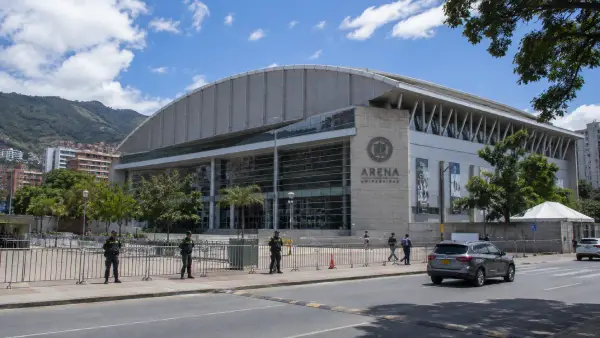
Colombia’s president-elect, Abelardo de la Espriella, will be inaugurated on Friday, August 7, 2026, in the city of Cali rather than Bogotá’s Plaza de Bolívar, breaking a tradition of holding the ceremony in the capital that has held for more than a century. The event will take place at the covered Arena USC on the campus of Universidad Santiago de Cali, after Colombia’s Congress approved a temporary relocation of its own session to authorize the move outside the capital.
De la Espriella defeated Iván Cepeda of the leftist Historic Pact coalition in a June 21 runoff, succeeding outgoing President Gustavo Petro. His original plan was to be sworn in at a military garrison in the department of Cauca, a proposal Petro, as sitting commander-in-chief, blocked by refusing to authorize the use of any military installation for the ceremony. De la Espriella’s team then shifted the venue to Cali, the capital of Valle del Cauca and a city with deep ties to the political left.
The View at Home
De la Espriella’s camp has framed the relocation as the start of a promised shift toward decentralizing power away from Bogotá, and city officials in Cali have leaned into the symbolism: Mayor Alejandro Eder said on social media that the city is “ready to receive the presidential inauguration” and to provide “all the security guarantees this historic moment demands.” Cali’s economic development secretariat has estimated the ceremony will draw roughly 6,000 national and international visitors.
The opposition reads the same move very differently. The Historic Pact’s 61 members of Congress, led by Cepeda and Representative Alfredo Mondragón, announced they will not attend, calling the incoming government’s legitimacy “seriously questioned” and warning the ceremony risks becoming, in Mondragón’s words, a “demonstration of military power.” Senator Carolina Corcho called her absence “an act of protest,” and the coalition has organized parallel demonstrations it is calling “spaces of peaceful resistance” in Cali, Bogotá, and Barranquilla, including a planned gathering in Cali’s Puerto Resistencia neighborhood, a district associated with the 2021 national protests.
A parallel and more serious dispute has resurfaced in just the past two days over de la Espriella’s eligibility itself. Cepeda revived long-standing objections to de la Espriella’s dual Colombian-American citizenship in a video published Monday, August 3, arguing that a naturalization oath to the United States creates a conflict of loyalty incompatible with the constitutional duty to defend Colombian sovereignty exclusively, and that de la Espriella should renounce his US citizenship before taking office. Colombian courts have rejected this argument each time it has been raised: the National Electoral Council ruled in June that holding foreign citizenship does not by itself create an inability to hold public office, and Bogotá’s Superior Tribunal separately declined in July to block his candidacy on the same grounds, ruling the matter would have to be pursued through a different legal channel after the vote. A group of former Constitutional Court and Council of State justices had earlier published a joint statement arguing that the constitutional duty of loyalty applies to how a president governs once in office, not to eligibility for the office itself. The legal question, in short, has already been settled against Cepeda’s position multiple times; his revival of it this week is a political statement more than a live legal threat.
The tension has also taken a sharper edge from the outgoing president. On Sunday, Petro warned Cali residents to avoid violence at Friday’s demonstrations, writing that unnamed actors were seeking to “confront the people with violence.” Two days later, on Monday, Petro went further, alleging without providing public evidence that he was aware of a “criminal plan” involving “tons of explosives in Cali” tied to a possible effort to declare a state of internal emergency after the handover of power. Colombian authorities have not confirmed this claim publicly, and it should be read as an assertion by the outgoing president rather than a verified security finding. De la Espriella’s team has not responded to it directly in reporting reviewed for this piece.
The guest list itself became a fresh controversy this week. De la Espriella’s team excluded former presidents Ernesto Samper and Juan Manuel Santos from the invitation list, while including Álvaro Uribe, Andrés Pastrana, César Gaviria, and Iván Duque. Samper responded on social media with pointed sarcasm, thanking the president-elect for a “gift” that arrived, he noted, on his own birthday, since it would save him the cost of a new suit. Members of Santos’s family criticized the snub more directly, with his son Esteban Santos writing that a president “represents all Colombians, including those who think differently.”
The View from Outside
International attention has centered less on the domestic legitimacy fight than on who is expected to attend. US Secretary of State Marco Rubio is expected to lead the American delegation, alongside Argentina’s Javier Milei and Ecuador’s Daniel Noboa, a guest list that regional outlets have read as a marker of the ideological alignment the incoming government is seeking with Washington and the Latin American right. De la Espriella has separately announced plans to close Colombian embassies in three European countries as part of a broader diplomatic realignment, a decision Euronews covered as consistent with a pivot away from the multilateral, left-leaning foreign policy Petro pursued.
What to Watch
Friday’s ceremony is now shaped by two separate security questions rather than one. The first is the scale and tone of the Historic Pact’s demonstrations, given Cali’s history as a center of the 2021 national protest movement and the “peaceful resistance” framing organizers have chosen deliberately to avoid direct confrontation. The second, and more serious if substantiated, is whatever specific threat Petro was referring to in his explosives claim; whether Colombian security services confirm, deny, or clarify that warning before Friday is a concrete near-term marker.
Beyond the ceremony itself, de la Espriella is scheduled to chair his first security council meeting as president the following morning, Saturday, August 8, at the Army’s Third Brigade facilities, also in Cali, a detail that keeps the military symbolism Petro blocked for the inauguration itself present at the edges of the transition. The dual-citizenship dispute is very unlikely to produce a fresh legal challenge given how consistently Colombian courts have already ruled on it, but Cepeda’s decision to revive it this week signals the opposition intends to keep contesting the government’s legitimacy rhetorically well past the handover.
Next specific milestones: the scale and outcome of Friday’s demonstrations in Cali, Bogotá, and Barranquilla; any official statement from Colombian security authorities on Petro’s explosives claim; whether de la Espriella responds directly to the Samper and Santos exclusion; and the substance of Saturday’s first security council meeting under the new government.
Sources
- Wikipedia, “Inauguration of Abelardo de la Espriella” (reference compilation), on the ceremony’s timeline and venue history
- The Bogotá Post (Colombia, English-language), on the Historic Pact’s planned boycott and Cali’s electoral history
- Euronews (Europe), on the venue change and planned embassy closures
- The City Paper Bogotá (Colombia, English-language), on the expected international delegation
- ColombiaOne (Colombia, English-language), on the Samper and Santos exclusion and family reactions
- Semana (Colombia, Spanish-language), on the Historic Pact’s formal boycott announcement
- Infobae Colombia (Colombia, Spanish-language), on Petro’s explosives allegation
- Infobae Colombia (Colombia, Spanish-language), on Petro’s call for calm and the planned demonstrations
- Pulzo (Colombia, Spanish-language), on Cepeda’s renewed dual-citizenship objection
- Infobae Colombia (Colombia, Spanish-language), on the constitutional lawyers’ joint statement
- El Tiempo (Colombia, Spanish-language), on the Bogotá tribunal’s rejection of the eligibility challenge
- Valora Analitik (Colombia, Spanish-language), on the security operation and the Puerto Resistencia demonstration