
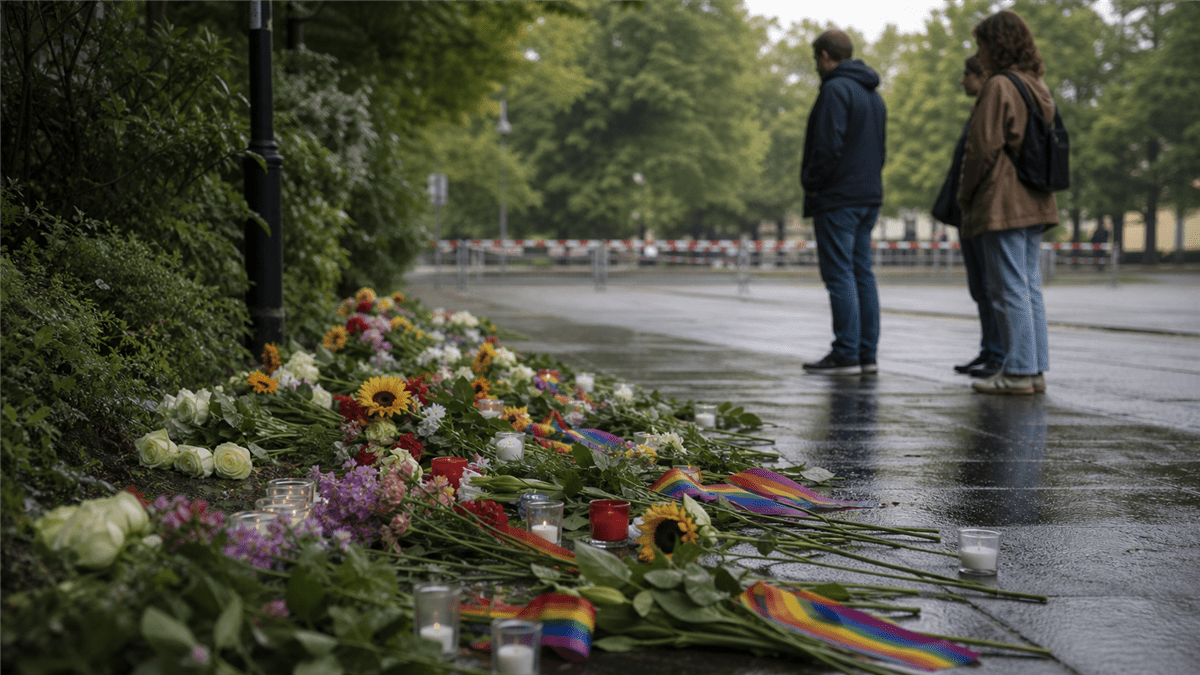
A vehicle-and-knife attack near Berlin’s Christopher Street Day celebrations killed one woman and injured 29 other people on Saturday night, turning one of Europe’s largest Pride events into a scene of mourning and an urgent security investigation. German authorities identified a 21-year-old Berlin-born man as the principal suspect and said he was known from earlier Islamist-related proceedings.
The suspect, identified under German privacy conventions as Abdul B., was shot and killed by police in Berlin-Spandau on Sunday evening. Authorities said he threatened officers with a knife during the operation. Investigators are still establishing the precise sequence of the attack, its motive and whether anyone else took part.
Germany debates security, accountability and restraint
Police said a white vehicle struck people around 10 p.m. on a path in the Tiergarten as Pride celebrations continued nearby. The official Berlin police appeal said one or more people then left the vehicle and that several victims suffered stab wounds. Authorities ended the remaining Christopher Street Day program while emergency teams treated the injured and police began a citywide search.
Later German reports put the toll at one dead and 29 injured, some seriously. Tagesschau’s updated account focused closely on the suspect’s history because a Berlin court had dealt with him only months earlier.
A joint prosecution and police statement said a youth court convicted Abdul B. on May 12 of preparing a serious act of violence endangering the state and twice violating a ban under Germany’s Associations Act. The court imposed a youth sentence of one year and ten months but deferred the decision on suspending that sentence, placed him under probation supervision and did not keep him in custody.
The statement said the court considered the time he had already spent detained in Germany and Lebanon, his admissions during trial and his claimed rejection of the Islamic State group. Prosecutors appealed, seeking a higher sentence that could not be suspended and continuation of the arrest warrant. The same statement said authorities had found that he posted prohibited Islamic State propaganda in 2024, while a separate July 2026 weapons investigation ended after a search found only a toy gun.
Those details have intensified questions about risk assessment and supervision. They do not by themselves establish the exact motive for Saturday’s attack, which remains a matter for investigators. Interior Minister Alexander Dobrindt described the event as a terrorist attack, but the authorities must still reconstruct planning, communications and any possible assistance.
Queer safety and the risk of wider blame
Germany’s largest LGBTQ rights organization, LSVD+, said the attack struck at the heart of the queer community and called for political measures to improve safety. Its July 26 statement argued that public events and everyday queer life both require stronger protection.
Chancellor Friedrich Merz urged Pride participants not to be intimidated, while President Frank-Walter Steinmeier called the violence an attack on Germany’s open society. Berlin Mayor Kai Wegner used similar language about freedom and cosmopolitan life. Across the political spectrum, however, the discussion quickly divided over policing, court decisions, migration and Islamist extremism.
The suspect was a German citizen born and raised in Berlin, with Lebanese family roots. The Berliner Zeitung’s survey of reactions showed both calls for solidarity and attempts to connect the case to broader migration policy. Pride organizers urged the public not to instrumentalize the attack or place entire communities under suspicion.
That concern also appears in international reporting. The Associated Press spoke with Ali Darwich, a gay Muslim Berlin police officer who feared both for queer people and for Muslims who could face increased racism. His perspective captures an overlap sometimes lost when public debate divides victims, religious minorities and security institutions into separate camps.
Outside Germany, coverage has largely emphasized Berlin’s identity as a center of LGBTQ life and the wider challenge of protecting open public celebrations. The international question is not only whether barriers and police deployments change at future Pride events. It is also whether governments can strengthen protection without turning solidarity with one targeted community into generalized suspicion of another.
What to watch
The immediate milestones are the final medical status of the injured and a formal investigative account of how the vehicle attack and stabbings unfolded. Police initially allowed for more than one person leaving the vehicle, so confirmation of whether authorities are seeking any additional suspect will be important.
Independent review of the police shooting in Spandau is another necessary step. Investigators will need to document the encounter, the reported knife threat and the officers’ use of lethal force, even though the dead man was the principal suspect in the Pride attack.
Berlin and other German cities are also likely to review security for upcoming LGBTQ events. The next concrete checkpoints are any joint federal-Berlin investigative briefing, the release of an updated casualty report, and announcements by police or event organizers about protective measures for the next scheduled Christopher Street Day gatherings.
Sources
- Berlin Police, Germany: official account of the attack and initial suspect search, German.
- Berlin General Prosecutor and Police, Germany: official account of the suspect’s earlier proceedings, German.
- Tagesschau, Germany: casualty update and domestic security scrutiny, German.
- LSVD+, Germany: LGBTQ community response and security demands, German.
- Associated Press, United States: suspect’s death, casualty count and international context.
This article was prepared with AI assistance and human editorial review. German- and English-language sources were checked.