
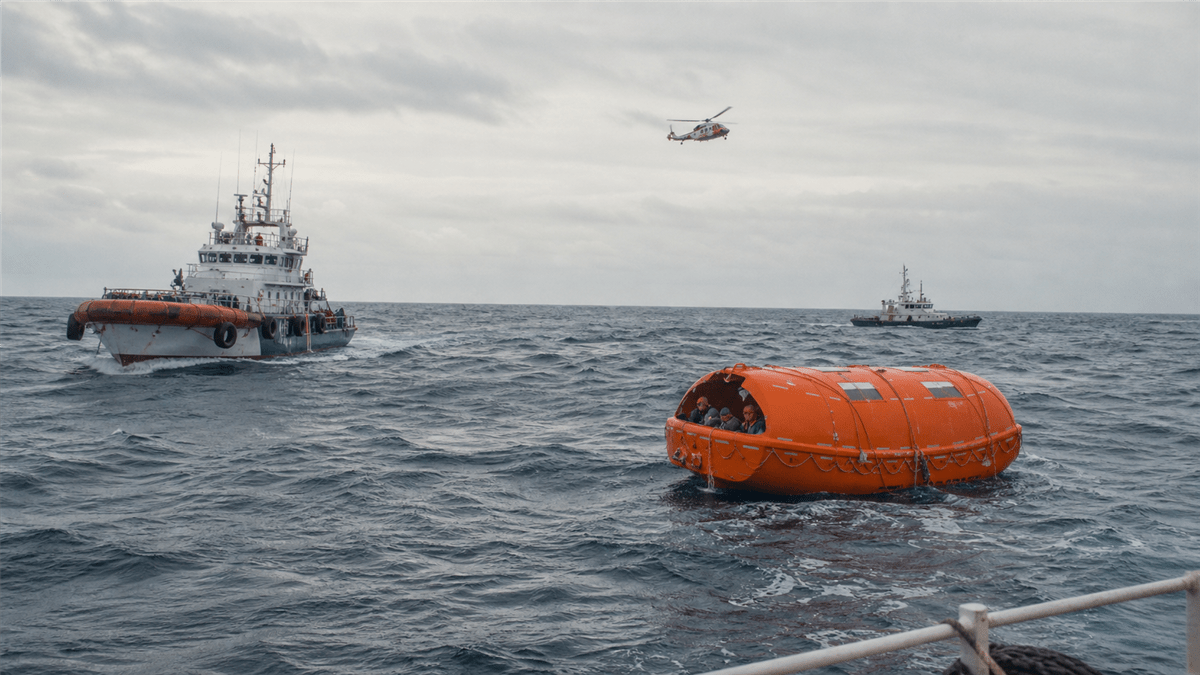
Vietnamese, Chinese and Philippine rescuers were searching the South China Sea after a Vietnamese cargo vessel carrying 62 people sank in bad weather near a disputed reef. Vietnamese authorities said 45 people had been rescued by midday Sunday, July 26, while 17 remained missing.
The Khoi Nguyen 18 went down on Saturday evening near the reef commonly known in English as Fiery Cross Reef. China controls the feature and calls it Yongshu Reef, while Vietnam also claims it and calls it Da Chu Thap. The competing names matter politically, but the immediate operation has required authorities that regularly dispute the surrounding waters to coordinate around a shared duty to save lives.
Vietnam puts the missing crew first
Vietnam’s official account has focused on the people aboard and the rescue effort. Foreign Ministry spokesperson Pham Thu Hang said the ship sank while operating in severe weather in what Vietnam calls the East Sea. A statement carried by the government news portal said Vietnamese agencies responded urgently, nearby fishing vessels joined the search, and the families of those aboard were being kept informed.
The ministry also thanked Chinese authorities for their rapid assistance and asked them to continue working closely with Vietnam. Voice of Vietnam reported the updated total of 45 survivors, which superseded early reports that only 39 people had been found.
The sequence of figures reflects a rescue still in motion. Chinese state news agency Xinhua initially reported that six Chinese vessels, a rescue helicopter and one Vietnamese vessel were operating at the scene after a Chinese salvage ship spotted a life raft. Later Vietnamese updates raised the rescued count from 39 to 45.
Vietnamese coverage has not turned the incident into a sovereignty confrontation. The emphasis has remained on finding the missing people and bringing survivors safely ashore. That restraint is notable because the wreck occurred in the Spratly Islands, where overlapping claims and frequent confrontations shape how almost every government describes a location.
Different maps, one rescue obligation
Chinese coverage presents the operation as evidence of China’s ability to provide maritime rescue services in the region. The state-affiliated Global Times highlighted the Chinese vessels and helicopter involved, using China’s names for the reef and island group. That framing links a humanitarian response to Beijing’s broader assertion that it administers the waters.
The Philippines entered from a different legal and geographic perspective. The Associated Press reported that the Philippine Coast Guard deployed a patrol vessel and an aircraft after Vietnam requested help. Coast Guard spokesperson Noemie Cayabyab said Manila was coordinating with its Vietnamese counterpart, using a search-planning system and warning other ships to watch for survivors.
According to that account, the Philippine Coast Guard described its role as consistent with international maritime agreements and bilateral cooperation with Vietnam. Manila also claims parts of the Spratly Islands and calls the wider area the West Philippine Sea when referring to waters within its claimed jurisdiction. Its participation therefore does not imply acceptance of either China’s or Vietnam’s territorial position.
The operation offers a narrow example of practical cooperation, not a settlement of the underlying dispute. China, Vietnam and the Philippines continue to disagree about sovereignty and maritime rights across the South China Sea. Search and rescue can proceed without resolving those disagreements because the basic priority is preserving life at sea.
What to watch
The first milestone is the next official Vietnamese count of survivors and missing people. Search conditions, the time people have spent in the water or in life rafts, and the area covered by participating ships and aircraft will determine whether the operation remains a rescue or shifts toward recovery.
Authorities also need to identify why the vessel sank. Vietnam has attributed the loss to bad weather, but a formal maritime inquiry could examine the ship’s condition, loading, emergency equipment, communications and decisions made before distress signals were detected. Any casualty list or investigation findings should come from Vietnamese authorities rather than the competing political narratives around the reef.
A final operational question is how the countries handle the survivors, evidence and eventual investigation across disputed waters. The next concrete checkpoints are Vietnam’s next Foreign Ministry or maritime-authority update, the conclusion of the active search, and any announced inquiry into the sinking of the Khoi Nguyen 18.
Sources
- Government News, Vietnam: Foreign Ministry rescue update, Vietnamese.
- Voice of Vietnam, Vietnam: updated survivor count and official response.
- Xinhua, China: initial rescue deployment and survivor count, Chinese.
- Global Times, China: Chinese institutional framing of the operation.
- Associated Press, United States: multinational search details and Philippine Coast Guard account.
This article was prepared with AI assistance and human editorial review. Vietnamese-, Chinese- and English-language sources were checked.