
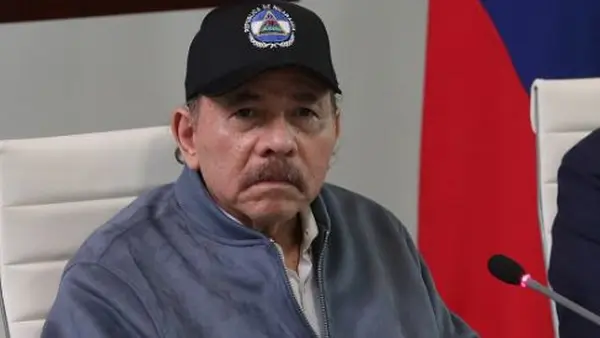
Nicaragua’s President Daniel Ortega has told the country there will be no more elections, closing off the last formal path for the opposition to challenge his government. Speaking on Sunday at an event marking the 47th anniversary of the 1979 Sandinista revolution, Ortega said the ban was meant to stop the opposition, which he described as controlled by the United States, from ever returning to power. “There will be no more elections here for them,” he said, according to Reuters.
Ortega gave no details on how the ban would be formally implemented, but said his government would work with the National Assembly, which the Sandinista party controls, to pass laws against the opposition. He is 80 and has governed Nicaragua since 2007, after an earlier term from 1979 to 1990. Since February 2025 he has shared power with his wife, Rosario Murillo, who was elevated from vice president to co-president under a constitutional reform that also extended the presidential term from five to six years and pushed the next general election from November 2026 to 2027, according to MercoPress.
The 2021 election that returned Ortega to a fourth term was already widely disputed. Authorities detained seven opposition presidential candidates before the vote, and Ortega was declared the winner with a reported 75 percent, a result Western governments and observers declined to recognize as legitimate, according to contemporaneous reporting on the vote.
A speech aimed outward, and a country that mostly cannot answer back
Ortega framed the ban as a defensive move rather than a power grab. He told supporters that parties aligned with Washington would never again reach government and accused exiled opponents of plotting to seize power through the ballot box, according to AFP’s Spanish-language wire report. He also addressed the United States’ January capture of Venezuelan leader Nicolás Maduro, a close ally, describing the raid on Maduro’s residence as monstrous and saying it killed Maduro’s mostly Cuban guards before flying him to detention in New York.
Domestic dissent is dangerous enough in Nicaragua that little of it surfaces publicly inside the country; most of the pushback is coming from exile. Opposition leader Juan Sebastián Chamorro, one of hundreds of political prisoners exiled from Nicaragua in recent years, said the speech was not really news. He was among 222 people stripped of their nationality and expelled to the United States in a single 2023 expulsion, and said, “Ortega has taken off one more mask,” arguing the government has governed without democratic legitimacy for years and has simply stopped pretending otherwise, according to Infobae.
The same Spanish-language reporting noted a detail largely absent from English-language coverage: Ortega had not appeared in public for two months before Sunday, and had previously been seen struggling to walk. Opposition figures have alleged, without independent confirmation, that Murillo is carrying out an internal purge across state institutions in anticipation of a possible succession, a claim Nicaragua’s government has not addressed.
Washington’s attention, and an isolated Managua
The announcement drew swift criticism from the United Nations, the Organization of American States, the US State Department and the European Parliament, all of which have called for a return to democratic processes in Nicaragua. The State Department already describes the Ortega government as a dictatorship and has sanctioned more than 2,000 Nicaraguan officials and relatives, according to Fox News. Human Rights Watch has documented at least 87 political prisoners still held in the country, according to reporting on the OAS’s June demand for their release.
Ortega’s reference to Maduro’s capture was not incidental. Nicaragua had spent years in an informal bloc with Venezuela and Cuba, and Maduro’s removal by a US military operation in January left Managua more isolated, with fewer regional allies able to shield it diplomatically. Trump administration officials have separately signaled that Cuba and Nicaragua could face similar pressure, a point Ortega’s own remarks on Sunday suggested he takes seriously.
What to watch
Ortega did not specify what legal mechanism would formalize the end of elections, whether a further constitutional amendment, an ordinary law passed by the Sandinista-controlled National Assembly, or simply an indefinite postponement of the vote already pushed to 2027. Whichever route the government takes will show how much further it intends to depart from even the managed elections it has held since 2007.
The exiled opposition has framed the declaration as confirmation rather than a turning point, which suggests its next moves will focus on international pressure rather than any renewed push to compete domestically. Whether the US responds with new sanctions, given its stated focus on Cuba and Nicaragua after Maduro’s removal, is a separate and more consequential question than anything likely to happen inside the country in the short term.
Specific things to watch: whether the National Assembly introduces legislation formalizing the ban in the coming weeks; any new US Treasury or State Department sanctions targeting Ortega, Murillo or their inner circle; further reporting on Ortega’s health and public appearances; and statements from the OAS or UN following up on their initial condemnations.
This post was produced with AI assistance and human editorial review. Spanish-language reporting from Latin American outlets was reviewed alongside English-language coverage, and surfaced domestic opposition reaction and health-related speculation not present in most English-language wire accounts.