
Published July 21, 2026
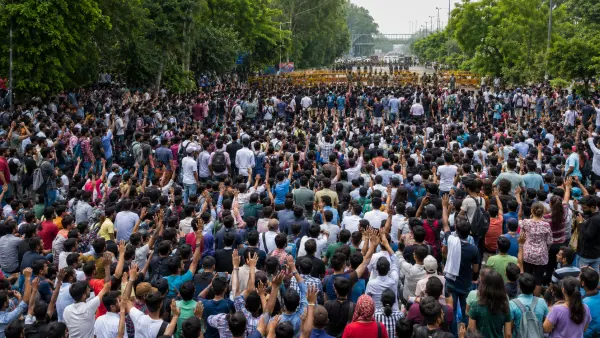
Indian police fired tear gas and swung batons at more than 10,000 protesters marching toward Parliament in New Delhi on Monday, July 20, 2026, in what organizers and observers called the largest confrontation yet in a youth-led movement that has become the most visible public challenge to Prime Minister Narendra Modi’s third term. The demonstrators, who call themselves the Cockroach Janta Party, had gathered overnight at Jantar Mantar, one of the few places in the capital where protest is permitted, and tried to march on Parliament as its monsoon session opened. Authorities had denied permission for the march.
The movement’s core demand is the resignation of Education Minister Dharmendra Pradhan over repeated leaks of examination papers, above all the NEET-UG medical entrance exam that millions of students sit each year. It also wants an overhaul of the exam system and compensation for families of students who died by suicide after leaks upended their results. The march swelled beyond expectations after police forcibly moved a hunger-striking activist, Sonam Wangchuk, to a government hospital on Saturday, an act his supporters call an illegal detention.
The view at home
Indian coverage put the exam system at the center, because for young Indians it is the mechanism that rations a shrinking supply of stable futures. NEET-UG and other national entrance tests are the gateways to medical schools, universities and government jobs, and a leak does not just taint one exam; it invalidates years of preparation for students who often have no second path. The trigger this time was alleged irregularities and paper leaks in the 2026 NEET-UG cycle, echoing the 2024 leaks that first drew mass student protest. Hindi-language outlets traced the anger to towns far beyond Delhi, including a sit-in at Gandhi Chowk in Latur, Maharashtra, where students and residents demanded Pradhan accept moral responsibility and resign, and condemned the police action at Jantar Mantar.
The movement’s identity is unusual, and the domestic press has treated it as a story in itself. The Cockroach Janta Party takes its name as a deliberate mockery of the ruling Bharatiya Janata Party, casting its members as the pest that cannot be stamped out. Its founder, Abhijeet Dipke, has run the campaign as much through meme as through manifesto. On Pradhan’s birthday in June, Dipke posted a video of a whiteboard reading “Happy Birthday Dharmendra Pradhan, please resign,” and said he was sending the minister a pre-written resignation letter that needed only a signature or a thumbprint. He later set a montage of Pradhan’s photographs to the lyrics of Taylor Swift’s “Anti-Hero.” Dipke has himself been on an indefinite hunger strike, and the party built the Monday march around an overnight vigil at Jantar Mantar.
The government has taken a hard line. Pradhan has refused to resign and, in an interview with the news channel NDTV, described the protesters as “a B-team of terrorists” trying to divide the country, a characterization Dipke rejected. Other ministers have acknowledged students’ concerns while insisting there is no need for negotiation. On the ground in Delhi, authorities cut mobile internet near the protest site, closed the entrances to five central metro stations including Rajiv Chowk and Central Secretariat, erected barricades, and deployed the Rapid Action Force. NPR reported that riot police charged the crowd with batons and shields, that protesters said dozens were struck on the head, and that Delhi police denied using violence even as reporters witnessed tear gas and baton strikes. Local media reported police later dismantled the movement’s stage and tents and cleared the site.
The Wangchuk flashpoint
Sonam Wangchuk, a 59-year-old engineer and education reformer from Ladakh, is the movement’s most recognizable figure, and his treatment has become a second front. He joined the protest weeks ago and began a hunger strike in solidarity; his party says he lost more than 18 pounds over 18 days before police moved him to Safdarjung Hospital on Saturday. His wife, Gitanjali Angmo, has called the heavy police presence at the hospital not medical care but illegal detention, and sought to transfer him to a private hospital of the family’s choosing. The government opposed the request, saying it had to be cautious about his health and had granted family round-the-clock access.
A Delhi court sided with the authorities on the narrow legal question. Judge Mini Pushkarna said doctors had administered only oral fluids and supplements with Wangchuk’s consent and that his bodily autonomy was not being violated. On Monday, Wangchuk asked in a handwritten note to be allowed to leave the hospital and join the march, even briefly, and said he would end his hunger strike only if the government took responsibility for the exam failures, or if protesters were allowed to reach Parliament and lawmakers pledged to raise the issues in both houses. Later that day, the movement said the health minister had promised the government would weigh its demands, its first reported outreach, though no substantive talks were confirmed.
The view from outside
International coverage placed the Cockroach movement inside a now-familiar global template: digitally organized, leaderless-seeming youth movements that erupt outside established parties and catch governments off guard. The comparison points that outside outlets reach for are the Gen Z-branded uprisings elsewhere in South Asia and beyond, from Nepal to Bangladesh, where online mobilization translated into street power with startling speed. The Cockroach Janta Party fits the mold: it claimed roughly 22 million Instagram followers within days of forming in May, then broadened from an online phenomenon into a street movement drawing support from opposition parties, rights activists and some Bollywood figures.
That framing captures something real but can flatten the specifics. The movement’s grievance is not a diffuse generational mood; it is a concrete institutional failure, the leaking of exams that allocate scarce university places and government jobs, layered over documented youth unemployment and rising living costs. Al Jazeera and others noted the pointed irony of the party’s name, chosen to mock the ruling BJP, and framed the crackdown within a wider argument that space for dissent has narrowed under Modi’s government, which critics accuse of jailing activists and suppressing protest. Supporters of the government counter that exam security has been tightened since 2024 and that Modi, at the time of the earlier leaks, publicly vowed the harshest punishment for those who gambled with young people’s futures. Both claims are part of the contest now playing out.
What to watch
The immediate question is whether Monday’s limited outreach, the health minister’s offer to weigh the movement’s demands, develops into real negotiation or functions as a pressure valve. The movement’s central demand, Pradhan’s resignation, remains flatly refused, and a government that has called the protesters a B-team of terrorists has not signaled it will concede the education ministry. Whether the monsoon session of Parliament, now open, becomes a venue where opposition parties force the exam-leak issue into formal debate is the institutional test Wangchuk himself named as a condition for ending his fast.
Wangchuk’s health and legal status are the most volatile variable. A deterioration, or a decision on his family’s transfer request, could re-galvanize the movement as his hospitalization already has. Beyond that, watch for arrests or charges against organizers following Monday’s clashes, whether the demonstrations spread further into cities beyond Delhi as the Latur sit-in suggests they might, and whether the government’s exam-security assurances are tested by any fresh leak during the 2026 admissions cycle.
Next specific milestones: any formal government response to the resignation demand; the outcome of the family’s request to move Wangchuk and updates on his condition; any arrests or charges arising from the July 20 march; whether the exam-leak issue is raised on the floor during the monsoon session; and whether protests continue or grow in other Indian cities.
Sources
- Associated Press via The Hill (United States, international wire), on the tear gas, the government’s first outreach, and protester accounts
- NPR (United States), on the internet shutdown, the baton charges, and Pradhan’s “B-team of terrorists” remark and Taylor Swift montage
- Al Jazeera (Qatar), on the scale of the march and the movement’s mockery of the ruling party
- NBC News (United States), on the movement’s demands and the government’s hard line
- Reuters via ThePrint (United Kingdom / India), on the march ban, the Instagram following, and Wangchuk’s “second freedom movement” message
- Reuters via US News (international wire), on the health minister’s promise to weigh the movement’s demands
- Panchjanya (India, Hindi-language, RSS-affiliated), on the overnight vigil, the NEET-UG 2026 trigger, and Dipke’s own hunger strike
- Palpal India (India, Hindi-language), on the metro closures and Rapid Action Force deployment
- Pratahkal (India, Hindi-language), on the solidarity protest in Latur, Maharashtra
- Prime TV India (India, Hindi-language), on Dipke’s “resignation gift” birthday stunt aimed at Pradhan
This post was produced with AI assistance and human editorial review. Hindi-language Indian coverage was reviewed alongside English-language wire and broadcast reports; the Hindi sourcing surfaced the NEET-UG 2026 trigger, the spread of protests beyond Delhi, and the movement’s meme tactics in more detail than the English wires. Casualty and injury counts from Monday’s clashes are contested between protesters and Delhi police and could not be independently verified.