
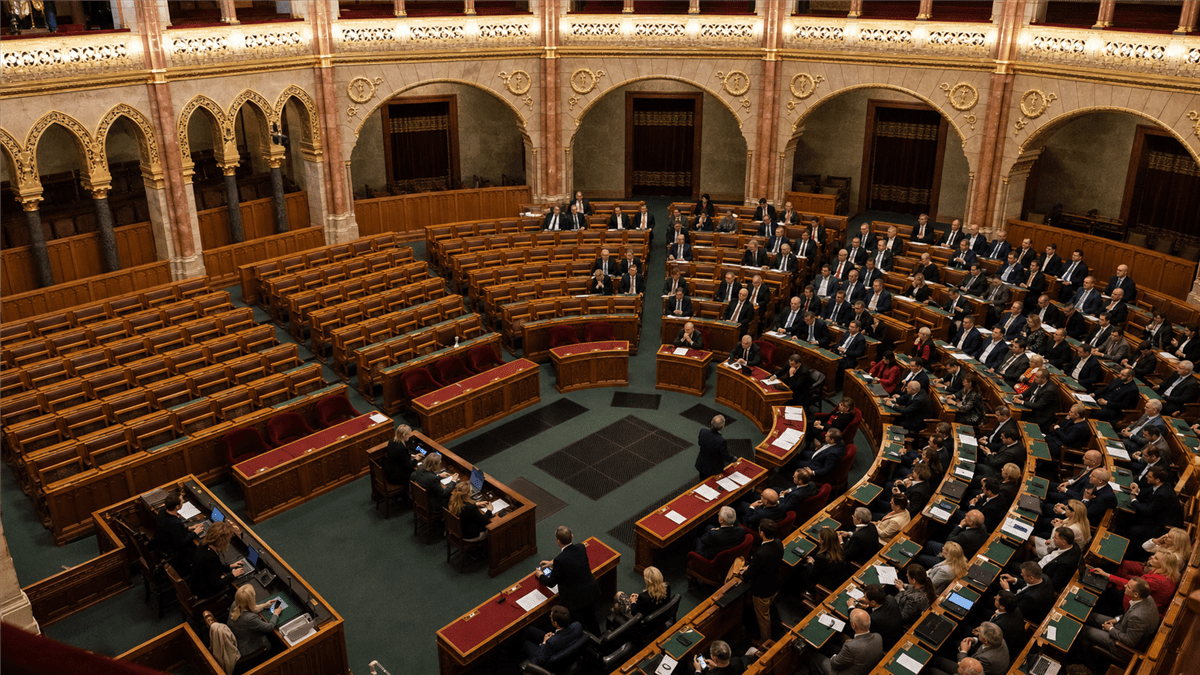
Hungary’s Parliament approved a constitutional amendment on July 13 that would end President Tamás Sulyok’s term and reshape several institutions inherited from Viktor Orbán’s 16 years in power. The measure passed by 139 votes to six in the 199-seat legislature, where Prime Minister Péter Magyar’s Tisza party holds the two-thirds majority needed to amend the constitution.
The amendment says the sitting president’s mandate ends the day after the law takes effect. Sulyok, who was elected by Parliament in 2024 during Orbán’s government, has five days after receiving the text to act. The dispute is therefore not only about who occupies a largely ceremonial office, but also about whether a new democratic mandate can justify constitutional language written to remove one named officeholder.
Hungary debates repair and precedent
Magyar presented the amendment as part of a transition away from the legal and institutional system built under Orbán. After the vote, he said the government had begun transforming that system and argued that Tisza’s landslide election victory supplied a clear public mandate. The package also creates a national asset-recovery office, limits lawmakers to 12 years in Parliament and changes rules governing the Constitutional Court.
Hungarian outlet 24.hu detailed the institutional changes. Constitutional Court judges would face a new age limit of 70, the terms of future judges would fall from 12 years to nine, and the court would regain authority over budget and tax matters that was restricted after 2010. Four sitting judges aged over 70, including court president and former chief prosecutor Péter Polt, are expected to leave on September 1.
Sulyok and Fidesz say the method undermines the rule of law it claims to restore. Sulyok has argued that a clause aimed at the “current president” is legislation tailored to one person and lacks a public-law basis. Fidesz lawmakers boycotted the vote after calling the measure an unprecedented attack on Hungary’s democratic order; Orbán marked the day with a social-media post suggesting democratic Hungary had ended.
The president’s options are unusually personal. Hungary’s head of state normally signs legislation and can refer legal questions to the Constitutional Court. According to 24.hu’s legal account, review of a constitutional amendment is limited to procedural validity rather than its substance. Magyar has said Parliament will begin a removal procedure if Sulyok does not sign, a step that would suspend the president’s powers while the case proceeds.
Europe sees a test of democratic restoration
International reporting has largely framed the vote as the first major dismantling of Orbán’s system by the government that defeated him. The Associated Press emphasized Tisza’s electoral mandate and the breadth of the reforms, while also noting that the president can refer ordinary legislation to the Constitutional Court and may therefore obstruct the new government’s program.
European attention is also focused on the method. The Council of Europe’s Venice Commission met both Sulyok and Magyar in Budapest in early July. Hungarian outlet Telex reported their competing accounts: Sulyok welcomed help in preserving a constitutional order consistent with European standards, while Magyar said the delegation had not criticized the plan to remove him.
The government did narrow another part of the proposal after concerns about European Union rules. Telex reported that lawmakers dropped a plan to remove the constitutional chapter covering independent regulatory bodies, which could have triggered conflict with the European Commission. That revision shows that outside legal constraints are shaping the transition, even as the central Sulyok clause remains intact.
What to watch
The immediate question is whether Sulyok signs, resigns or seeks procedural review. His five-day window begins when Parliament’s speaker formally sends him the amendment, so the exact deadline depends on delivery. If his office becomes vacant, the speaker of Parliament would temporarily exercise presidential powers.
The amendment requires Parliament to elect a successor within 30 days of the vacancy. The selection will show whether Tisza chooses a broadly acceptable institutional figure or treats the presidency as another office to be rapidly reset after the election.
Further milestones are publication of the amendment in the Hungarian Gazette, any Constitutional Court or removal proceeding, the new president’s election and the September 1 departure of judges affected by the age limit. A Venice Commission opinion would provide the clearest external assessment of whether Hungary’s effort at democratic repair respects the constitutional safeguards it seeks to rebuild.
Sources
- 24.hu, Hungary: vote, amendment text and institutional changes, Hungarian.
- Telex, Hungary: revisions to the constitutional package and EU-related concerns, Hungarian.
- Telex, Hungary: meetings with the Venice Commission, Hungarian.
- Associated Press, United States: parliamentary vote, political reactions and presidential powers.
- Euronews, Europe: European framing of the vote and constitutional dispute.
This article was researched and drafted with AI assistance and reviewed by a human editor. Hungarian- and English-language reporting and official material were checked directly.