
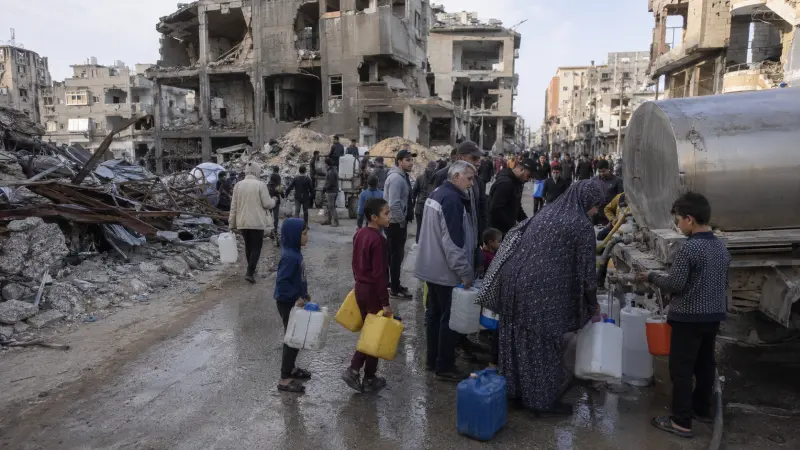
Hamas announced on July 6, 2026 that it was dissolving the body that has governed the Gaza Strip since 2007, clearing a formal path for a Palestinian technocratic committee to take over civilian administration. Ismail al-Thawabta, head of the Hamas-run government media office, said the chairman of the governing Emergency Committee, Mohammed al-Farra, had resigned, and that only technical and professional staff would remain in their posts to keep services running under the authority of the National Committee for the Administration of Gaza, or NCAG.
The NCAG was created under a UN Security Council resolution as part of the US-brokered peace plan that produced an October 2025 ceasefire, and it is meant to answer to the Board of Peace, the oversight body President Donald Trump set up when he brokered that truce. The committee, led by Palestinian technocrat Ali Shaath, has been based in Cairo for months because Israel has not allowed it to enter Gaza. Hamas’s move does not touch the issue that has actually stalled the peace process: its refusal to disarm.
The view from Gaza and the mediators
Hamas spokesman Hazem Qassem called the dissolution “a positive step forward” and told Al Jazeera the move was meant to remove Israel’s pretexts and put the ball in the mediators’ court. Other Palestinian factions, briefed on the decision at a meeting in Cairo, reportedly welcomed it as a serious step toward letting the national committee take up its role. Yet reporting from inside Gaza describes a different mood among ordinary residents: many treated the announcement with open skepticism, seeing it as a symbolic move on paper that changes nothing about who actually controls the territory day to day. One displaced Palestinian from Jabaliya told a US broadcaster only that he hoped the handover would bring relief from tents, mosquitoes and the conditions families are enduring, a hope framed around daily survival rather than governance.
The Board of Peace’s own response was pointedly unenthusiastic. In a statement, it said it had “taken note” of the announcement but that its assessment “will be guided by actions, not promises,” and it reiterated that the core requirement remains consolidating all weapons under NCAG’s control, a single authority, one law and one armed force. Nickolay Mladenov, the Board’s high representative for Gaza, called the move a bridge between declarations and implementation rather than implementation itself.
The view from Israel
Israeli officials dismissed the announcement outright. Foreign Minister Gideon Saar wrote that Hamas is pursuing a “Hezbollah model” for Gaza, in which a technocratic administration handles garbage collection and municipal services while Hamas remains the dominant military force behind the scenes, and said the maneuver is designed specifically to avoid disarmament. An unnamed Israeli official went further, calling the dissolution “spin that has no significance,” noting that the same Hamas personnel remain in their posts under a different label. Hebrew-language commentary captured the same skepticism at street level: one widely used framing summarized the episode simply as “a Hamas man replaced a Hamas man.”
Israeli security assessments reported in the Hebrew press suggested the move is a symbolic gesture aimed outward, at Washington and the Board of Peace, timed to head off a broader Israeli military operation in the roughly 30 percent of Gaza still outside Israeli control. Israeli and Peace Council sources also described a parallel, less publicized effort: a pilot plan to help part of Gaza’s population move to areas outside Hamas’s control near the so-called Yellow Line, ahead of winter, reflecting a strategy of building alternatives to Hamas rule rather than waiting for it to disarm voluntarily.
One further wrinkle emerged in Hamas’s own telling. A Hamas spokesman publicly accused officials in the Ramallah-based Palestinian Authority of using language strikingly similar to Israeli officials in criticizing the dissolution, suggesting to him a shared, if unstated, alarm at any sign of independent Palestinian initiative in Gaza. The claim could not be independently corroborated, but it captures how contested the “who benefits” question around the announcement has become even among Palestinian factions.
What to watch
The practical marker to watch is whether the NCAG is actually permitted to enter Gaza, something Israel has withheld for months pending progress on disarmament, a condition Hamas continues to reject in the absence of a functioning Palestinian government structure first. Nine months after the ceasefire, an Israeli assessment reported by N12 found the technocratic committee still had not entered the territory, the international stabilization force had not deployed, and reconstruction remained largely on paper, despite the completed return of hostages.
Mediator dynamics are the other thread. Egypt, Qatar and Turkey continue rounds of talks in Cairo aimed at narrowing the remaining gaps on the ceasefire’s second phase, and Board of Peace officials, including Mladenov, have been reported traveling to the region for parallel discussions. Whether Washington treats the dissolution as sufficient progress to press Israel on entry for the NCAG, or whether Jerusalem holds firm to its disarmament-first sequencing, will determine whether this becomes a genuine turning point or another entry in a long list of symbolic gestures.
Next specific milestones: any Israeli decision on allowing NCAG entry into Gaza; further Cairo talks among Palestinian factions and mediators; progress or the absence of it on Hamas disarmament; and the fate of the Israeli-reported pilot relocation plan around the Yellow Line.
Sources
- Al Jazeera (Qatar), on the announcement, NCAG structure and factional reaction
- The Times of Israel and Ynet/N12 (Israel, English and Hebrew editions), on Israeli government and security-source reaction
- Davar and Walla News (Israel, Hebrew-language), detailed coverage including the Foreign Ministry’s and Board of Peace’s statements
- Makor Rishon (Israel, Hebrew-language, right-leaning), on the nine-month assessment of the ceasefire’s implementation
- Tasnim News Agency Hebrew service (Iran, state-affiliated), on Hamas’s accusation against the Palestinian Authority
- France 24 and TIME (France / United States), on the broader context of the stalled second phase
- Democracy Now! (United States), on civilian reaction inside Gaza
This post was produced with AI assistance and human editorial review. Hebrew-language Israeli coverage was reviewed alongside Arabic-sourced quotations carried in English-language wire reports; direct Arabic-language Gazan media was not separately reviewed for this post.