
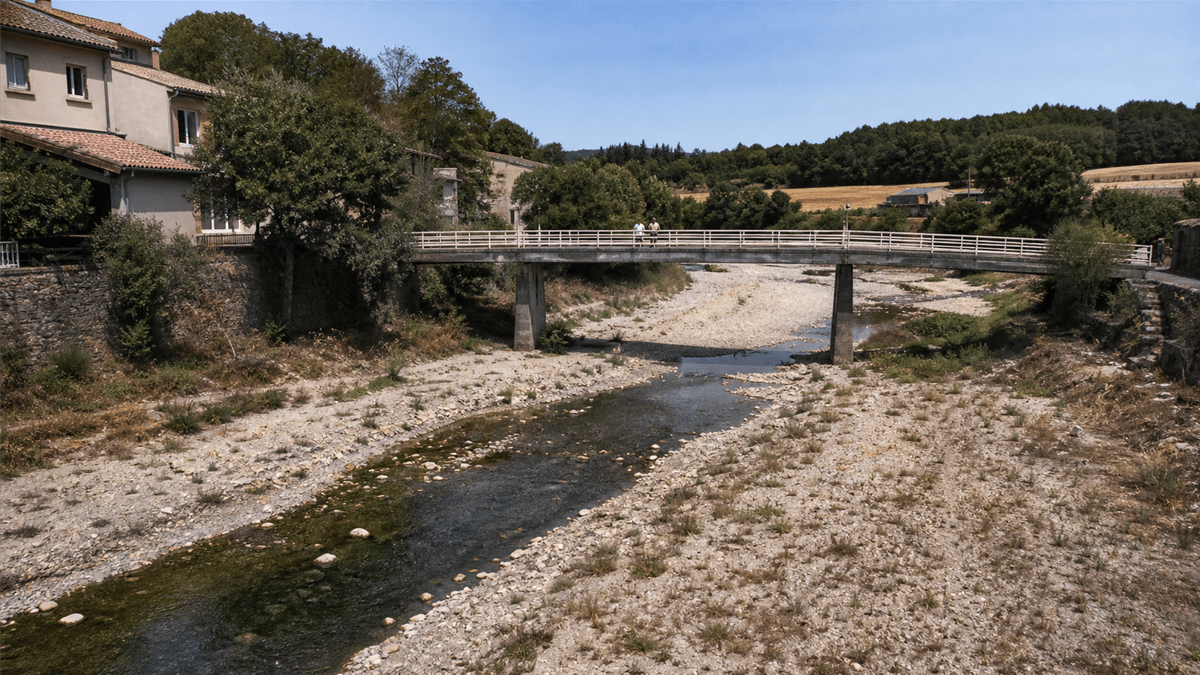
France has entered the middle of summer with water restrictions affecting most of the country after an unusually dry June and repeated heatwaves. A national hydrological bulletin published in July says 79 departments had restrictions beyond the lowest vigilance level by July 9, including 40 at the crisis level.
The figures turn drought from a forecast into an immediate allocation problem. Local authorities must decide which uses to limit as river flows, soil moisture and groundwater decline while farms, households, tourism, industry and energy producers all need water.
French data show a fast deterioration
The Eaufrance national bulletin says rainfall was about 45 percent below normal and describes June as France’s sixth driest since 1959. It reports that 54 percent of groundwater monitoring points were below normal.
The national picture contains important regional differences. Some aquifers still benefit from earlier rain, while shallow groundwater and smaller rivers respond quickly to heat and a lack of precipitation. Restrictions therefore vary by watershed and can change even within the same department.
France’s Environment Ministry called the situation both early and exceptional in a July 13 statement. It asked users to make water conservation a collective practice and highlighted especially severe conditions in the Massif Central.
Domestic debate is likely to intensify around fairness. Household restrictions are highly visible, but agriculture accounts for heavy seasonal demand in many basins, industry needs predictable supplies and electricity generation can be constrained when rivers are too warm or too low for normal cooling and discharge conditions.
Europe sees a test of adaptation
International coverage places France within a broader pattern of hotter summers and more frequent pressure on European water systems. Yet the practical decisions remain local: prefects issue restrictions, water agencies monitor basins and municipalities must communicate rules that differ from one area to another.
Le Monde reported that the Loire had reached historically low July levels and connected the drought to three heatwaves. The same conditions have also increased wildfire risk, linking water management with emergency response.
France’s experience matters outside its borders because it has extensive monitoring, basin institutions and a national restriction system. If those tools struggle during an early drought, other European governments face the same question: whether emergency limits can keep pace with a climate that is shifting faster than long-term infrastructure plans.
The story is not simply that all of France is running out of water. It is that several indicators are deteriorating at once, across a large area, early enough in the season to leave weeks of peak demand ahead.
What to watch
VigiEau and prefectural orders will show whether additional areas move into alert, heightened alert or crisis status. Rain can improve river flows temporarily, but groundwater recovery usually requires sustained precipitation over a longer period.
Agricultural organizations and local governments will begin producing firmer estimates of crop losses, emergency costs and restrictions on commercial activity. Energy operators should also be watched for output adjustments linked to river temperature or flow.
The next national hydrological and groundwater bulletins will provide the clearest common measure of whether conditions are stabilizing. The key dates are the next monthly releases from Eaufrance and the French geological service, alongside any new prefectural orders issued during late July.
Sources
- Eaufrance, France: July national hydrological indicators and restriction counts, in French.
- Ministry for Ecological Transition, France: official drought assessment and conservation measures, in French.
- Le Monde, France: reporting on river levels, heatwaves and national response.
- Vaucluse prefecture, France: example of local drought monitoring and restrictions, in French.
This article was researched and drafted with AI assistance and reviewed by a human editor. French- and English-language government and news sources were checked directly.