
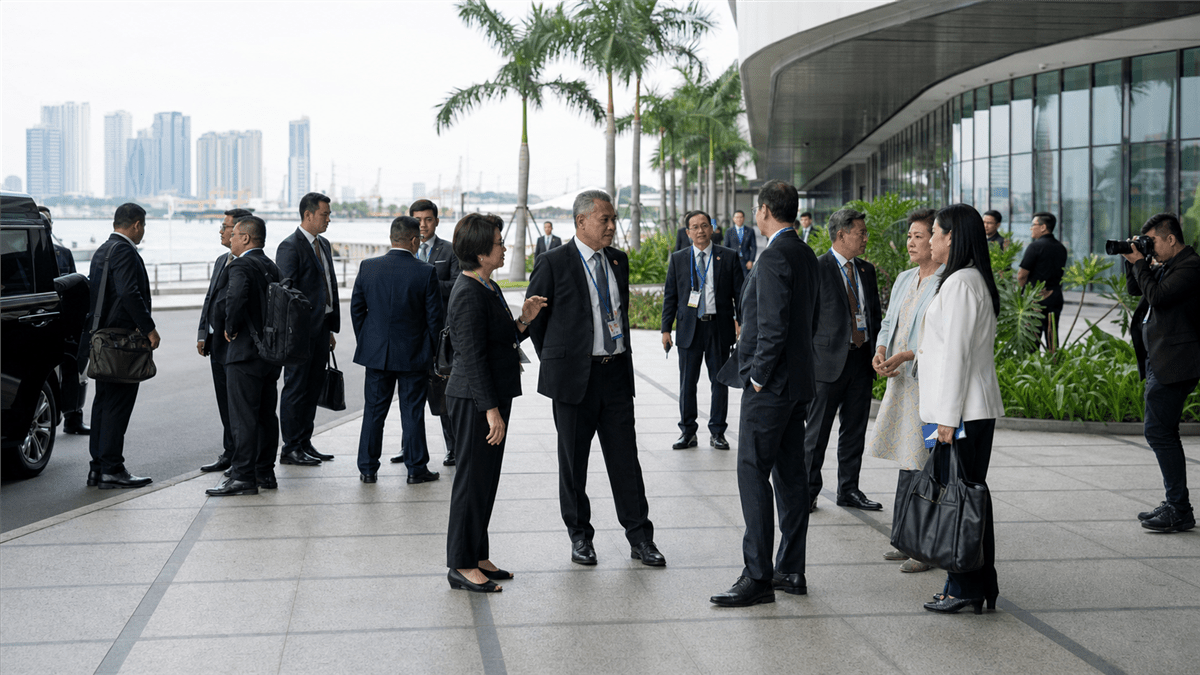
Southeast Asian foreign ministers meeting in Manila are trying to contain several different crises with the same diplomatic tools: consultation, consensus and appeals to international law. Their agenda includes a fresh confrontation between the Philippines and China in the South China Sea, Myanmar’s continuing civil conflict and the economic risks spreading from renewed fighting between the United States and Iran.
The meetings bring ASEAN’s 11 members together with major partners including China, the United States, Russia, Japan, India, South Korea, Australia and the European Union. That reach gives the regional organization unusual convening power, but it also exposes the limits of statements that every member and external partner can accept.
In the Philippines, cooperation follows a formal protest
As this year’s ASEAN chair, the Philippines has presented dialogue as a strategic necessity even while challenging Chinese conduct at sea. During a July 22 meeting with Chinese Foreign Minister Wang Yi, Philippine Foreign Secretary Theresa Lazaro protested what Manila described as violent Chinese Coast Guard actions near Ayungin Shoal and Chinese installations at Bajo de Masinloc, according to the Philippine News Agency account.
The same bilateral meeting also produced a less confrontational message. The two ministers noted progress in negotiations between ASEAN and China on a South China Sea code of conduct and expressed willingness to finish the document by the end of 2026. That combination, a protest alongside a promise to keep negotiating, captures the Philippine approach to the Manila gathering.
Domestic coverage gives the maritime issue particular urgency because the latest confrontation directly involved Filipino personnel. It also reflects a wider Philippine concern that a code should be meaningful in practice and consistent with international law, not simply another declaration that leaves dangerous encounters unmanaged.
Yet the Philippines cannot set ASEAN policy alone. Several members have claims in the South China Sea, while others place greater weight on economic ties with China or on avoiding alignment with either Beijing or Washington. Channel NewsAsia described the dispute as a shadow over the meetings while noting that Manila continued to emphasize cooperation.
Across the region, the agenda is broader than the sea
ASEAN’s foreign ministers also reaffirmed their Five-Point Consensus on Myanmar. A Singapore foreign ministry statement called for measurable implementation, including an end to violence, the release of political prisoners and safe delivery of humanitarian assistance.
The language shows how ASEAN governments describe the task, but it also reveals how little the core problem has changed. The consensus dates to 2021, and violence has continued despite repeated regional meetings. Some ASEAN governments emphasize engagement and humanitarian access, while others have pressed for clearer evidence of progress before Myanmar’s military authorities receive normal political representation.
The Middle East conflict has added a problem that no ASEAN government controls but many will feel through energy prices, shipping and inflation. The ministers expressed serious concern about renewed US-Iran hostilities and called for an immediate halt to fighting and the safe reopening of the Strait of Hormuz, according to the Associated Press report from Manila.
That concern is not an outside distraction for Southeast Asia. Several member economies depend heavily on imported energy and open sea lanes. The participation of senior officials from Washington, Beijing and Moscow therefore gives ASEAN a forum to raise its economic exposure, even if the organization has little influence over the fighting itself.
A regional forum with global participants
International coverage has tended to frame the gathering through competition among large powers. US Secretary of State Marco Rubio, Wang and Russian Foreign Minister Sergey Lavrov are all attending related meetings, making Manila a place for bilateral diplomacy as well as ASEAN-led sessions. The Philippine foreign ministry’s participant list also includes ministers from Australia and other regional partners.
ASEAN’s own framing is different. Its statements stress “centrality,” meaning that Southeast Asian governments want the region’s institutions to remain the meeting point for larger powers rather than becoming an arena organized exclusively around their rivalries. The concept does not guarantee a common policy, but it helps explain why ASEAN continues to bring governments with sharply conflicting interests to the same table.
The Manila meetings therefore offer two measures of success. One is whether ministers produce agreements on immediate issues, especially the maritime code and Myanmar. The other is whether ASEAN can keep external powers engaged on terms that preserve room for its members to make different national choices.
What to watch
The first test is the final set of outcome documents. Malaysia’s foreign ministry said ministers were expected to adopt a joint communiqué covering the meeting’s decisions. Its wording on the South China Sea, Myanmar and the Middle East will show where consensus was possible and where differences were left unresolved.
The second test will come after the delegates leave Manila. ASEAN and China have set the end of 2026 as their target for completing the South China Sea code, so negotiators will need to settle questions about scope, legal force and implementation. On Myanmar, the practical markers are reductions in violence, political access and whether aid can reach communities safely.
The immediate ceremonial milestone is July 24, when ASEAN marks the 50th anniversary of the Treaty of Amity and Cooperation and welcomes additional countries to the regional peace and security pact. The more consequential deadline is the end of 2026, when the promised maritime code will either be completed or become another delayed ASEAN commitment.
Sources
- Philippine News Agency, Philippines: Lazaro-Wang meeting, Philippine protest and code-of-conduct target.
- Philippine News Agency, Philippines: participants and schedule for ASEAN-related meetings.
- Channel NewsAsia, Singapore: regional agenda covering energy, Myanmar and the South China Sea.
- Ministry of Foreign Affairs, Singapore: official account of ASEAN positions on Myanmar and the regional order.
- Ministry of Foreign Affairs, Malaysia: meeting program and expected joint communiqué.
- Associated Press, United States: Manila reporting on the Middle East statement and regional security agenda.
This article was researched and drafted with AI assistance and reviewed by a human editor. English-language Philippine, Singaporean, Malaysian and international reporting was checked directly. Useful Filipino-language coverage was not found in the reporting reviewed.