
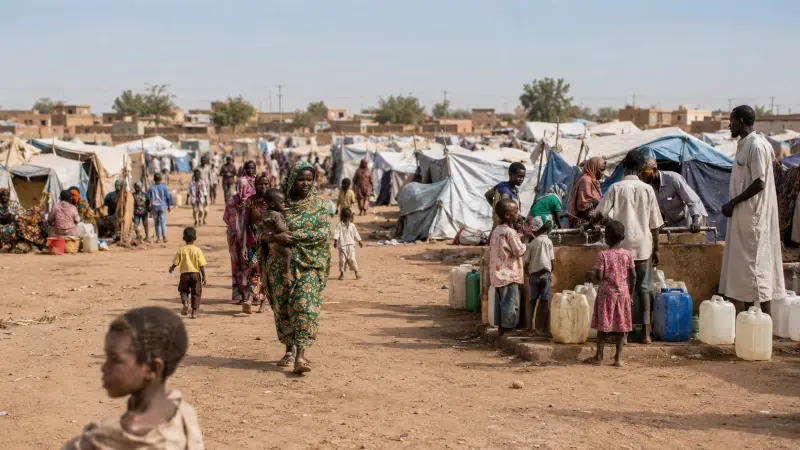
The Rapid Support Forces have tightened their siege of El Obeid, the capital of Sudan’s North Kordofan state, massing troops around a city of roughly half a million people and hitting it with near-daily drone strikes. The UN’s human rights chief, Volker Türk, called the situation a red alert and warned of a possible repeat of the atrocities the RSF committed in El Fasher, in Darfur, in October 2025. On July 6, the UN Human Rights Council adopted by consensus a resolution condemning the escalating violence and ordering an urgent inquiry into abuses in and around El Obeid.
The stakes are strategic as well as humanitarian. El Obeid sits at a crossroads linking Darfur and western Sudan to the Nile Valley and the center of the country, and the army uses it as a logistics hub, with an infantry division and airbase there. Whoever holds it controls a key gateway for supplies and movement. The war, now in its third year since the RSF and the army turned on each other in April 2023, is among the world’s worst humanitarian crises, and the fear is that El Obeid becomes the next El Fasher, where UN investigators found the assault bore the hallmarks of genocide and where thousands were killed in days.
The view on the ground
Coverage from inside Sudan and the wider Arab press captured a grim daily reality and one striking dispute. Residents told outlets the city had been in near-total darkness for weeks after strikes on its power station, with water supplies disrupted, fuel scarce and prices soaring, while RSF drones hovered overhead. The UN documented at least 15 drone attacks in and around the city in June that killed dozens, and the International Organization for Migration reported displacement across Kordofan rising sharply, with more than 11,000 people, over half of them children, displaced from the El Obeid area in a two-week span.
The dispute is over the word siege itself. In Arabic-language reporting, the governor of North Kordofan, Abdel-Khaleq Abdel-Latif, publicly denied the city was under siege, saying the army was handling RSF concentrations professionally and that the nearest RSF position was in Bara, some 40 to 50 kilometers away. The army said it had downed a strategic drone over neighboring White Nile state and struck RSF gatherings. That official reassurance sat uneasily beside residents’ accounts of blackout and fear, and beside UN warnings of imminent atrocity, a gap that Sudanese and pan-Arab outlets reported side by side. Sudanese human rights groups, in a joint statement, held the RSF and its regional backers responsible for the siege while also pressing the army not to turn residential areas into military targets.
The view from outside, and the coverage question
The international response split along familiar lines, and one thread is really about coverage and accountability. The United Kingdom led the push for the emergency Human Rights Council session, backed by Germany, Ireland, the Netherlands and Norway, and a broader coalition of states warned of impending atrocities. China disassociated itself from the resulting resolution, saying it opposed investigations targeting individual countries without their consent. The United Arab Emirates, widely accused of arming the RSF, took a different tack in its own media: The National, an Abu Dhabi outlet, foregrounded a $30 million UAE humanitarian pledge for El Obeid and did not carry the complicity allegations against Abu Dhabi that dominated British and pan-Arab coverage.
Those allegations are the heart of the accountability story. Nathaniel Raymond, who directs Yale’s Humanitarian Research Lab and tracks the war by satellite, testified to a UK parliamentary committee that Britain was uniquely placed to help prevent the El Fasher massacre but failed to act, in his account, because of pressure from the UAE and a desire to preserve relations with Abu Dhabi. He described El Fasher as among the most accurately predicted mass atrocities in modern history and argued that sanctions on UAE officials could have interrupted the weapons pipeline to the RSF. Abu Dhabi denies backing the RSF. Raymond warned the same pattern was repeating at El Obeid and suggested the most effective pressure on the UAE would be a consumer boycott of its retail and travel hubs.
What to watch
The immediate risk is a ground assault. Investigators say the RSF is deploying the same tactics it used at El Fasher: encirclement, strikes on civilian infrastructure, and restrictions on humanitarian access. The UN fact-finding mission, mandated by the July 6 resolution, will now investigate abuses in El Obeid and report to the Human Rights Council, with findings expected at its September session. Türk has called for Security Council action, a pause in hostilities to allow aid, and cooperation with the International Criminal Court.
The accountability question runs in parallel. Whether the UK or other states move from statements to measures against the RSF’s external backers, and whether the UAE faces any consequence, will test Raymond’s charge that Western governments are covering for earlier inaction. Some Arabic analysts argue El Obeid may be harder for the RSF to take than El Fasher, given the army’s positions, which could change the timeline.
Next specific milestones: any RSF ground offensive on El Obeid; the UN fact-finding mission’s report to the Human Rights Council in September; further UK parliamentary follow-up to Raymond’s testimony; any sanctions naming RSF backers; whether the army opens safe exit corridors for trapped civilians; and the trajectory of displacement figures reported by the IOM and Save the Children.
Sources
- UN News and Human Rights Watch (international institution / NGO), on the emergency session, the resolution and the fact-finding mission
- Al Jazeera (Qatar), on the strategic stakes and the coalition statement
- Reuters via US News (international wire), on Volker Türk’s warning and the UK-led council session
- Middle East Eye (United Kingdom), detailed account of Nathaniel Raymond’s testimony to UK Parliament
- The National (United Arab Emirates, state-aligned), on the UAE humanitarian pledge and residents’ accounts
- Sudan Tribune (Sudan), on Sudan’s rejection of the fact-finding mission and RSF’s response
- Raseef22 (pan-Arab, Arabic-language), on the North Kordofan governor’s denial of a siege
- Darfur Network for Human Rights via AllAfrica (Sudan / pan-African), on the HRC resolution details
- Democracy Now! (United States), on the suppressed-warnings allegation
This post was produced with AI assistance and human editorial review. Arabic-language Sudanese and pan-Arab coverage was reviewed alongside English-language editions, including the local official’s denial of a siege.