
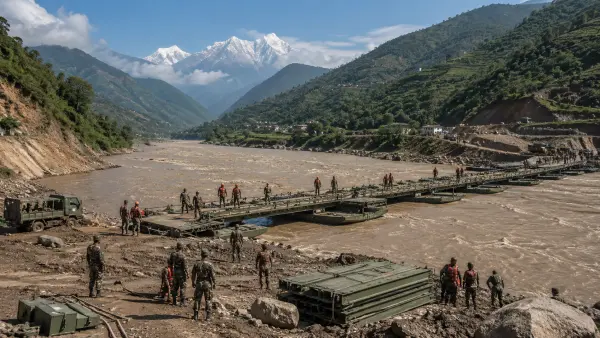
Nine days after a glacier collapse triggered catastrophic flash floods along the Nepal-China border, Nepal’s death toll stood at 1,252 as of Thursday, September 3, 2026, with 4,216 people still missing or out of contact, according to the National Disaster Risk Reduction and Management Authority’s latest update. On the Chinese side of the border, in Tibet, state media have reported 16 deaths and 546 people missing, bringing the combined cross-border toll to 1,268 dead and 4,762 missing. Nearly 12,000 people have been rescued in Nepal alone.
The disaster struck on August 26, when part of the Langtang glacier system broke away and fell into the border area separating Nepal from Tibet, unleashing flash floods down the Bhote Koshi and Trishuli river corridors into Rasuwa, Nuwakot, Dhading, and as far as Chitwan and Nawalparasi East. More than 21,000 security personnel have been mobilized, and over 5,000 injured people have received treatment.
Still trapped: the hydropower tunnels
The single largest concentration of missing people is tied to Nepal’s hydropower sector. Of the 4,216 people unaccounted for, approximately 900 are linked to hydroelectric projects, according to Thursday’s NDRRMA figures, making hydropower workers the largest identifiable category among the missing. Nepal Police confirmed that search and rescue operations remain actively underway inside the tunnel of the Langtang Hydropower Project-2 in Rasuwa district, conducted jointly with the Nepali Army more than a week after the disaster began.
The rescue effort has drawn in international expertise. Specialist teams from India, China, and South Korea are supporting Nepali crews attempting to reach workers trapped in mud-filled tunnels across multiple flood-damaged hydropower facilities. Nepal’s Ministry of Energy, Water Resources and Irrigation has issued a running series of updates covering both the rescue effort and separate work to restore electricity supplies in Rasuwa, Nuwakot, and Dhading, where transmission infrastructure was severely damaged. In the immediate aftermath, the Nepali Army reported 279 people were rescued alive from hydropower-related sites, though the roughly 900 still missing from that sector indicates the toll there remains far from resolved.
Elsewhere, the missing include 583 foreign nationals and 164 Nepalis who had been accompanying foreign tourists, reflecting the border region’s popularity with trekkers. The US State Department said Wednesday it was still tracking around 75 unaccounted-for Americans, while Latvia’s government reported 33 of its citizens missing, none yet confirmed rescued. Nearly 4,000 displaced people are currently staying in holding centers, concentrated in Nuwakot, Rasuwa, Dhading, and Kathmandu.
Why this became so devastating
Nepali analysis of the disaster has pushed past the immediate rescue effort to ask why a glacier collapse translated into a catastrophe of this scale, and the answers center on cross-border information gaps as much as on the physical event itself. Nepali outlet Himal Press reported that the disaster has raised pointed questions about how much information Nepal and China were actually exchanging on the glacier’s condition before it broke away, and how much warning data China held on the deteriorating ice formation in the lead-up to the collapse.
A broader Nepali-language analysis published by US Khabar argued the flood was not simply a natural disaster but a stress test that exposed serious weaknesses in Nepal’s disaster management capacity, its physical infrastructure, and its tourism-dependent economy. The piece argued Nepal cannot manage Himalayan-scale disaster risk alone, given that the mountain systems involved are shared with neighboring countries, and called for sustained cross-border information exchange and early-warning cooperation among Nepal, China, India, and international scientific institutions.
That argument was echoed more pointedly by Nepali civil society activists, who, according to a report from The Print’s Hindi edition, criticized the government’s flood response for sidelining local government bodies during the crisis and called for stronger cooperation with China specifically on early-warning systems. The activists’ statement pointed to rising regional temperatures, glacial instability, and melting permafrost as issues requiring cooperation across the entire Hindu Kush-Himalaya region, while explicitly noting their criticism was not meant to diminish the contributions of security forces conducting the rescue.
The World Meteorological Organization added a further complication on Thursday, forecasting a “very strong” El Niño pattern that raises the risk of further extreme weather across the region. Separately, a new glacial lake has formed on the Chinese side of the border as a consequence of the original collapse, and Al Jazeera has reported this poses a renewed flood threat; China resumed downstream rescue work only after assessing the new lake’s conditions.
The shift toward rebuilding
Nepali Prime Minister Balendra Shah said this week that his government’s focus is moving from search, rescue, and relief toward rehabilitation, a transition disaster-response officials typically make once the window for finding survivors narrows. The government has released an initial 1 billion Nepali rupees, roughly $6.5 million, to begin rebuilding affected areas, though Shah acknowledged that a full accounting of damaged roads, bridges, and buildings is still being compiled by helicopter and on-foot survey.
The scale of what comes next is considerably larger than that initial sum. Finance Minister Swarnim Wagle said this week that Nepal will need between $4 and $5 billion for reconstruction following the floods and landslides in the Nepal-China border region, a figure roughly equivalent to 600 billion Nepali rupees. Nepal’s cabinet has already begun approving specific relief measures: a Thursday cabinet meeting decided to grant tax relief and concessions to businesses affected in the border flood zone, according to Hindi-language coverage, allowing companies to claim the value of destroyed business property as a one-time deductible expense, while the central bank will offer debt restructuring and rescheduling facilities to affected businesses.
What to watch
The Langtang Hydropower Project-2 tunnel operation is the most concrete near-term marker, both for the fate of the roughly 900 people still linked to hydropower sites and as a signal of how much longer active rescue operations, as opposed to recovery and rebuilding, will continue. Whether Nepal and China formalize any new early-warning or glacial-monitoring arrangement in response to the information-exchange questions raised by Himal Press and Nepali civil society groups is a slower-moving but structurally significant thread.
The new glacial lake on the Chinese side of the border is an immediate hazard requiring separate tracking, given its direct role in whatever flood risk the region faces next. On the financial side, whether international donors and lending institutions move to help close the gap between Nepal’s initial $6.5 million relief release and Wagle’s $4-5 billion reconstruction estimate will determine how quickly rehabilitation actually proceeds beyond emergency tax relief and debt rescheduling.
Next specific milestones: the outcome of the Langtang Hydropower Project-2 tunnel search; any updated fatality or missing-persons figures from NDRRMA’s daily reports; formal announcements on Nepal-China cooperation over glacial monitoring; progress toward Wagle’s stated reconstruction financing target; and further WMO guidance on the forecast El Niño pattern’s regional risk.
Sources
- ANI, via Tribune India (India), on the September 3 NDRRMA figures and missing-persons breakdown
- The Tribune (India), on the ongoing Langtang tunnel rescue and holding-center figures
- ABC News (United States), on the combined Nepal-China toll and the WMO El Niño forecast
- ABC News (United States), on hydropower tunnel rescue operations and early casualty figures
- ABC News (United States), on PM Shah’s rehabilitation announcement and the initial relief fund
- CNN (United States), on cross-border missing-persons figures and glacier warning signs
- International Water Power (trade press), on the international specialist teams supporting tunnel rescues
- Himal Press (Nepal, Nepali-language), on questions over Nepal-China early-warning information exchange
- US Khabar (Nepal, Nepali-language), analysis of the disaster’s structural causes and regional cooperation needs
- The Print, Hindi edition (India), on civil society criticism of the government’s flood response
- Arthikpati (Nepal, Nepali-language), on Finance Minister Wagle’s reconstruction cost estimate
- Daily Kiran (India, Hindi-language), on the cabinet’s business relief measures