
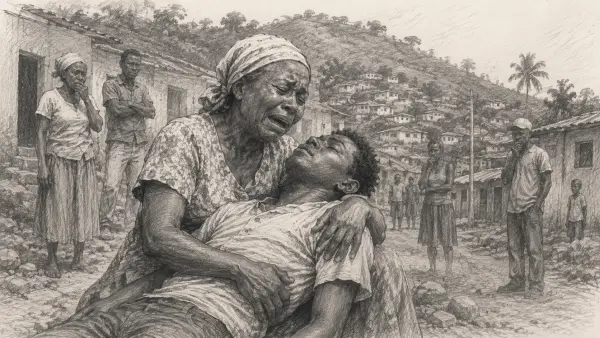
Armed men from the Viv Ansanm gang coalition attacked the highland community of Kenscoff, roughly 10 kilometers southeast of Port-au-Prince, on the night of August 23 into August 24, 2026. At least 47 people were killed, more than 50 kidnapped, and 22 injured, according to the UN’s count, which the Haitian mayor’s office says may still rise as communications in the area remain cut. At least five of the dead were children. Homes were set ablaze, and a gang member identifying himself as “Izo 2” has threatened to kill the hostages if security forces move against his men.
Kenscoff had been considered relatively insulated from the gang violence that controls an estimated 70% of the capital. Romain Le Cour, who heads the Haiti Observatory at the Global Initiative Against Transnational Organized Crime, called the attack “a major political and security test, for the government, for the police and for the international mission,” and said its scale punctures the belief that Haiti’s security situation was improving.
The view at home
Haiti’s government responded with pledges of force. Prime Minister Alix Didier Fils-Aimé, who also chairs the Superior Council of the National Police, convened an emergency meeting and, according to a statement from his office, vowed to “retake the initiative, track down those responsible and dismantle the criminal networks that terrorize the population,” adding that “the Kenscoff massacre will not go unpunished.”
Haitian civil society did not find that reassuring. The Observatoire International pour la Démocratie et la Gouvernance, in a statement, condemned what it called the state’s powerlessness and warned that “Kenscoff cannot become one more massacre that we condemn today only to forget tomorrow.” French-language coverage from franceguyane.fr described calls placed to the mission’s spokespeople going unanswered as the attack unfolded, and characterized the government’s promises of reinforcement as struggling to convince residents facing a brutal reality on the ground.
A separate thread of domestic criticism has focused on a private security arrangement that predates this attack by more than a year. In March 2025, Haiti’s transitional government signed a contract with Vectus Global, a firm founded by former Blackwater head Erik Prince, to help retake gang-held territory; a second, unconfirmed arrangement reportedly extends to a decade and includes tax and customs reform. Haitian outlet Vantbefinfo, marking the contract’s anniversary in a report published the same week as the Kenscoff attack, noted that despite the financial resources mobilized, gangs still control multiple territories and civilians remain exposed to massacres, kidnappings, and forced displacement, citing Kenscoff itself as illustration. Gedeon Jean, a Haitian human rights researcher quoted in earlier reporting, had warned that “resorting to private military companies cannot be seen as a solution to insecurity in Haiti.”
The attack has also revived doubt about Haiti’s electoral timeline. A first round of general elections is scheduled for December 13, 2026, the country’s first since 2016. Haitian outlet RHINEWS noted that the Provisional Electoral Council’s own published calendar had already flagged secure access to communes and polling centers as a precondition for the vote, a precondition Kenscoff calls directly into question.
The view from outside
At the UN Security Council, Haiti’s crisis was framed in institutional and humanitarian terms. UN officials briefing the Council reported that the UN’s Integrated Office in Haiti documented 1,408 people killed and 656 injured between April and June 2026 alone, and that nearly 1.5 million people, 12% of Haiti’s population and half of them children, are now internally displaced, a figure that has doubled in two years. Secretary-General António Guterres condemned the Kenscoff attack directly, calling it evidence of Haiti’s alarming security situation.
The international response carries its own history of contested confidence. In September 2025, the UN Security Council voted 12-0, with Russia, China, and Pakistan abstaining, to authorize a larger, 5,550-member Gang Suppression Force, converting an earlier Kenya-led mission that had struggled to reach even 1,000 of its planned 2,500 troops due to funding shortfalls. The first reinforcing troops, from Chad, arrived only in April 2026, led by a South African UN official. Following Kenscoff, Haitian authorities and the mission agreed the force would strengthen its Port-au-Prince presence while national police reinforce Kenscoff directly, though Le Cour cautioned that redeploying scarce personnel to one crisis point inevitably thins protection elsewhere. Separately, the Organization of American States condemned the attack and called for action, and Kenscoff’s mayor said members of Viv Ansanm, the gang coalition the United States has formally designated a foreign terrorist organization, set fire to roughly 25 homes during the raid.
What to watch
Le Cour’s warning about the hostage threat frames the most immediate danger: if security forces move against the gang holding the roughly 50 kidnapped residents, gang leaders have signaled they will kill them; if forces hold back, the government’s claims of protection ring hollow either way. How Haitian and multinational forces navigate that trap in the coming days is the sharpest near-term test.
Beyond the immediate crisis, three threads are worth tracking in parallel: whether the Gang Suppression Force’s reinforcement actually materializes on the ground in Kenscoff and Port-au-Prince, given the force’s documented staffing shortfalls; whether the Vectus Global contract produces any public accounting of results after eighteen months of gang control persisting largely unchanged; and whether the December 13 electoral calendar survives contact with a deteriorating security picture that election observers already considered fragile before this attack.
Next specific milestones: the fate of the more than 50 people still held hostage; any formal statement from Vectus Global or the Haitian government on the private security contract’s results; further UN Security Council briefings on Gang Suppression Force deployment numbers; and whether the Provisional Electoral Council adjusts or reaffirms the December election timeline.
Sources
- UN Security Council press coverage (UN Meetings Coverage), on casualty and displacement figures reported to the Council
- The Haitian Times (Haiti, English-language), on Le Cour’s analysis and the electoral-timing stakes
- NPR (United States), on survivor accounts and the hostage threat
- Al Jazeera (Qatar), on Guterres’s condemnation and UN casualty figures
- ABC News (United States), on the mayor’s account and the gang coalition’s US terrorist designation
- France-Guyane (France, French-language), on the multinational mission’s unanswered calls during the attack
- Le Nouvelliste (Haiti, English edition), on Prime Minister Fils-Aimé’s response
- HPN Info (Haiti, French-language), the OIDG’s civil-society statement
- RHINEWS (Haiti, French-language), on the electoral calendar’s security preconditions
- Vantbefinfo (Haiti, French-language), on the Vectus Global contract’s one-year record
- The Conversation, background on the Vectus Global arrangement and Gedeon Jean’s criticism
- Global News (Canada), on the September 2025 Security Council vote authorizing the Gang Suppression Force