
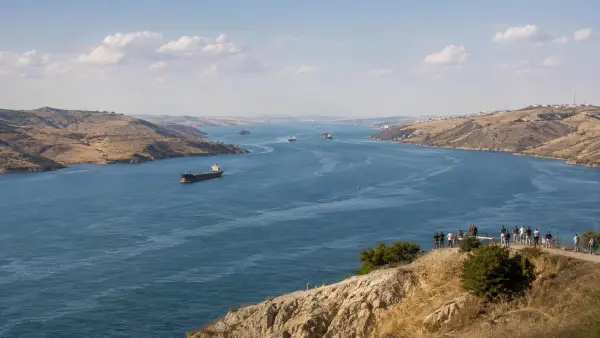
Oil prices fell sharply for a second consecutive session on Tuesday, August 4, 2026, as hopes grew for an interim deal to reopen the Strait of Hormuz, the narrow waterway that has been effectively closed since Iran mined and blockaded it earlier this year amid its war with the United States and Israel. Brent crude dropped more than 10 percent across the two sessions, trading below $80 a barrel for the first time since mid-July, while US Treasury yields rallied on optimism that mediators could avert a renewed wave of American airstrikes on Iran.
The movement followed a call between US President Donald Trump and Qatar’s Emir, Sheikh Tamim bin Hamad Al Thani, in which the two discussed de-escalating US-Iran tensions. Qatar’s government said afterward that a proposal had been drafted, and Treasury Secretary Scott Bessent told CNBC there was “a chance we may have a deal today or tomorrow to open the strait.” Both Qatar and Bessent cautioned that nothing was finalized. Secretary of State Marco Rubio told reporters separately that “there’s been progress made in those talks, but not finality yet.”
The View from Washington
The American framing has been one of an imminent, unified settlement. Trump and senior officials have described the negotiations as a single track toward reopening Hormuz, with Bessent putting a same-day or next-day timeline on a possible agreement and Rubio describing active, converging talks. That optimism moved markets directly: US government bonds rallied and oil fell on the expectation that a deal would avoid further military escalation.
The picture is complicated by a separate track Bloomberg had reported the prior week, in which Oman and Iran were discussing reopening a so-called middle passage through the strait, a route that Iran has mined and that mediators say may need to be cleared before regular shipping can resume. Most vessels currently moving through the area do so either along a northern route close to Iran’s shore with Tehran’s permission, or a southern route near Omani territory, with transponders frequently switched off.
The View from Tehran
Iranian officials have pushed back directly on the Washington framing, and the pushback is specific rather than general. Foreign Ministry spokesperson Esmaeil Baghaei told reporters Monday, as carried by the state-run Islamic Republic News Agency, that the talks between Iran and Oman are strictly bilateral discussions between the two coastal states over safe inbound and outbound shipping routes, and that any issues related to Iran-US relations or Washington’s fulfillment of its own commitments “will be reviewed at a later stage, in accordance with circumstances.” That is a meaningfully different claim than the one coming out of Washington: Iran’s government is drawing a hard line between a narrow, technical maritime arrangement with Oman and any broader settlement with the United States, and explicitly declining to fold the two into a single deal in progress. Reuters, in reporting carried by Canada’s CBC, noted separately that Tehran had denied Trump’s own assertion that US-Iran talks were already under way.
Iran’s public rhetoric elsewhere has stayed combative even as the shipping talks proceed. Mohsen Rezaee, an adviser to Iran’s supreme leader, told state television Monday that “US warships and bases will be in serious danger” if Trump does not lift what he described as a blockade of Iranian ports. Iranian domestic coverage has also carried notably contradictory signals from the American side, with one Farsi outlet’s headline this week describing “contradictory claims by US officials: from readiness for a war beyond World War II to restarting talks today,” reflecting how starkly Tehran’s press has portrayed the gap between American officials’ public statements. Domestic Iranian commentary has also floated a harder negotiating position than a simple reopening: a senior Iranian source described to Reuters an ambition for full Iranian control over inbound shipping through the strait and visibility over outbound traffic, with the ability to intervene, a position that would mark a significant shift in regional maritime authority rather than a return to the prior status quo. Iranian domestic energy commentary has also noted the country has roughly 60 days of oil storage capacity remaining under the current blockade conditions, a detail that helps explain Tehran’s own incentive to reach some arrangement even while publicly rejecting Washington’s framing of the talks.
Ordinary sentiment in Tehran, as captured by Iran’s West Asia News Agency and carried by Reuters, split along familiar lines. One resident, Fatemeh Sadat Mirzadeh, said Iran “must definitely keep the Strait of Hormuz at any cost” and should never back down “even if they make harsh threats.” Another resident, speaking anonymously, said there was “no problem” with renewed talks, reflecting a public more divided on the diplomatic track than either government’s official statements suggest.
The View from the Mediators
Qatar and Pakistan both described themselves as active but distinct channels rather than parties to a single negotiation. Qatar’s public statement called for freedom of navigation and consensus among regional states on any future arrangement governing the strait, a notably more cautious framing than the “deal by Tuesday or Wednesday” language coming from the US Treasury Secretary. A senior Pakistani official separately told The Guardian that understandings reached earlier between the parties remain in place and that Islamabad is actively engaged in “silent diplomacy” to reduce US-Iran tensions, work distinct from the Qatari and Omani channels.
The same day markets fell on optimism, an attack on a vessel near the Strait of Hormuz was reported, which Reuters said underscored doubts that the broader US-Iran war was nearing resolution even as the Hormuz-specific talks advanced. Oil rebounded on the news before falling again as the Qatari and American statements landed. Trump also spoke by phone with Saudi Crown Prince Mohammed bin Salman on efforts toward a diplomatic solution, a call Gulf state media framed as part of a wider regional push rather than a US-Iran bilateral matter.
What to Watch
The clearest test in the coming days is whether the Iran-Oman shipping arrangement, which both sides describe as further along than any broader settlement, produces a concrete, announced mechanism, and whether Iran continues to insist that arrangement remains separate from any US-Iran deal regardless of how Washington characterizes it publicly. Bessent’s same-day or next-day timeline, given Tuesday, had not produced a confirmed agreement as of this writing, and Qatar’s own language stopped well short of declaring a deal reached.
Whether the mined middle passage requires clearance before regular shipping resumes, and who would conduct that clearance, is an unresolved operational question that neither side’s public statements have addressed directly. The gap between Iran’s insistence on separating the Oman shipping talks from a broader US settlement and Washington’s framing of a single converging deal is worth tracking closely, since it suggests the two governments may be describing genuinely different processes rather than the same negotiation from different angles.
Next specific milestones: any formal announcement of an Iran-Oman shipping mechanism; whether Bessent’s stated timeline for a broader deal is met or lapses; further vessel incidents in or near the strait; the outcome of Pakistan and Qatar’s efforts to schedule a new round of direct US-Iran talks, reported as a goal for the coming week; and Brent crude’s trajectory as a practical indicator of how the market is weighing these competing signals.
Sources
- The Spokesman-Review, via wire service (United States), on the Qatar-US call and the mined middle passage
- Jefferson City News-Tribune, via wire service (United States), on Brent crude’s decline and Rezaee’s warning
- CNN, live coverage (United States), on Baghaei’s statement distinguishing the Oman talks from US-Iran issues and Tehran resident reactions
- Bloomberg (United States), on the Trump-Tamim call and White House confirmation
- Rigzone (energy trade press), on Bessent’s CNBC remarks and Iran’s rejected Omani proposal terms
- CBC News, via Reuters (Canada), on the vessel attack, Iran’s denial of Trump’s claim, and Iran’s demand for control over inbound shipping
- Fararu (Iran, Farsi-language), on mediator efforts and the market’s reaction to the Iran-Oman talks
- Javan Online (Iran, Farsi-language, state-aligned), Baghaei’s press briefing distinguishing bilateral Oman talks from US-related issues
- Sarpoosh (Iran, Farsi-language), on the 4 percent oil price drop attributed to deal hopes
- Fararu (Iran, Farsi-language), on Pakistan’s “silent diplomacy” role and contradictory US official statements
This post was produced with AI assistance and human editorial review. Farsi-language Iranian coverage, including state-aligned outlets, was reviewed alongside English-language wire reporting and surfaced Iran’s explicit distinction between the Oman shipping talks and any broader US-Iran settlement, a distinction less prominent in the English-language sources reviewed. Arabic-language Gulf state coverage was not separately reviewed for this post.