
The Middle East conflict has expanded across several new fronts after Saudi Arabia joined the United States in strikes on Iran-aligned armed groups in Iraq and Egypt confirmed that a drone caused fires on two gas vessels at Damietta port. The developments came as the United States and Iran resumed direct attacks, Jordan and Kuwait faced new missile strikes, and Yemen’s Houthis threatened Saudi shipping through the Red Sea.
The sequence does not amount to one clearly coordinated campaign. The United States, Saudi Arabia, Iran, Iraqi armed groups and the Houthis have offered competing accounts of responsibility and self-defense. At Damietta, Egyptian investigators confirmed a drone was involved but had not identified who launched it when this article was prepared.
Saudi Arabia moves from defense to joint strikes
Saudi Arabia had spent much of the five-month US-Iran war trying to limit its direct military role while keeping diplomatic channels open. That position shifted after Riyadh said drones launched by Iran-affiliated militias in Iraq targeted oil facilities in the Eastern Province and around the capital.
The Saudi Foreign Ministry said the kingdom reserved the right to respond and demanded that Baghdad prevent Iraqi territory from being used as a launch point. The Islamic Resistance in Iraq, an umbrella name used by Iran-aligned factions, rejected the Saudi accusation. The Houthis separately said they had attacked Saudi energy infrastructure from Yemen.
US Central Command and Saudi forces then carried out joint strikes in Iraq. CENTCOM said fighter aircraft hit logistics and weapons sites used by groups directed by Iran’s Islamic Revolutionary Guard Corps after more than 30 drone attacks over 72 hours.
Saudi Arabia publicly framed the operation as limited self-defense. A Foreign Ministry statement carried by Ajel said the July 29 strikes targeted sites connected to attacks on Saudi oil facilities and cited Article 51 of the United Nations Charter. The ministry said Riyadh did not seek escalation but would protect its territory, people and resources.
The Popular Mobilization Forces said at least 20 fighters were killed and 32 wounded. Iraqi militia officials also reported the deaths of six Iranian advisers, while an Iranian provincial official gave a lower figure of four. Those differing counts had not been reconciled.
Iraq condemned the US-Saudi operation. Its National Security Council said the strikes took place while Baghdad was investigating the allegations raised by Washington and Riyadh and that innocent people were among those killed or wounded. An Associated Press report said a planned visit to Saudi Arabia by Iraqi Prime Minister Ali al-Zaidi was postponed indefinitely.
The dispute exposes Iraq’s difficult position. The Popular Mobilization Forces are formally part of the Iraqi security system, but constituent groups retain considerable autonomy and some have attacked US facilities. Baghdad is trying to maintain relations with both Washington and Tehran while promising to bring weapons under state control.
Egypt confirms a drone at Damietta
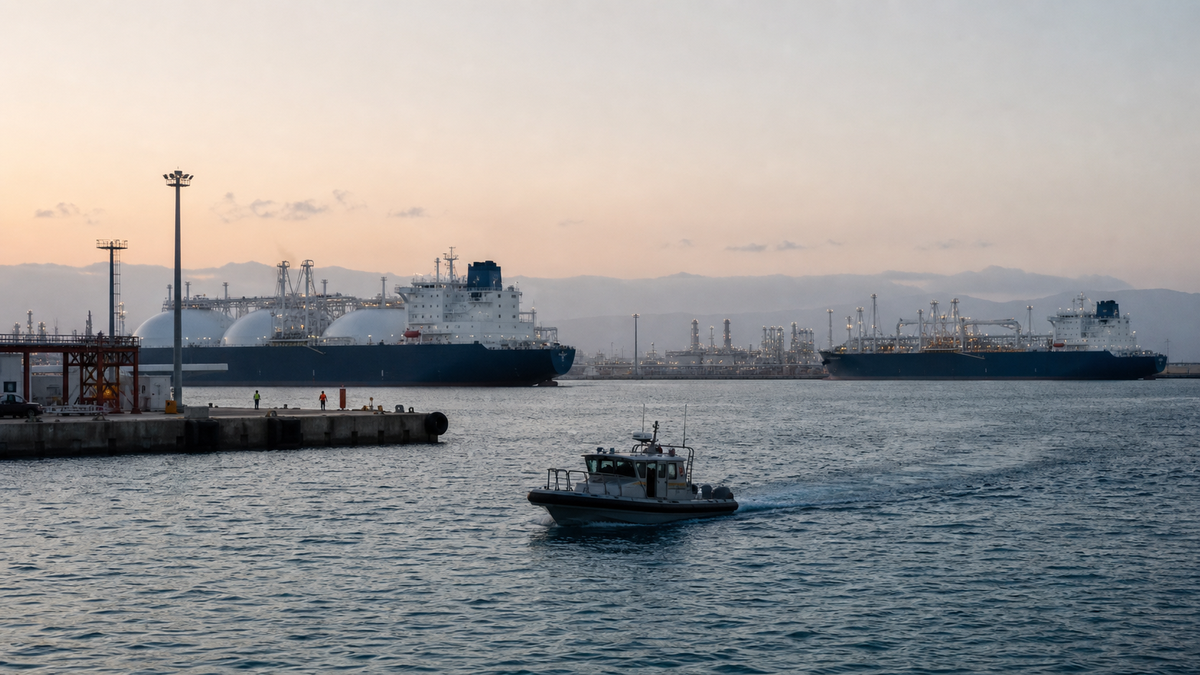
In Egypt, fires broke out on the US-owned floating storage and regasification unit Energos Winter and the Greek-owned tanker GasLog Salem at the Mediterranean port of Damietta. Emergency teams brought the fires under control, and no injuries or deaths were reported.
Egypt’s prime minister’s office said an initial investigation found that a drone caused the incident. Prime Minister Mostafa Madbouly said investigators recovered drone fragments and would work to determine their origin. No group had claimed responsibility, and the Houthis denied involvement.
The distinction between cause and attribution is important. Egypt has established that a drone was involved, but it has not publicly blamed Iran, the Houthis, Israel or any other actor. Iranian Foreign Minister Abbas Araghchi called Egypt an important regional partner and warned about possible efforts to drive countries apart, without directly establishing who was responsible.
The vessels form part of Egypt’s gas-import infrastructure. El País and Reuters reported that both ships could remain out of service for repairs. Egypt has alternative import facilities, but losing capacity during peak summer demand could reduce its margin for supplying power stations and industry.
The attack also matters because Egypt had remained outside direct military action while serving as a regional mediator. Damietta lies on the Mediterranean side of the Suez Canal system, near routes that became more important as disruption in the Strait of Hormuz forced energy shipments toward alternative corridors.
US and Iran return to direct exchanges
The new fronts opened as a brief pause between Washington and Tehran collapsed. Iran’s Revolutionary Guard said it fired missiles at Muwaffaq Salti Air Base in Jordan, where US forces are stationed. Jordan said its air defenses intercepted five Iranian missiles.
The United States answered with what CENTCOM called a heavy two-hour wave of strikes against dozens of Revolutionary Guard targets, including command centers, missile and drone facilities, and coastal surveillance sites. Iranian state media reported three people killed and two wounded on Qeshm Island in the Strait of Hormuz.
Iran then launched another barrage. Kuwait said a strike severely damaged a building used by a Chinese company and killed one worker, while Jordan reported another interception. Each government describes its actions as a response to the other side, making the order of events and the separation between connected and unconnected attacks especially important.
The latest regional reporting said mediators were still trying to restore talks. Pakistan described the security situation as precarious. No firm timetable for direct negotiations had emerged.
Two shipping routes under pressure
The Strait of Hormuz remains the central economic pressure point. Ship movements through the waterway, which carried about one-fifth of traded oil and gas before the war, fell from 82 vessels in the week of July 13 to 19 to 39 in the following week, according to Lloyd’s List Intelligence figures cited by the Associated Press.
The Houthis have now declared a blockade of Saudi shipping and threatened traffic through the Bab el-Mandeb, the entrance to the Red Sea and Suez route. They also claim attacks on Saudi oil infrastructure connected to the East-West pipeline. Saudi Arabia relies on that corridor to move some exports away from Hormuz.
An Associated Press assessment said Bab el-Mandeb transits had fallen 30 percent since July 21 compared with June. A sustained squeeze on both routes would affect not only Gulf producers but importers, crews, insurers and consumers well beyond the region.
Israel and Lebanon remain another risk. Their June 20 truce has largely held, and implementation talks call for Israeli withdrawal, Lebanese army deployment and Hezbollah’s disarmament. Hezbollah rejects forced disarmament, and renewed fire by any party could reopen that front.
What to watch
Egypt’s attribution investigation is the most immediate unresolved milestone. Watch for laboratory findings on the recovered drone fragments, repair estimates for Energos Winter and GasLog Salem, and any security changes at Damietta or other Egyptian energy sites.
In Iraq, the next tests are Baghdad’s investigation of the alleged launches, the response to civilian-casualty claims and whether Prime Minister al-Zaidi’s postponed Saudi visit is rescheduled. The planned completion of the US military withdrawal from federal Iraq at the end of September adds a fixed deadline to disputes over armed groups and state control.
Regionally, the clearest indicators will be missile launches or interceptions in Jordan and Kuwait, further Saudi or US strikes, Houthi action against shipping, and any announcement by Pakistan, Oman or another mediator of renewed US-Iran talks. Until one of those diplomatic channels produces a dated meeting or written arrangement, claims of de-escalation remain provisional.
Sources
- US Central Command, United States: official account of joint US-Saudi strikes in Iraq.
- Ajel, Saudi Arabia: Saudi Foreign Ministry self-defense statement, English.
- Saudi Press Agency, Saudi Arabia: official condemnation of drone attacks attributed to Iraqi militias.
- Associated Press, United States/Iraq: Iraqi response, casualties and renewed US strikes.
- Associated Press, United States/Egypt: Damietta investigation and latest regional exchanges.
- El País with Reuters, Spain/Egypt: vessel details, Egyptian response and gas-market context, Spanish.
- Al Jazeera Arabic, Qatar/Saudi Arabia: Saudi account of intercepted drones and regional context, Arabic.
This article was prepared with AI assistance and human editorial review. Arabic-, English- and Spanish-language sources were checked.