
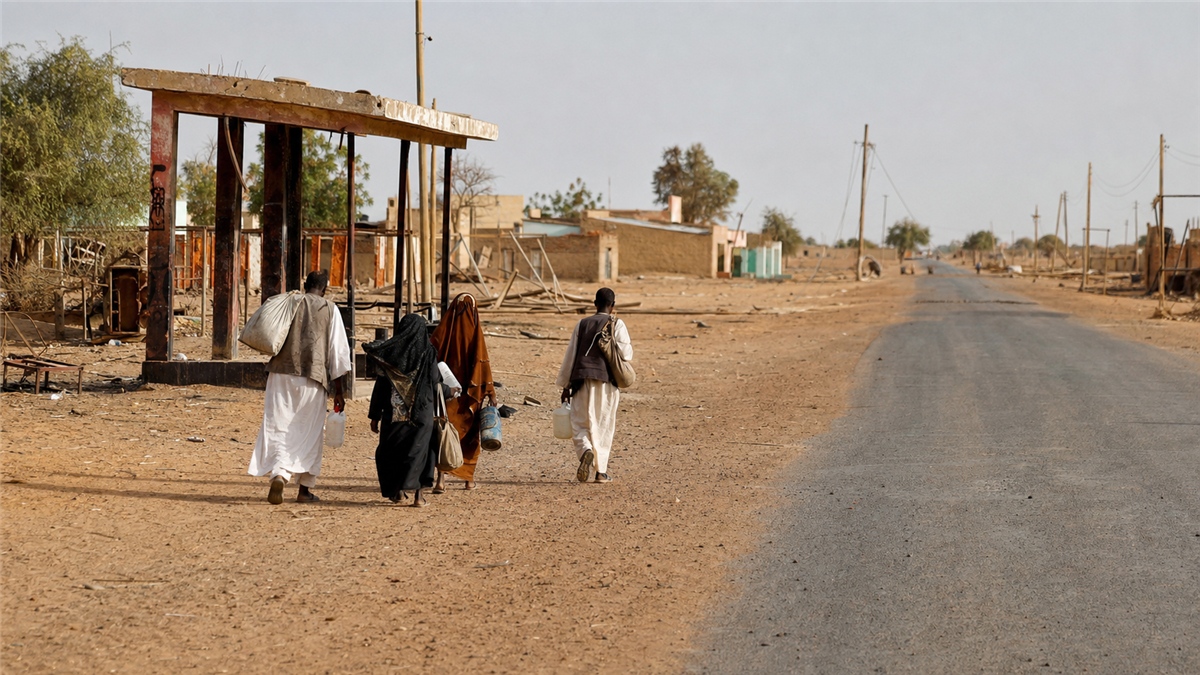
Sudan’s civil war is shifting deeper into Kordofan after the Sudanese Armed Forces and allied groups reopened a strategic road west from Khartoum, while Rapid Support Forces leader Mohamed Hamdan Dagalo, known as Hemedti, gave field commanders greater freedom to launch attacks. The changes point to a new, dangerous phase rather than an imminent end to the war.
Army chief Gen. Abdel Fattah al-Burhan inspected recently recaptured positions in North Kordofan on July 27. According to Sudan Tribune’s battlefield account, SAF-aligned forces took Bara, Jabrat al-Sheikh, Um Sayala and nearby settlements, securing the roughly 360-kilometre road between Khartoum and North Kordofan’s capital, El Obeid. The RSF still controls large areas of Darfur and parts of Kordofan, leaving Sudan divided between rival military and political centers.
Military gains do not settle Sudan’s political struggle
Burhan has presented the latest advances as the start of a wider campaign. A senior SAF commander said the army had been ordered to push through Kordofan toward the Central African Republic border, while Burhan publicly ruled out restoring the former relationship with the RSF. His camp operates Sudan’s internationally recognized state institutions from Khartoum and Port Sudan, supported by an array of former rebel movements and other armed groups.
Hemedti’s response suggests the RSF is adapting to territorial losses rather than preparing to surrender. On July 27, he authorized frontline commanders to begin offensive operations without waiting for central orders. Decentralization could make the force more flexible, but it also raises questions about command discipline and accountability for local attacks.
The rivals were once partners. They helped remove Omar al-Bashir in 2019, then jointly overthrew Sudan’s civilian-led transition in October 2021. Their alliance collapsed amid disagreement over how and when the RSF would be integrated into a unified army and who would control that force. Fighting erupted in April 2023, with each side accusing the other of starting it.
Sudanese views cannot be reduced to support for either general. Many people regard the SAF as a national institution that must survive the RSF assault, while civilian groups also remember Burhan’s role in the 2021 coup and reject permanent military rule. The RSF describes its project as civilian and decentralized, but its roots in the Janjaweed militias and documented atrocities in Darfur have severely damaged that claim.
Civilians face violence from both directions
The latest offensive has made North Kordofan the immediate center of the war. Emergency Lawyers, a Sudanese rights group, reported air and drone strikes on a water station, vehicles, a health center and a school between July 24 and 26. Its allegations, reported by Sudan Tribune, included dozens of civilian deaths. Independent verification remains difficult, and responsibility for individual drone attacks is sometimes disputed.
UNICEF said at least 330 children were reported killed or injured across Sudan in the first six months of 2026. It estimated that 500,000 civilians were at risk in and around El Obeid and North Kordofan. A separate UNICEF statement said a July 20 drone attack on Ar Rahad market reportedly killed two children and four adults and injured more than 20 people.
Reports of abuses also followed the RSF retreat from newly contested areas. Local rights monitors accused RSF fighters of reprisals against civilians in North Kordofan, while the RSF and allied media have accused SAF aircraft of indiscriminate bombing. The pattern reflects a wider war in which investigators have accused both sides of grave violations, though allegations of systematic ethnic killing and sexual violence have been especially extensive against the RSF and allied forces in Darfur.
In July, a United Nations fact-finding mission concluded that RSF forces committed mass killings, sexual violence, abductions and deliberate starvation during the siege and capture of El Fasher. The mission said the conduct formed part of an intentional policy amounting to genocide, according to Reuters’ report on its findings. The RSF has previously rejected broad allegations against the organization while acknowledging that some fighters committed abuses.
Outside mediation confronts incompatible demands
The United States has circulated a peace proposal, and both camps submitted responses in July. The RSF accepted the idea of a truce but rejected withdrawing from captured territory, while raising security-sector restructuring, transitional justice and a transitional government. Burhan’s government says peace must preserve Sudan’s unity and sovereignty, but its military rhetoric makes a near-term ceasefire unlikely.
The conflict is also regional. Egypt has supported Sudan’s state institutions and army, while Sudan has repeatedly accused the United Arab Emirates of arming the RSF. The UAE denies supporting either side. Supply routes through Libya, Chad, the Central African Republic and other neighbors have made border control part of the battlefield and have increased the danger of further regional spillover.
International coverage often frames the war as a contest between Burhan and Hemedti. That is accurate but incomplete. Armed movements, local defense groups, former rebels, civilian coalitions and foreign sponsors now shape the conflict, making it harder for either commander to promise or enforce a nationwide settlement.
What to watch
The first test is whether the SAF can hold the Khartoum-El Obeid road and continue toward West Kordofan and Darfur. Control of towns alone will not be decisive if the RSF can use drones, mobile columns and decentralized attacks to disrupt transport and isolate army positions.
The second is civilian protection. Watch for independent findings about the July strikes in North Kordofan, humanitarian access to El Obeid and surrounding communities, and whether retreating or advancing forces punish residents accused of supporting the other side.
The diplomatic milestone is the next response from U.S. mediator Massad Boulos to the rival peace submissions. Any viable process will have to bridge the RSF’s refusal to withdraw, the SAF’s rejection of a restored RSF role, demands for civilian government and accountability for atrocities.
Sources
- Sudan Tribune, Sudan: SAF gains and Burhan’s North Kordofan visit.
- Sudan Tribune, Sudan: Hemedti’s operational changes after RSF losses.
- Sudan Tribune, Sudan: Emergency Lawyers’ allegations about civilian strikes.
- UNICEF, United Nations: 2026 child-casualty and North Kordofan risk figures.
- UNICEF Sudan, Sudan: Ar Rahad market attack statement, Arabic.
- Reuters, international: UN fact-finding mission’s El Fasher findings.
- Sudan Tribune, Sudan: competing positions on the U.S. peace proposal.
This article was prepared with AI assistance and reviewed by a human editor. NewsBridges checked English- and Arabic-language reporting and official material; access and security constraints limit independent verification inside several contested areas.