
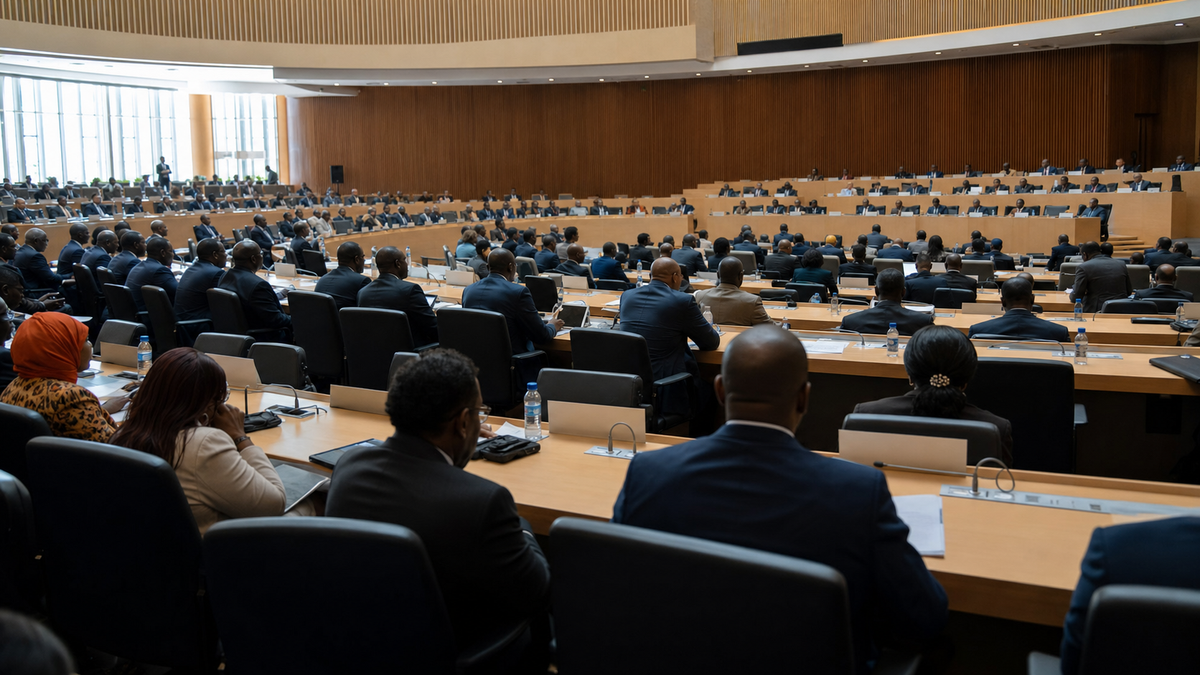
African foreign ministers have renewed their demand for permanent representation on the United Nations Security Council as the African Union’s Executive Council meets in Addis Ababa. The appeal restates a common position that Africa should receive at least two permanent seats with the same powers as existing permanent members and five non-permanent seats.
The call does not mean Security Council reform is imminent. It matters now because the African Union is trying to convert a position first agreed more than two decades ago into influence during an active phase of UN negotiations, while insisting that member states speak with one voice.
African ministers return to a common demand
The AU’s 49th Ordinary Session of the Executive Council opened on July 28 and runs through July 29. Its broader agenda covers water and sanitation, financing, institutional reform, peace and security, Agenda 2063 and coordination with regional economic communities.
In his opening statement, council chair Édouard Bizimana of Burundi argued that Africa must move from consuming international rules to helping set them. The AU reported that he urged member states to defend the Ezulwini Consensus and Sirte Declaration together as the foundation of the common African position.
That position asks for no fewer than two permanent African seats with full prerogatives, including the veto for as long as current permanent members retain it, plus five non-permanent seats. It also holds that the African Union should choose which states occupy the African seats.
The demand addresses a widely acknowledged imbalance. Africa has 54 UN member states and is frequently the subject of Security Council deliberations, yet no African country holds a permanent seat. The current five permanent members are China, France, Russia, the United Kingdom and the United States.
Unity over the principle does not remove difficult internal questions. The AU has not publicly settled which countries would hold permanent seats, how they would be selected or whether seats would rotate. Those questions can be deferred while reform remains hypothetical, but they would become central if negotiations moved toward a binding text.
At the UN, support for reform has not produced agreement
The United Nations General Assembly is conducting intergovernmental negotiations on Security Council reform. Its official reform page records the April 2026 transmission of an “African Model,” giving negotiators a more concrete expression of the continent’s position.
Other reform groups have overlapping but different proposals. Brazil, Germany, India and Japan seek permanent seats, while another coalition opposes adding new permanent national members. Existing permanent members also differ over the size of an expanded council, candidates and veto rights.
Those divisions explain why broad statements that Africa is underrepresented have not led to Charter reform. Amending the UN Charter requires approval by two-thirds of the General Assembly and ratification by two-thirds of UN members, including all five current permanent members.
The AU’s insistence on veto equality presents both a principle and a negotiating challenge. African leaders have long criticized the veto, but the Ezulwini position says that if it continues to exist, new African permanent members should not enter with lesser powers.
What to watch
The Executive Council is scheduled to adopt its decisions at the end of the July 29 session. The final documents will show whether ministers add concrete negotiating instructions or simply reaffirm the established common position.
Next, watch how African representatives use the African Model in the UN intergovernmental negotiations and whether they secure explicit support for equal permanent-seat powers. Statements of general support are less consequential than agreement on membership categories, numbers and the veto.
The next UN General Assembly session in September will be the major diplomatic milestone. Any movement toward text-based negotiations, alongside coordinated lobbying by the AU’s Committee of Ten on Security Council reform, would indicate whether the renewed demand is gaining practical traction.
Sources
- African Union, continental: opening statements, Ezulwini appeal and session agenda, English.
- African Union, continental: official dates, venue, theme and institutional context, English.
- Ethiopian News Agency, Ethiopia: domestic report on the opening session, French.
- African Union Commission, continental: details of the common African position, English.
- United Nations General Assembly, international: current intergovernmental negotiations and African Model, English.
This article was prepared with AI assistance and human editorial review. English- and French-language African Union, Ethiopian and United Nations sources were checked directly.