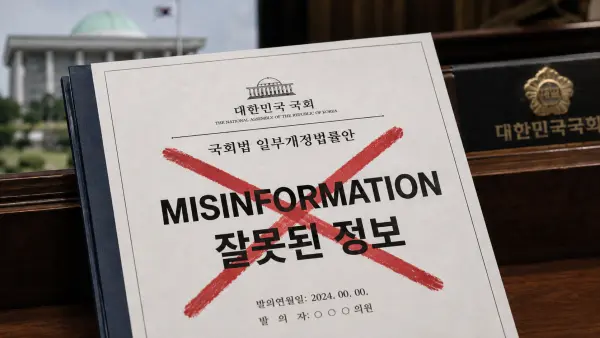
South Korea began enforcing a revised version of the Act on Promotion of Information and Communications Network Utilization and Information Protection on July 7, allowing courts to award punitive damages of up to five times proven losses against anyone who deliberately circulates false or manipulated information online. The law applies to news organizations, online outlets and large social media accounts on the same terms. A separate provision lets the regulator fine repeat distributors up to one billion won, roughly 690,000 US dollars, once a court has already ruled the information illegal or false.
The measure passed the National Assembly on December 24 last year, driven by President Lee Jae Myung’s Democratic Party, and was promulgated on January 6 with a six-month lead-in. What it is called depends on who is speaking. Supporters use the legislative shorthand, the disinformation eradication law. Opponents call it the ipteulmak law, an idiom meaning roughly to clamp someone’s mouth shut. Much of the Korean press has settled on a neutral third option, the “7·7 law,” named for the day it took effect.
The mechanics matter more than the slogans. Platforms with at least one million average daily users, a group the regulator has identified as eight companies including Naver, Kakao and Google, must operate channels for receiving reports of false information. Content creators clear the threshold at 100,000 subscribers or 100,000 average views. Public-interest reporting is excluded from the aggravated damages provision, as is material the distributor had reasonable grounds to believe true, and simple error is not penalised. The self-regulatory guidelines drafted by the Korea Internet Self-Governance Organization exclude satire and parody, and exclude private messaging and email, on the reasoning that policing private conversation would amount to violating communications secrecy.
The argument in Seoul
The government’s case rests on a specific recent memory. As the AP noted in its coverage of the law taking effect, the push gathered force after former president Yoon Suk Yeol’s short-lived martial law declaration in 2024, during which unsubstantiated election-fraud claims circulating on YouTube were used to rally supporters. The Fact reported the Democratic Party’s own framing as a response to “cyber wreckers,” accounts that monetise defamatory content, and to the falling cost of producing manipulated images and video with generative AI. Prime Minister Han Seong-sook, quoted by SBS, said legitimate criticism would be protected while clear disinformation would be dealt with firmly.
The opposition People Power Party has attacked the law in unusually vivid historical terms. YTN reported floor leader Jeong Jeom-sik comparing it on the first day to the sineonpae, a tablet the Joseon-era tyrant Yeonsan-gun forced officials to wear to silence them. Democratic Party leader Han Byung-do, in the same YTN report, dismissed the framing as reflexive obstruction and urged the public to report malicious falsehoods. Hankook Ilbo reported that PPP lawmaker Joo Jin-woo planned to recruit citizens for a class-action-style constitutional complaint, modelled on an earlier collective challenge to Korea’s game industry law.
Framing the dispute as government versus opposition, however, misses what makes the Korean argument distinctive. Opposition runs across the political spectrum. Financial News reported that the progressive civic group People’s Solidarity for Participatory Democracy had objected immediately after passage, arguing the definition of manipulated information was too broad, that “harm to the public interest” was too abstract to satisfy the constitutional clarity requirement, and that granting platforms wide deletion powers invited private censorship. A Kyeongin Ilbo editorial observed that the Journalists Association of Korea, the progressive lawyers’ group Minbyun and civic organisations were all calling for re-amendment, which is not a coalition that assembles easily in Korean politics.
The Journalists Association of Korea itself stopped short of outright opposition. Its statement, issued the day before the law took effect, said no law should operate so as to shrink constitutionally guaranteed expression or the public’s right to know, and asked the government to sharpen the criteria for judging what counts as manipulated information. The AP reported the association warning of an “unavoidable chilling effect” from the prospect of repeated large damage claims. The Seoul Foreign Correspondents’ Club also issued a statement of concern.
Two smaller things happened in the first weeks that say more about the atmosphere than the statements do. Financial News described the circulation of a so-called “7·7 law workaround,” a habit of substituting hedged constructions such as “it is claimed that” or “one hears that” for direct assertions. And on day one, according to a KOREA WAVE report carried by Yahoo Japan, false claims spread on social media that posts were already being censored under the new law, which the regulator publicly denied. Disputes over whether a politician’s dialect phrasing and a girl group member’s speech amounted to hate speech, tracked by Hankook Ilbo and Kyeongin Ilbo, became proxy arguments about the statute within days.
The view from outside
International coverage has largely folded the story into two existing narratives, and the fit is imperfect in both cases.
The first is a bilateral one. The Korea JoongAng Daily reported that the US State Department raised concerns on July 8 both about freedom of expression and about excessive burdens on American companies including Google, Meta, X and TikTok. The Korea Times described the department expressing “significant concerns” and placed the episode in a sequence of recent frictions, notably Seoul’s investigation into the US-listed e-commerce company Coupang after a large data breach, which several US Republican lawmakers have called discriminatory treatment. Under Secretary of State Sarah B. Rogers had criticised the bill on X in December, arguing civil remedies for victims were preferable to regulatory licence. In this telling the law is a trade and tech-policy irritant, and the free-expression objection travels alongside a commercial one.
The second is the global press-freedom narrative. The International Press Institute condemned the bill in January and asked Seoul to pause implementation for a human rights risk assessment conducted with civil society. That framing is accurate as far as it goes, but it tends to render the story as a government moving against a press it dislikes, which is not quite what the Korean record shows. The bill was pushed by a party that had, for years, positioned itself as the target of hostile coverage, and it is opposed by press bodies and by parts of its own political base at once.
Japanese coverage has taken a third angle. Writing as an expert contributor on Yahoo Japan, the commentator Kim Hyun argued that because President Lee is himself under indictment in multiple cases, a statute penalising factual error makes investigative scrutiny of those cases substantially riskier, and suggested the law could affect how Japan-related opinion forms in Korea. Japanese outlets have also tracked the anxiety among Korean-language YouTubers based in Japan, who fall within the creator thresholds. Chinese-language coverage has been more mechanical: the Taiwan Post laid out the subscriber thresholds, the repeat-offence trigger and the won figures converted into New Taiwan dollars, with little on the domestic politics.
What almost no coverage outside Korea has picked up is the question Korean reporting treats as central. It is not whether false information should carry consequences. It is who decides. Newsis reported that manipulated information was deliberately excluded from the jurisdiction of the broadcasting and communications review commission, which means the first judgment on a reported post falls to Naver, Kakao or Google. Where a platform cannot determine the facts, it may contract with a certified fact-checking body. As SBS reported, the opposition’s objection is that those bodies can receive support from a transparency centre under the regulator, and that the dispute-mediation panel sits within a commission the opposition regards as politically exposed. The government’s answer, given at the July 8 guidelines briefing by senior official Shin Young-kyu, is that platforms judge first and courts judge last, so the state is not the arbiter.
What to watch
The constitutional challenge is the main event. The PPP has said it will pursue both a complaint and full re-amendment as party policy, and a private lawyer has already filed a challenge to the hate-speech provision, arguing that terms such as discrimination and social status are too vague to satisfy the clarity principle, as Herald Business reported. How the Constitutional Court frames the question will matter well beyond this statute. France’s 2018 anti-manipulation law survived review only after the Constitutional Council read it narrowly, excluding opinion, satire, exaggeration and partial inaccuracy, a precedent Korean commentators have cited repeatedly.
The second thing to watch is capacity. The regulator has designated adherence to the International Fact-Checking Network’s principles as the standard for certified verification bodies, and very few Korean organisations hold that certification. MBC reported only JTBC certified with three more organisations applying; Newsis reported the online outlet Newstof as also certified. Either way the supply is thin relative to the volume of reports platforms are likely to receive. The transparency centre meant to support this work had not yet been established when the government briefed reporters in July.
The third is the trade dimension. If Washington folds the network act into the same file as the Coupang investigation, the law stops being purely a domestic speech question and becomes a bargaining chip, which would change the incentives for a government heading toward the 2027 presidential cycle. Korean ambassador to the United States Kang Kyung-wha has said both governments intend to manage the Coupang dispute so it does not weigh on the relationship.
Specific milestones to watch:
- Whether the PPP’s collective constitutional complaint is actually filed, and whether the Constitutional Court accepts it for full-bench review
- The first damages suit brought against a news organisation under the fivefold provision, and whether the public-interest reporting exemption holds
- The first platform takedown that a major outlet publicly contests, and the 60-day mediation window that follows
- Additional IFCN certifications for Korean fact-checking organisations, and the establishment of the regulator’s transparency centre
- Whether the regulator’s promised review of platform compliance policies produces enforcement or only guidance
- Any move by the US to raise the act formally in trade consultations alongside the Coupang case
Sources
- Associated Press (US, international news agency), reporting from Seoul, carried here by the Washington Times, English
- YTN (South Korea, 24-hour news channel), Korean: first-day political reaction and explainer on the law’s provisions
- SBS (South Korea, commercial broadcaster), Korean
- MBC (South Korea, public broadcaster), Korean
- Newsis (South Korea, news agency), Korean: three outstanding issues on the eve of enforcement and the July 8 guidelines briefing
- Hankook Ilbo (South Korea, daily newspaper), Korean
- Financial News (South Korea, business daily), Korean
- Kyeongin Ilbo (South Korea, regional daily serving Gyeonggi and Incheon), editorial, Korean
- The Fact (South Korea, online news outlet), Korean
- Herald Business (South Korea, business daily), Korean: constitutional challenge to the hate-speech provision and party positions on the first day
- Korea JoongAng Daily (South Korea, English-language edition of the JoongAng Ilbo), English
- Korea Times (South Korea, English-language daily), English
- VOA Korean (US, government-funded international broadcaster), Korean
- KOREA WAVE via Yahoo News Japan (Japan, news aggregator carrying a Korea-focused wire), Japanese: false censorship claims on day one and the KISO self-regulation guidelines
- Yahoo News Japan expert commentary by Kim Hyun (Japan, signed opinion contribution), Japanese
- Taiwan Post (Taiwan, online news outlet), column, Chinese
- International Press Institute (Austria, press freedom organisation), statement, English
- Korea Policy Briefing, Broadcasting, Media and Communications Commission briefing transcript (South Korea, government), Korean
This post was produced with AI assistance and human editorial review. Korean-language coverage and government briefing material were reviewed alongside English editions, together with Japanese and Chinese-language reporting. Reported details of the enforcement guidelines are drawn from regulator briefings as covered by Korean outlets; the number of Korean organisations holding IFCN certification was reported inconsistently across sources and is noted as such in the text.