
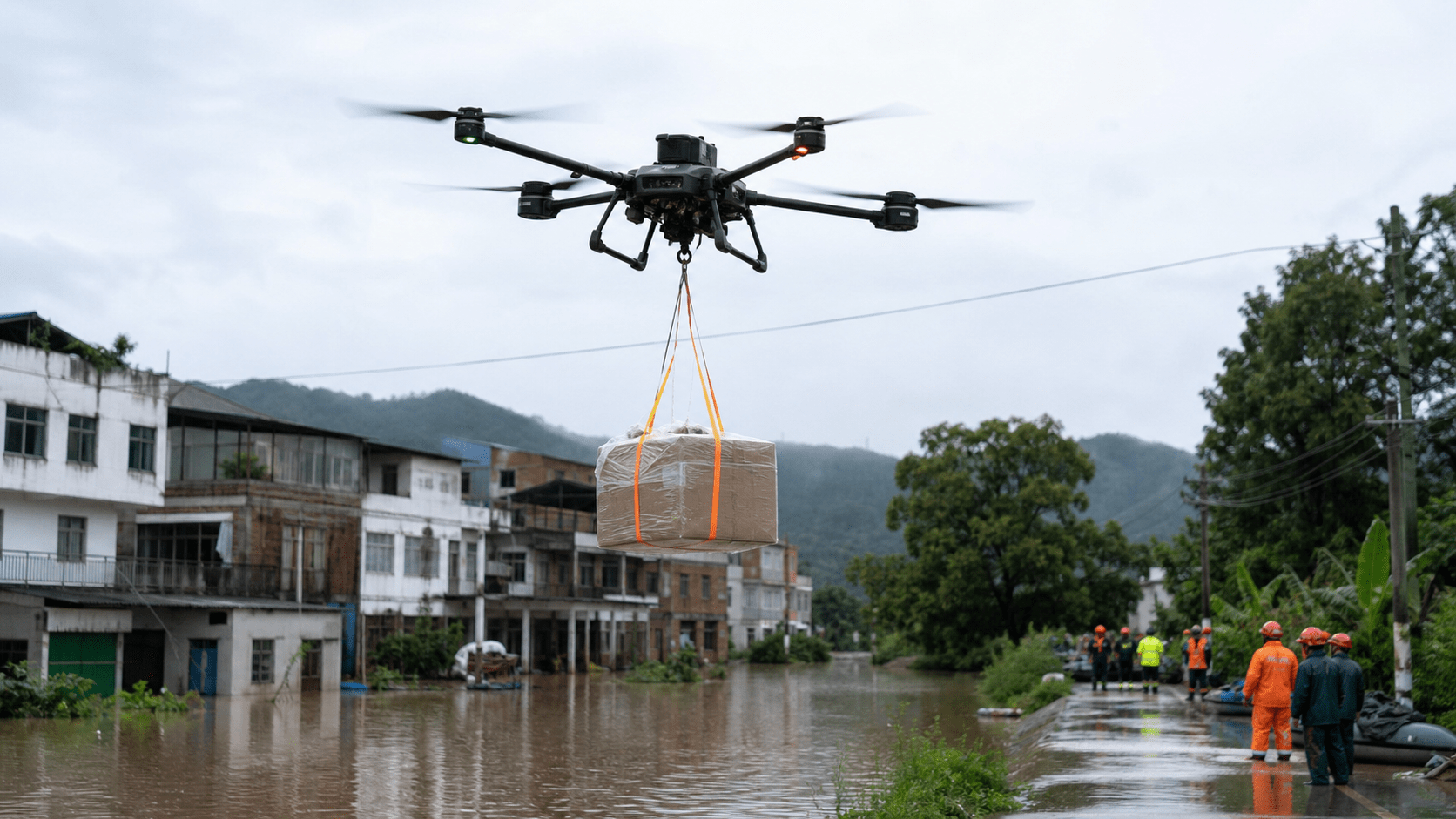
Drones have lifted people out of floodwater, carried food and medicine to isolated villages, surveyed damaged communities and restored mobile coverage during the emergency response in China’s Guangxi region. The most striking footage shows heavy-lift aircraft carrying trapped residents above fast-moving water, but the broader operation has depended on several kinds of drone doing different jobs alongside thousands of rescuers, boats and ground vehicles.
The deployments followed days of exceptional rain from Tropical Storm Maysak, which breached reservoirs, cut roads and communications, and inundated parts of Hengzhou and other communities. By July 9, authorities said the floods had killed 39 people, including 26 in Hengzhou, while nine people remained missing across Guangxi. About 130,000 people had been evacuated, according to an Associated Press account of the wider disaster.
What the drones actually did
The rescue work ranged from direct extraction to logistics. People’s Daily published video of people being carried from rising water, while Xinhua reported that a heavy-lift drone lifted a truck driver to safety on July 6. Chinese financial outlet Caixin’s Chinese-language report and video said pilots could transport a person when someone faced an immediate danger of being swept away and the on-site emergency command approved the flight.
Those lifts were the most visible use, not necessarily the most common. Caixin reported that nearly 100 drones were working in the disaster area by July 8 and that agricultural and cargo models had delivered hundreds of tonnes of water, food, medicine and other supplies. Local agricultural drones began joining the response on July 6 under the organization of the agricultural and rural affairs bureau, followed by pilots and equipment arriving from elsewhere in China.
Other aircraft filled gaps that lifting and delivery drones could not. Xinhua said two long-endurance Wing Loong drones sent by the Ministry of Emergency Management flew from Hubei and orbited above the worst-hit areas as airborne mobile base stations, providing more than 8,000 instances of communications service. Smaller drones relayed live aerial images to rescue teams, while cargo aircraft shortened some supply journeys from a two-to-three-hour boat round trip to a flight of several minutes.
The view inside China
Chinese state coverage has presented the deployments as an “aerial lifeline” and an example of civilian technology being rapidly repurposed for public rescue. Reports by Xinhua, China Daily and CGTN emphasize the combination of government dispatch, state-owned emergency engineering teams, commercial suppliers and hundreds of volunteer pilots. A CGTN video report focuses on volunteers and company staff forming an improvised transport fleet when villages could not be reached by road or boat.
Caixin’s domestic reporting adds operational limits that are less prominent in the celebratory clips. Carrying a person requires approval from emergency commanders and is reserved for urgent danger, rather than being a routine evacuation method. The distinction matters because most drone missions involved supplies, communications or reconnaissance, while boats and ground teams continued to move far larger numbers of people.
The view from outside
International coverage has treated the drone footage as a remarkable part of the response but placed it inside the scale and human cost of the floods. The Associated Press noted the drones while leading on the death toll, reservoir failure, mass evacuation and the rescue of more than 10,000 students and teachers by military teams using boats. That framing makes the technology part of the story without allowing the most dramatic clips to stand in for the whole operation.
Video circulating away from named news organizations needs additional care. Some social posts mix verified Guangxi material with clips whose location, date or playback direction is disputed. The linked reports from People’s Daily, Caixin and CGTN’s on-site footage provide attributable examples; unlabeled compilations do not provide the same assurance.
What to watch
The immediate test is whether drones remain useful as floodwater recedes and the work shifts from emergency extraction to sustained delivery, mapping and infrastructure repair. Thick mud and broken roads were still keeping some villages isolated after water levels fell. Weather conditions, battery endurance, payload limits and airspace coordination will determine where aircraft can help and where boats or crews on foot remain necessary.
The response may also influence how Chinese authorities organize private drone fleets for future disasters. Guangxi brought together government aircraft, state-owned engineering units, logistics companies, manufacturers, local dealers and volunteer agricultural pilots. Turning that improvised network into a repeatable system would require clearer command rules, pilot registration, communications planning and standards for the exceptional decision to carry people.
Next specific milestones: updated casualty and missing-person figures from Guangxi authorities; restoration of road, power and mobile networks in isolated Hengzhou villages; official totals for drone sorties, supply deliveries and person-lift rescues; and any Ministry of Emergency Management review of how government and civilian fleets were coordinated.
Sources
- Caixin (China, Chinese-language financial and investigative outlet), on agricultural and cargo drone deployment, delivery estimates, person-lift approval and video footage
- Xinhua (China, state news agency), on communications restoration, cargo flights, volunteer pilots and the truck-driver rescue
- People’s Daily Online (China, state newspaper), video of people carried to safety by drone
- China Daily (China, state-owned English-language newspaper), on volunteer pilots and supply missions to isolated villages
- CGTN (China, state broadcaster), video of the volunteer aerial supply operation
- Associated Press (international news agency), on the death toll, evacuations and the larger boat-and-ground rescue operation
This post was produced with AI assistance and human editorial review. Chinese-language reporting and video were reviewed alongside Chinese English-language coverage and international wire reporting.