
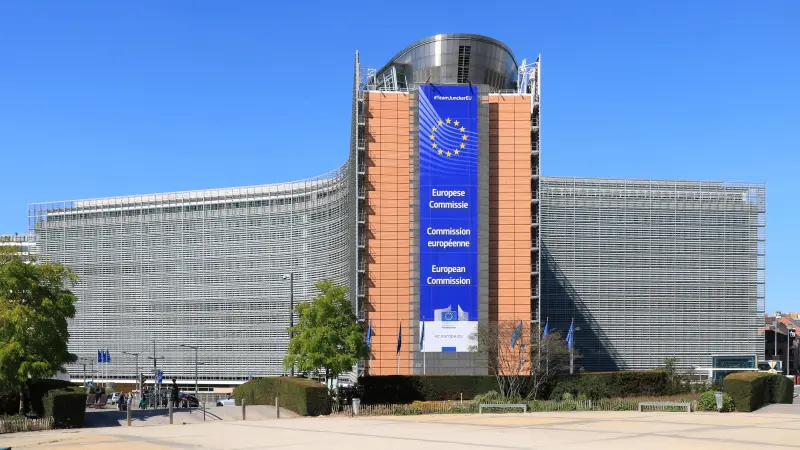
Most explanations of the European Union start with three institutions: the Commission, the Council, and the Parliament. That framing is missing something. There are actually four bodies in play, because “the Council” is used for two entirely different things, and mixing them up is the single most common way people get the EU wrong.
The Commission: the EU’s executive
The European Commission is the EU’s civil service and executive branch combined. It is the only body that can propose new EU legislation, and it also enforces existing EU law, negotiates trade deals on the bloc’s behalf, and manages the EU budget day to day.
The Commission has one commissioner per member state, 27 in total, each responsible for a policy area such as trade, competition, or climate. It is led by a president, currently Ursula von der Leyen, who was nominated by national leaders and elected by the European Parliament to a second term in July 2024. Von der Leyen’s Commission runs until the next European Parliament elections in 2029.
Two councils, not one
Here is the part that trips almost everyone up. There are two separate bodies called “Council.”
The European Council is the summit of national leaders, the presidents and prime ministers of all 27 member states, meeting several times a year to set the EU’s overall political direction. It does not pass laws. Its job is closer to a board setting strategy than a legislature voting on bills. It has a fixed president, currently António Costa, elected by the national leaders themselves to a two-and-a-half-year term.
The Council of the European Union, sometimes called the Council of Ministers, is different. It is made up of national government ministers, whichever minister matches the topic, so foreign ministers for foreign policy, finance ministers for the budget, and so on. This Council, alongside the Parliament, is one of the EU’s two actual lawmaking bodies. It has no fixed leader; instead, its presidency rotates among member states every six months. Cyprus held it for the first half of 2026; Ireland took over on July 1 and holds it through the end of the year.
One sentence worth keeping: the European Council decides where the EU is heading, and the Council of the EU decides whether specific laws get passed.
The Parliament: the only body voters elect directly
The European Parliament is the EU’s one directly elected institution. Its roughly 720 members are elected by voters in all 27 countries and sit in political groups that cross national lines rather than by nationality. Parliament shares lawmaking power with the Council of the EU under what is called the ordinary legislative procedure: the Commission proposes a law, and both Parliament and the Council of the EU must agree on the final text before it takes effect.
Parliament also elects the Commission president and can force the entire Commission to resign, a power it has used before. Its own president, currently Roberta Metsola, is elected by MEPs to a renewable two-and-a-half-year term and chairs its sessions and represents it externally.
So who actually decides what?
It depends on the type of decision.
For most day-to-day EU law, trade rules, product standards, environmental regulation, the process runs through all three lawmaking bodies: the Commission proposes, and the Parliament and the Council of the EU both have to agree on the final version, sometimes after rounds of negotiation called trilogues.
For foreign policy and other sensitive areas, national governments keep more direct control. Many foreign policy decisions still require unanimous agreement among all 27 member states in the Council of the EU, which is why a single country can sometimes hold up an EU-wide sanctions package or statement.
For big-picture direction, without the legal power to pass anything, the European Council is where it happens. National leaders meeting as the European Council are currently negotiating the EU’s next long-term budget, covering 2028 onward, with the country holding the Council of the EU presidency preparing the working proposal leaders debate. The European Council can push, prioritize, and pressure, but the actual budget law still has to go through Parliament and the Council of the EU to be adopted.
A short version to keep
Commission proposes and enforces. Council of the EU and Parliament both have to agree before most laws take effect. European Council sets direction and handles the leader-level summitry that doesn’t show up as legislation. When a story mentions “the Council” without specifying which one, that ambiguity is usually the reporter’s shorthand, not a sign the distinction doesn’t matter.
How Much Did You Understand?
Test yourself with a quick true-or-false and multiple-choice activity based on this explainer.
This post was produced with AI assistance and human editorial review.