
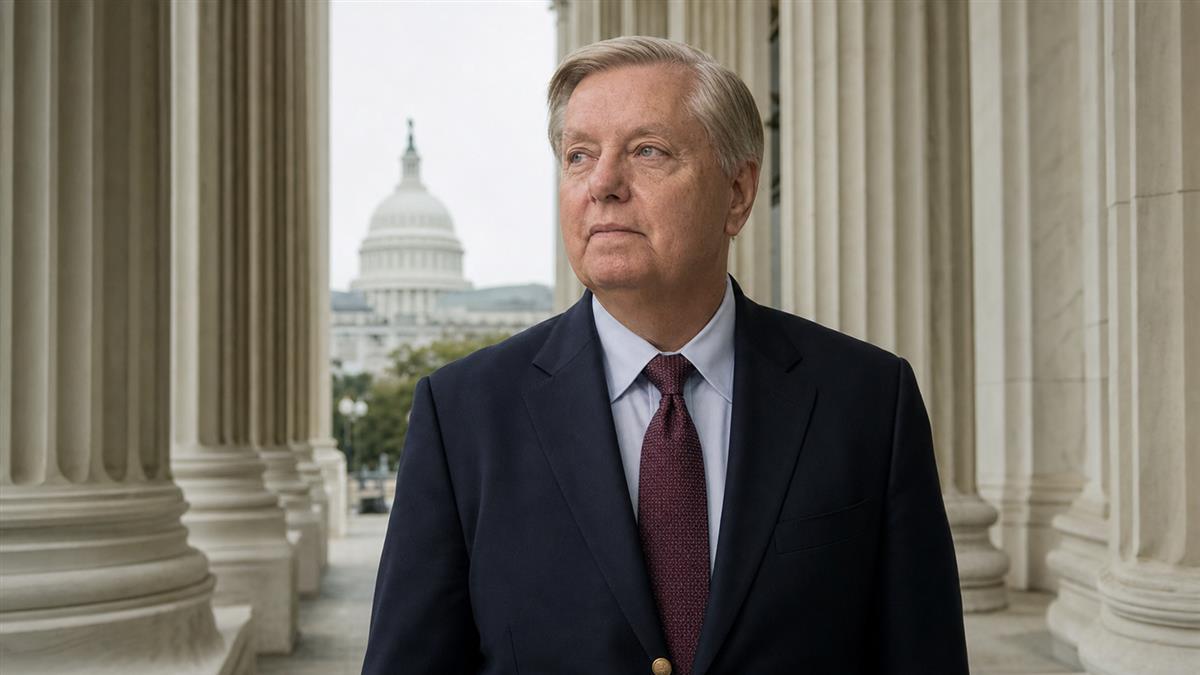
U.S. Senator Lindsey Graham of South Carolina died Saturday evening at 71 after what his office called a brief and sudden illness. The statement announced his death early Sunday but gave no diagnosis, medical history, or specific cause. His family asked for prayers and privacy.
That limited account is all that has been officially confirmed about why he died. Reports that emergency crews responded to Graham’s Washington home may describe his final medical emergency, but they do not establish what caused it. Graham had returned from Ukraine shortly before his death and had been scheduled for a Sunday television appearance, underscoring how unexpected the announcement was.
South Carolina loses a political fixture
Graham represented South Carolina in Washington for more than three decades, first winning a House seat in 1994 and election to the Senate in 2002. Before Congress, he served as an Air Force lawyer, a background that remained central to his public identity and his long involvement in military and legal policy. The House historical record also notes his role as a manager in President Bill Clinton’s 1998 impeachment trial.
In the Senate, Graham became one of Washington’s most persistent advocates for an assertive American role abroad. He worked closely with Senator John McCain, supported NATO and Ukraine, pressed for tougher action against Russia, and favored military pressure on Iran. Two days before his death, he was in Kyiv on his tenth visit to Ukraine, and the Associated Press reported that he had just reached an agreement with the Trump administration to advance Russia sanctions legislation.
A legacy that divides the right
Many movement conservatives will remember Graham through the federal courts. As a senior Judiciary Committee Republican and later its chairman, he helped advance Donald Trump’s judicial nominees and led the committee during Amy Coney Barrett’s 2020 Supreme Court confirmation. His campaign biography emphasized that record as one of his chief conservative achievements.
Internationalist Republicans and many officials in allied countries saw a senator who kept arguing for American military strength, alliances, and support for Ukraine even as parts of his party turned inward. Spanish coverage of his death, including Europa Press, led with the two labels most familiar abroad: Republican hawk and close Trump ally.
Those descriptions do not fully fit together, and that tension is central to his legacy. Graham called Trump unfit for office during the 2016 campaign, then became one of his closest Senate confidants. He defended Trump through two impeachment trials and increasingly tied his own political survival to the president, while still pressing foreign-policy positions that clashed with the less interventionist wing of the MAGA coalition.
That wing never entirely trusted him. In this year’s Republican primary, businessman Mark Lynch attacked Graham from the right over Iran and his long Washington career. Graham nevertheless won with 58.6 percent after endorsements from Trump, Governor Henry McMaster, and Senator Tim Scott, according to The State’s primary report.
How Democrats and critics will remember him
Some Democrats will recall an earlier Graham who joined bipartisan negotiations on immigration, budgets, and judicial nominations. That willingness to bargain also made him suspect among Republican activists long before Trump. For centrist admirers, his career showed that partisan combat and occasional dealmaking could coexist.
His critics will give greater weight to what followed. They saw his embrace of Trump as a retreat from the warnings he issued in 2016, and his support for Barrett’s election-year confirmation as evidence that institutional arguments yielded to partisan power. Anti-war voices will remember his repeated support for military action, especially the confrontation with Iran that he defended during his final campaign.
The divide is not simply conservative praise against liberal condemnation. America First Republicans also criticized his interventionism, while some Democrats and European officials valued his commitment to Ukraine and alliances. Graham’s record crosses those newer political fault lines, even as his late-career alliance with Trump will shape many first assessments.
Two vacancies, two separate processes
Graham’s death creates an immediate Senate vacancy and a separate vacancy on the November ballot. Under South Carolina’s Senate-vacancy law, McMaster may appoint an interim senator. Because Graham died more than 100 days before the November 3 general election and his term expires January 3, 2027, that appointment would cover the remaining months of the current term.
The governor does not simply choose the Republican nominee for the next six-year term. Graham had already won the June 9 Republican primary, so Section 7-11-55 requires a special Republican primary. The law also allows candidates defeated in the original primary to seek the nomination again after the winner’s death, but it does not automatically promote the runner-up.
If officials apply the statutory calendar from Graham’s July 11 death, candidate filing would open July 21 for one week. The special primary would follow on August 11, with an August 25 runoff if nobody wins a majority. Those calculated dates await formal confirmation from the South Carolina Election Commission, but they leave enough time to certify a Republican nominee for the November ballot.
Democratic nominee Annie Andrews remains in the race. Graham’s death removes a deeply established incumbent with a large donor network, but it also forces Andrews to redirect a campaign built around his record toward an opponent not yet known. Republicans begin with a durable statewide advantage: AP noted after the primary that Democrats have not won a South Carolina Senate seat in decades and that recent Republican statewide victories have usually reached double digits.
The uncertainty still matters in a close national battle for Senate control. Republicans must hold a compressed and potentially divisive second primary, transfer Graham’s campaign organization and money lawfully, and introduce a nominee to general-election voters in less than three months. Andrews gains an opening to define that person before Republicans reunite, but the state’s underlying partisan lean remains a substantial obstacle.
What to watch
The first announcements will be McMaster’s interim appointment, the Election Commission’s formal calendar, and the names entering the special Republican primary. Watch whether Graham’s former rivals return and whether statewide figures who did not contest the June Senate primary decide to enter.
The specific milestones are the expected July 21 to July 28 filing period, the projected August 11 special primary, a possible August 25 runoff, and the November 3 general election. Funeral arrangements and any further information from Graham’s family or office about his illness also remain pending.
Sources
- Associated Press, United States: death announcement, known circumstances, career, and final Ukraine trip.
- CBS News, United States: confirmation of the office’s statement.
- U.S. House History, Art and Archives, United States: official congressional biography.
- The State, South Carolina: primary result, campaign finances, and intra-Republican criticism.
- Associated Press primary report, United States: race background and South Carolina’s partisan history.
- South Carolina Code, Section 7-11-55, United States: special-primary process after a nominee’s death.
- South Carolina Code, Section 7-19-20, United States: gubernatorial appointment to a vacant Senate seat.
- Europa Press, Spain: international framing of Graham as a hawk and Trump ally, Spanish.
This article was researched and drafted with AI assistance and reviewed by a human editor. English-language primary documents and reporting were checked directly, alongside Spanish-language coverage. The special-primary dates are calculations from South Carolina law and await official confirmation.