
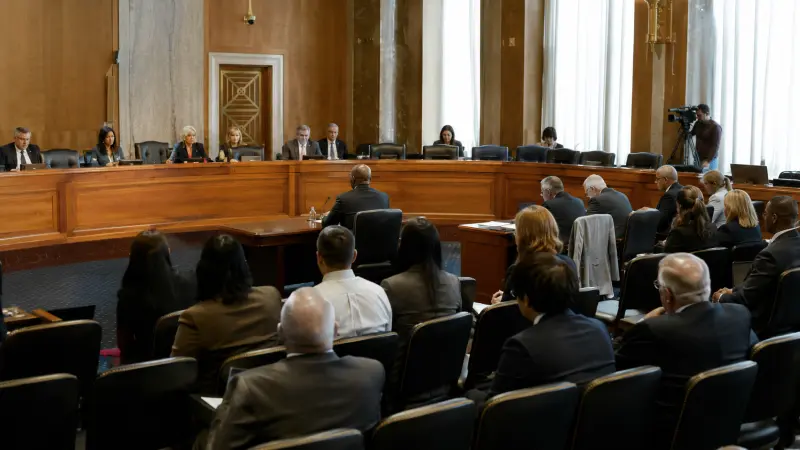
Brazil’s Chamber of Deputies voted on July 8, 2026 to formally summon Foreign Minister Mauro Vieira to explain a written warning his ministry sent Congress days earlier: that Washington’s decision to designate two Brazilian criminal organizations as foreign terrorist groups could, in theory, open the door to US military action on Brazilian soil. Because the summons is binding under Brazilian legislative procedure, rather than a voluntary invitation, Vieira’s appearance is now compulsory, and an unjustified absence could constitute what Brazilian law terms a crime of responsibility.
The dispute traces to a US State Department decision that took effect June 5, 2026, classifying the Primeiro Comando da Capital, a São Paulo-based prison-linked syndicate, and the Comando Vermelho, its older Rio de Janeiro rival, as Foreign Terrorist Organizations, placing them in the same US legal category as al-Qaeda and Islamic State. Secretary of State Marco Rubio said the designation reflected the groups’ violent activity and networks extending into US territory. Under Brazilian law, both organizations remain classified as organized crime groups, not terrorist entities.
The view from Itamaraty
Brazil’s foreign ministry, universally known in the country as Itamaraty, responded to a congressional information request on July 1 with a letter that went well beyond routine diplomatic language. Vieira wrote that the US designation “could be invoked as justification for extraterritorial actions against Brazilian institutions,” and stated plainly that there is “a risk of the use of US military force against national territory.” He noted Brazil had received no formal advance notification from Washington before the designation took effect, calling the US move a unilateral act that required no formal Brazilian response, though he stressed the executive branch still considered the matter serious.
According to Brazilian diplomats who spoke to CNN, Itamaraty’s assessment did not emerge from abstract legal reasoning alone. It rests explicitly on recent precedent: the January capture of Venezuelan president Nicolás Maduro in a US military operation, American strikes on vessels in the Caribbean, and separate US military actions against targets in Mexico and Iran, all cited by Brazilian diplomats as context for treating the risk as real rather than dismissing it under domestic political pressure.
The view from Washington and Brazil’s opposition
The US State Department rejected the scenario outright, calling the possibility of military action against Brazil “absurd” and stating that the terrorist designation’s legal tools extend to visa bans and financial sanctions, with nothing in the relevant law providing for armed intervention. That rebuttal, however, did not resolve the domestic political fight in Brasília, which by the accounts of Brazilian outlets covering the story was never really about whether an invasion was imminent.
Opposition lawmakers, led by Deputy Evair de Melo, argued the ministry’s response to their original information request had been vague, and pressed a separate, narrower question the letter left unanswered: had Washington notified Brazil before the designation was announced. Itamaraty’s answer only said it had “conveyed its position” to American authorities, without specifying when, through what channel, or what was actually said. Deputy Marcel Van Hattem, a government critic, called the ministry’s original letter “shameful” and “absurd” in a different sense, arguing Vieira’s framing suggested the government opposed labeling the gangs as terrorists specifically because doing so might invite a US invasion, a posture Van Hattem considers incompatible with a foreign minister’s role. Governing-party deputy Arlindo Chinaglia defended Vieira and tried, unsuccessfully, to have the binding summons downgraded to a voluntary invitation with dates proposed for August, after the legislative recess; the committee rejected that attempt.
The Brazilian Senate’s equivalent committee, by contrast, approved only a non-binding invitation for Vieira to appear, a procedural split that itself reflects how divided Brazilian political actors are on how seriously to treat the ministry’s warning.
What to watch
The hearing itself, expected before the Brazilian Congress’s July 18 recess but possibly delayed into August, is the immediate marker; the exact date rests with the committee chairs in each chamber. Deputy Evair de Melo has separately said he is gathering signatures to establish a full parliamentary inquiry commission, a CPMI, into Itamaraty’s broader handling of what he calls narco-terrorist organizations, a move that would extend the controversy well past a single hearing.
The dispute unfolds against a genuinely separate but simultaneous economic deadline: a 25 percent US tariff threat affecting an estimated $14.9 billion of Brazilian exports, with a decision expected around July 15, giving the diplomatic and trade tracks overlapping stakes in an election year where security is already a top voter concern and the opposition casts President Lula’s government as soft on crime.
Next specific milestones: the date and content of Vieira’s compulsory hearing before the Chamber’s foreign affairs committee; any movement on Deputy de Melo’s proposed CPMI inquiry; the US tariff decision expected around July 15; and any further US Treasury sanctions actions against Brazilian individuals or companies tied to the two designated gangs.
Sources
- UPI and RT (international wire / Russian state-funded outlet), on the initial warning and US State Department’s “absurd” response
- Rio Times (Latin America-focused English outlet), detailed coverage of the committee summons and the tariff-deadline context
- Diário do Centro do Mundo and Revista Fórum (Brazil, Portuguese-language, left-leaning), on the broader pattern of US military operations across Latin America cited by Brazilian diplomats
- Jornal de Brasília and ND Mais (Brazil, Portuguese-language regional outlets), on the committee vote and lawmakers’ direct quotes
- O Antagonista (Brazil, Portuguese-language, right-leaning), on the US State Department’s formal rejection of the intervention scenario
- Revista Sociedade Militar (Brazil, Portuguese-language, defense-focused), on the proposed parliamentary inquiry commission
- Prensa Latina (Cuba, state news agency), on the Itamaraty letter’s specific wording
This post was produced with AI assistance and human editorial review. Portuguese-language Brazilian coverage across the political spectrum was reviewed alongside English-language wire reports and the US State Department’s public statements.